Niger’s escalating conflict displaces thousands in Loga, exposing security gaps
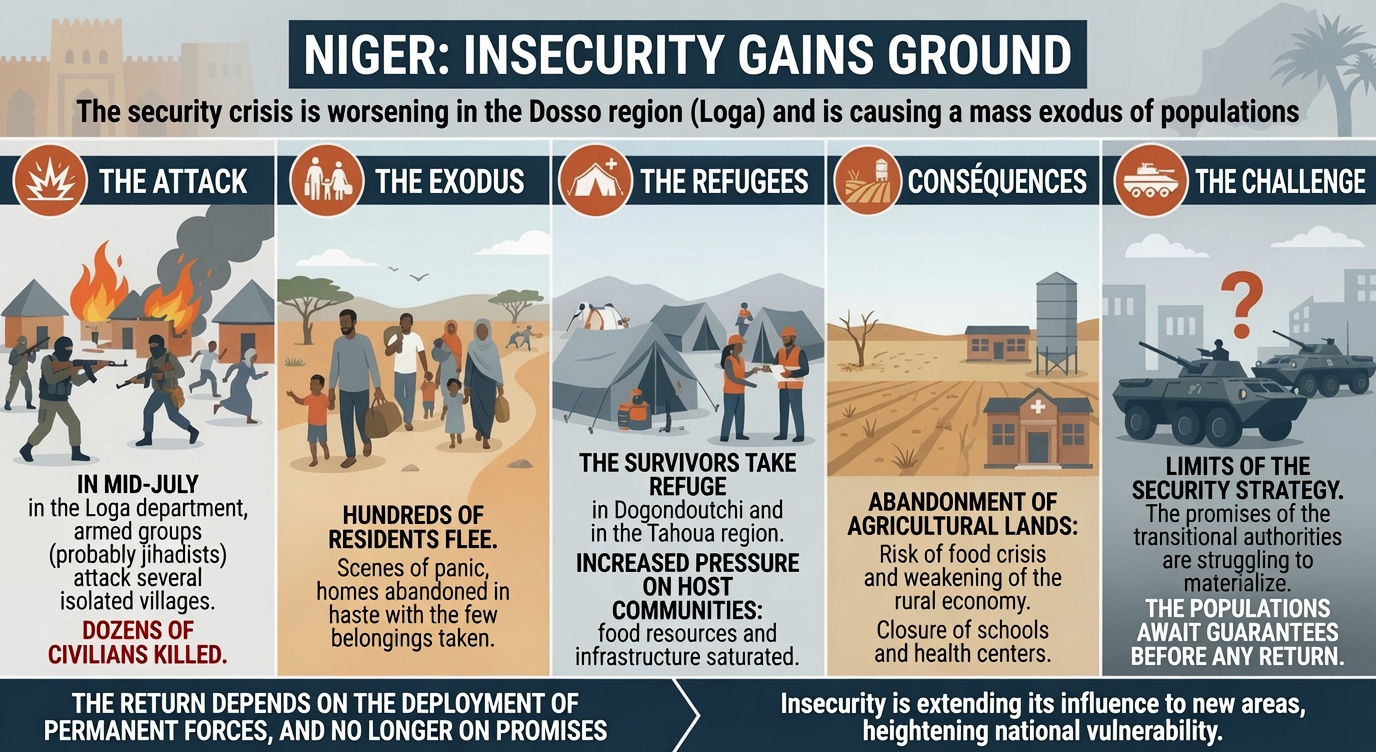
Niger is facing an intensifying security emergency, with the Loga department in the Dosso region experiencing a surge in deadly violence in mid-July. The attacks, linked to armed groups, forced hundreds of civilians to flee their homes, revealing persistent vulnerabilities despite military claims of progress in combating insurgencies.
The violence claimed numerous civilian lives as assailants targeted remote villages, taking advantage of perceived security lapses. Survivors described scenes of panic, with families abandoning their homes with only essential belongings, leaving behind livelihoods and property. The psychological and material toll on affected communities has been devastating.
Flee to safety, yet new challenges arise
The displaced individuals, mostly seeking refuge in Dogondoutchi and towns across the Tahoua region, now face a different set of hardships. Host communities, already struggling with economic strain, inadequate infrastructure, and food shortages, are overwhelmed by the influx of newcomers. The sudden population increase exacerbates existing tensions and complicates resource distribution.
Military promises fall short amid persistent instability
The recent displacement underscores ongoing failures in Niger’s security strategy, despite the transitional government’s pledge to prioritize stability. Since the junta assumed power, military operations and troop redeployments have yet to stabilize border areas and parts of the interior, raising doubts about their effectiveness. The relentless violence has eroded public trust in state protection, with many civilians viewing displacement as a matter of survival rather than choice.
Nigerien authorities have announced plans to reinforce military deployments in Loga to encourage returns, but skepticism among locals remains high. Many insist they will only contemplate returning once a sustained and visible security presence is assured—one capable of preventing future attacks. For them, past assurances have repeatedly proven insufficient in the face of recurring threats.
Broader consequences: economic and humanitarian strain
The conflict’s ripple effects extend far beyond immediate violence. The abandonment of farmlands jeopardizes food production, deepening food insecurity in a region already plagued by instability. Schools and healthcare facilities are shutting down, while local economies are collapsing, leaving rural populations increasingly vulnerable. Humanitarian organizations warn of a growing crisis as the number of internally displaced persons continues to climb, with critical needs—food, clean water, medical aid, and shelter—outstripping available resources.
This crisis also signals a troubling expansion of insurgent influence. The spread of attacks beyond traditional hotspots suggests armed groups are exploiting gaps in Niger’s security framework, posing a broader threat to national stability. The events in Loga serve as a grim reminder that the security challenge facing Niger is not only deepening but also evolving in dangerous new directions.
For the residents of Loga, the path forward remains shrouded in uncertainty. The immediate priority is securing a stable environment where they can safely return. Without tangible improvements in safety and protection, the exodus of civilians is likely to continue, further straining Niger’s already fragile social and economic fabric.