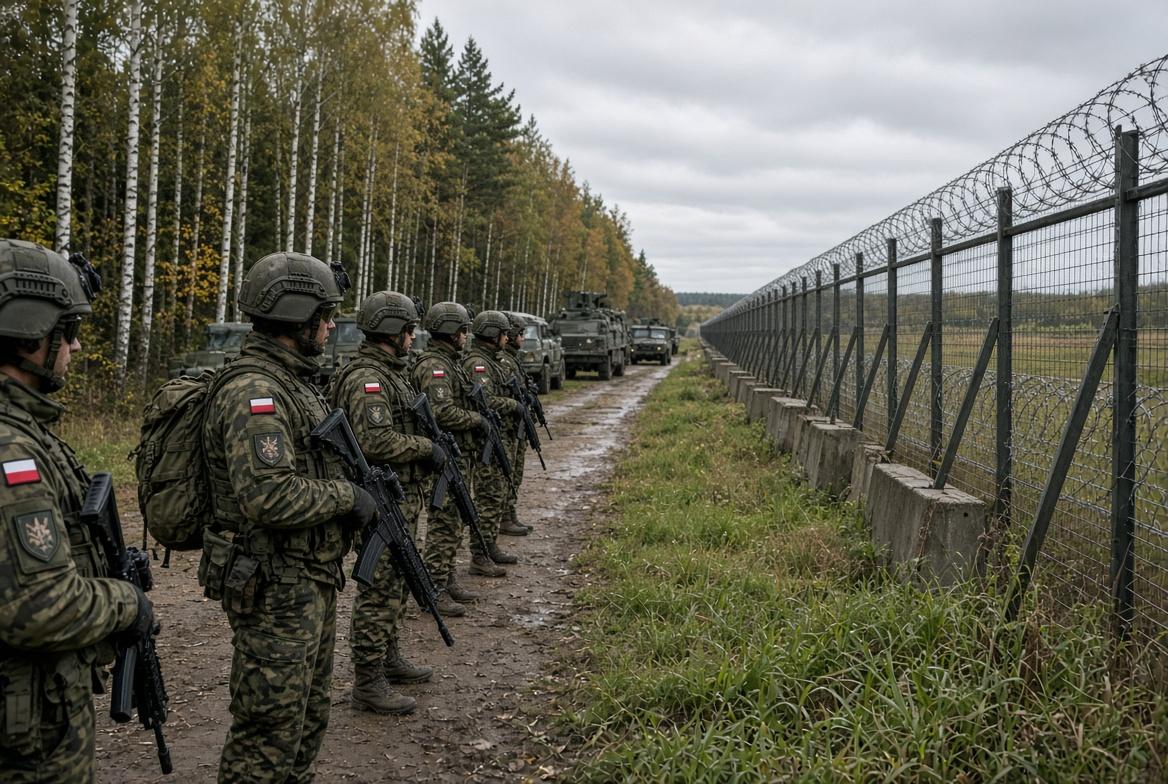
In a historic pivot that underscores its commitment to regional security, Poland has launched an unprecedented security operation along its northeastern border, directly adjacent to the heavily militarized Kaliningrad enclave. This decisive move signals a turning point in Europe’s evolving shadow war with Moscow, as Warsaw takes bold steps to neutralize Russia’s escalating hybrid warfare tactics before they gain a foothold.
Unmatched security overhaul transforms Poland’s Baltic frontier into a fortress
The scale and precision of Poland’s new border security initiative mark a radical departure from conventional defensive measures. Rather than relying on standard patrol protocols, this initiative integrates a multi-layered defense system that combines elite military units, counter-terrorism specialists, border guards, and national police forces. The primary goals are clear: seal the border against potential saboteurs, disrupt covert infiltration routes, and shield critical infrastructure from asymmetric threats.
This fortified approach comes at a time when regional tensions have reached a boiling point. Reports of unidentified drone incursions, unauthorized airspace violations, and suspicious cross-border movements have surged in recent months, keeping Baltic states in a state of heightened alert. Poland’s response leaves no room for ambiguity—every sector, from energy grids to transportation hubs, is now under constant surveillance and protection.
From rhetoric to reality: Warsaw’s hardline stance against Russian aggression
Poland’s strategic pivot is not merely symbolic—it is a direct response to a pattern of provocations that have intensified as the Ukraine conflict rages. Since Moscow’s hybrid warfare playbook includes tactics such as migrant flux manipulation, cyber harassment, and psychological operations, Warsaw is leaving nothing to chance. The deployment of advanced radar systems, drone detection networks, and rapid-response units ensures that any attempt at destabilization will be met with immediate and overwhelming force.
By positioning itself as the eastern flank’s first line of defense, Poland is sending a clear message: the era of passive deterrence is over. With Kaliningrad serving as a strategic foothold for Russian operations in the region, Poland has made it unequivocally clear that its territory will not be a backdoor for covert aggression. This proactive stance is reshaping NATO’s eastern defense paradigm, proving that deterrence is not just about presence—it’s about decisive action.
Securing Europe’s eastern gateway: what’s at stake beyond Poland’s borders
The ripple effects of Poland’s bold initiative extend far beyond its own frontiers. The Baltic region, long considered a potential soft underbelly for Russian subversion, now faces a reinforced security architecture that leaves no margin for error. For neighboring EU and NATO members, Poland’s model offers a blueprint for balancing vigilance with transparency—ensuring that critical infrastructure remains operational while maintaining public trust in regional stability.
As Poland redefines its role in Europe’s security landscape, one thing is certain: the Baltic frontier is no longer a passive border. It is a frontline of resilience, where every sensor, patrol, and rapid-reaction team reinforces the continent’s collective defense. In an era where hybrid warfare blurs the lines between peace and conflict, Poland’s decisive measures are not just protecting its own soil—they are safeguarding the future of European security.
The message to Moscow is unambiguous: hybrid aggression will meet an ironclad response. And in the high-stakes game of 21st-century geopolitics, Poland is raising the stakes.