Massive migrant influx at Ceuta tests Spain-Morocco ties
Massive migrant influx at Ceuta tests Spain-Morocco ties
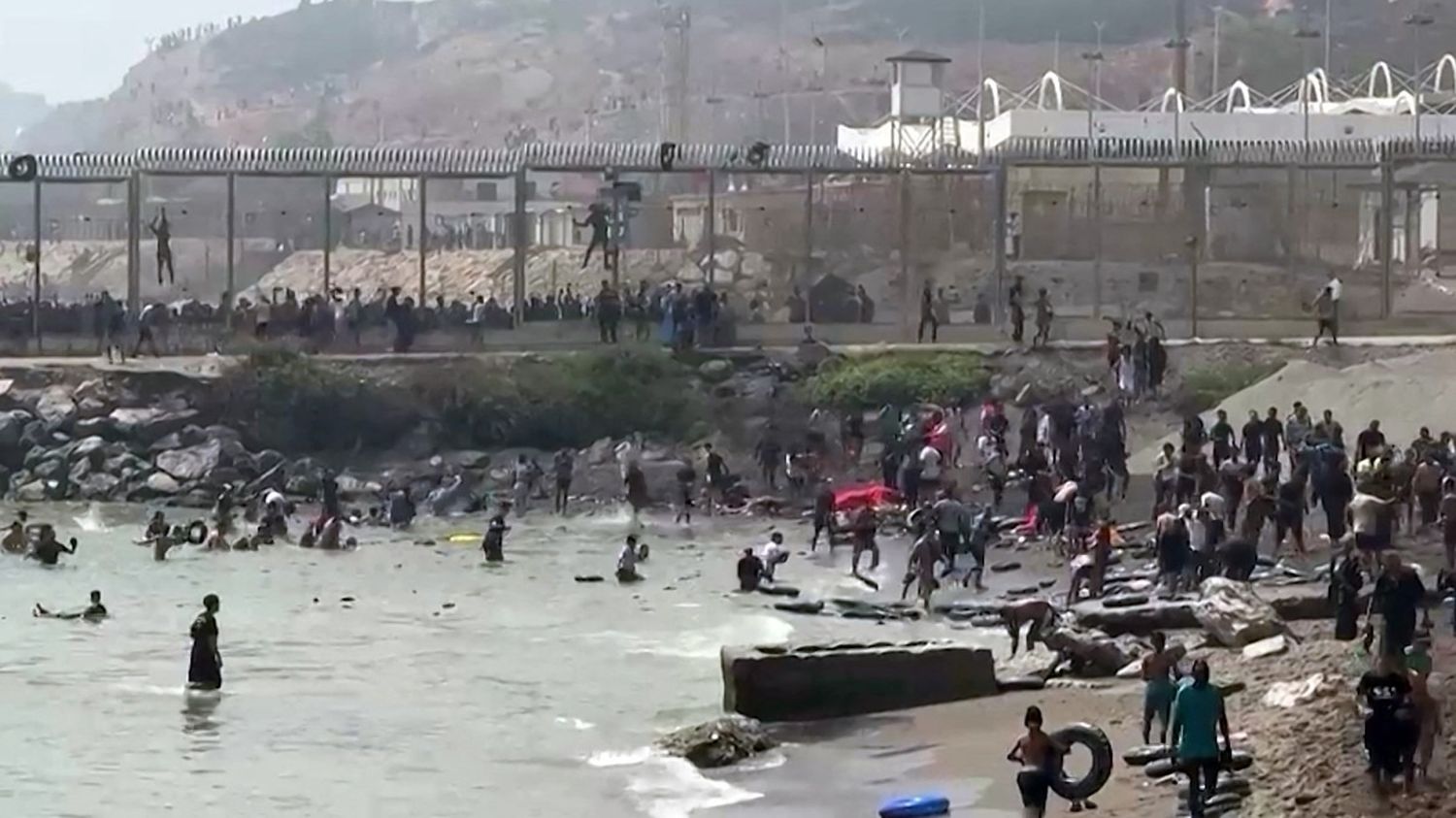
In just 24 hours, nearly 60,000 migrants crossed into this Spanish enclave bordering Morocco—a 20 km² territory home to 85,000 residents. The surge raises questions about whether Rabat is using migration as political leverage amid Spain’s warming ties with Algeria.
Reading time: 8 minutes
Thousands of Moroccans reached the autonomous city of Ceuta by swimming just one week after Spanish Prime Minister Pedro Sanchez visited Algeria. In 2021, nearly 9,000 people entered the country after Spain hosted the leader of the Polisario Front—a political and armed independence movement opposed to Morocco.
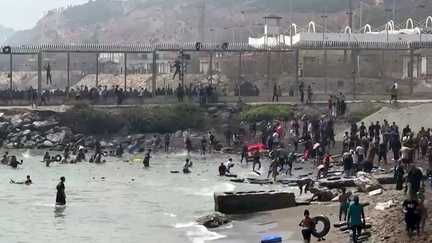
Chaos erupted at the border between Ceuta and Castilejos after thousands of young Moroccans poured into Spanish territory in one of the largest migration crises in five years. While Moroccan police blocked road access, endless lines of young people, families, and even persons with reduced mobility dispersed across hills and waded into the sea to swim to the Spanish enclave.
The Spanish administration insists bilateral relations between the two countries remain strong. Foreign Ministry sources confirmed the current agreement with Morocco is “excellent,” describing migration coordination as “intense.” Together, they pledged to redouble efforts to address the crisis. After hours of institutional silence, the Moroccan government confirmed what Spain had announced and stated both countries had reached an agreement to repatriate those who entered Ceuta illegally.
Legal decision “misinterpreted”, says expert
Many unknowns persist about what triggered this episode. The Interior Ministry, led by Fernando Grande-Marlaska, attributes the event to human trafficking networks that allegedly “exploit a court ruling” to facilitate the flow of undocumented migrants.
This recent Supreme Court decision establishes that anyone entering Spanish territory is entitled to legal assistance and that their situation must be “reviewed individually.” Ruth Ferrero, a political science professor and researcher at the Complutense Institute of International Studies (ICEI), explains the ruling has been “misinterpreted.” She clarifies: “It simply applies international asylum law—it does not mean there is an ‘open door’ policy or that no returns to Morocco can occur.” This interpretation does not preclude the possibility that, as the Interior Ministry asserts, trafficking networks were used to promote entry.
A precedent from 2021
A similar situation occurred in May 2021 when nearly 9,000 people entered Ceuta. The Moroccan government retaliated after Spain hosted Brahim Ghali, leader of the Polisario Front, in a Spanish hospital. Morocco called the move “deplorable.” Reports later revealed rumors circulating among sub-Saharan migrant communities that Moroccan security forces would lift coastal controls that day.
This is not the first time Rabat has resolved diplomatic crises with Madrid by allowing mass migration, though the political motivations behind the current influx remain unclear. Haizam Amirah Fernández, executive director of the Center for Contemporary Arab Studies (CEARC), notes a “pattern” in these mass entries: “Moroccan authorities use human movements to send messages, often tied to unmet expectations of Moroccan leaders.”
Ferrero urges caution, arguing it is incorrect to “interpret all migration pressure from Morocco as a political strategy.” She states: “What we are seeing does not appear, at first glance, to align with a Moroccan political objective. This is at least what available information and the Interior Ministry’s messaging suggest.” For Ferrero, the real issue lies in how disinformation networks have operated alongside criminal gangs.
According to police sources, Moroccan authorities attempted to halt the arrival of young people in the north by conducting public transport and road inspections. However, the multiplier effect of rumors overwhelmed local security forces.
A week after a meeting with Algeria
The massive influx into Ceuta occurred a week after Pedro Sanchez’s visit to Algeria, marking “a new phase” in relations between Spain and the Maghreb country. During the meeting with President Abdelmadjid Tebboune and Prime Minister Sifi Ghrieb, discussions focused on gas supply—a critical issue amid the Middle East conflict and the blockade of the Strait of Hormuz.
“Whether this can be considered a determining factor is unclear, but the timing is striking,” Amirah Fernández says regarding a possible link between the Ceuta influx and Spain’s recent proximity to Algeria. He adds: “The rivalry between the two countries has existed since their independence. While there have been periods of cooperation and regional integration attempts, the current phase is among the worst in decades. It is reasonable to assume Sanchez’s visit was not well received in Rabat.”
For Morocco, according to the expert, Spain’s relations with Maghreb countries are often seen as a “zero-sum game.” “If Spain improves ties with Algeria, Morocco perceives it as detrimental; similarly, if it strengthens relations with Morocco, Algeria views it as harmful.”
Ferrero believes Rabat maintains a position of influence over Madrid, but this is “a result of a security-focused policy and outsourcing migration management”: “It is not that Morocco deliberately sought this position, but rather that it has skillfully played its cards in a context where European governments, including Spain, have delegated migration control to third countries.”
The Western Sahara conflict at the heart of tensions
This migration pressure follows years of bilateral tensions between Spain and Morocco. In December 2020, Rabat suspended the High-Level Meeting (RAN) with Madrid days after Donald Trump—then in his first term—recognized Moroccan sovereignty over Western Sahara in exchange for normalizing relations with Israel. Months later, Spain admitted Brahim Ghali from Algeria to a hospital in Logroño for COVID-19 treatment.
Morocco “took note” of this hospitality toward the Polisario leader, which led to a border incident resulting in two deaths.
“The Spanish-Moroccan relationship is complex,” Amirah Fernández affirms. “Morocco employs an assertive style—decision-making is concentrated in a small circle, and force is often used as a tool.”
Since gaining independence in 1956 following the end of French and Spanish protectorates, the two countries have clashed over Western Sahara—a former Spanish colony invaded by Morocco in 1975. Madrid withdrew from the area the following year, relinquishing administrative responsibility. Today, 80% of the territory is under Moroccan control, while the remaining portion is held by the Polisario Front, founded in 1973 as a Sahrawi national liberation movement.
Since Trump took office, Washington’s pro-Morocco stance has pushed the Western Sahara conflict to a breaking point. In 2020, he recognized Moroccan sovereignty over the region, sparking a period of diplomatic tension that culminated in the Ceuta crisis of 2021.
The turning point came in 2022 when Pedro Sanchez wrote to Mohamed VI, reportedly supporting Morocco’s autonomy proposal for Western Sahara—a historic shift in Spain’s stance on the conflict. “What truly happened with this letter is that the Spanish government abandoned its neutral position,” Amirah Fernández explains. “Until then, Spain supported any solution agreed upon by the parties. However, in this letter, it expressed a preference for the first time: Morocco’s autonomy proposal for Western Sahara, precisely the option defended by Rabat. But this does not constitute a legal recognition of Moroccan sovereignty over the territory.”
The role of social networks
Beyond potential political interests from the Mohamed VI regime, social media undoubtedly played a key role in this migration crisis. A report from the North African Human Rights Observatory this week found that 81% of young people surveyed in northern Morocco considered social media content portraying irregular migration as “a solution to improve living conditions.”
The study, based on a survey of 500 young people from Tangier, Tetouan, and Al Hoceima, also revealed that 78.4% of participants stated young people easily find publications promoting irregular migration, while 74.2% follow pages that provide information or assist in planning such journeys.