Mali sees fragile calm in Bamako amid deepening terror threat in central regions
While Bamako enjoys a rare moment of relief thanks to the arrival of two critical convoys—one carrying fuel and another heavy weaponry—the vast central regions of Mali remain trapped in a relentless cycle of violence. The contrast could not be sharper: a capital where supplies flow more freely and a hinterland where terror groups tighten their grip with deadly precision.
Bamako’s lifelines hold steady despite regional threats
The Malian capital has seen a noticeable easing of tensions after months of supply bottlenecks and fuel shortages. Two high-stakes deliveries broke the deadlock in late July, proving that alternative logistics routes can outmaneuver the blockade tactics employed by the Jama’at Nusrat al-Islam wal-Muslimin (JNIM) across the subregion.
The first breakthrough came on July 24, when a massive convoy of fuel tankers completed a perilous journey from Kayes to Bamako. The 200-vehicle column navigated a gauntlet of potential ambush points, avoiding the usual traps set by jihadist cells along the Senegal-Mali corridor. The successful transit ensured that gasoline reserves in the capital could be replenished, averting a potential economic paralysis.
A new military corridor challenges jihadist dominance
A day later, Bamako witnessed another pivotal moment: the arrival of a Russian-origin arms shipment. The cargo, which had been offloaded at the port of Lomé in Togo, took an unconventional route—avoiding the unstable Guinea corridor by passing through Burkina Faso before entering Mali via Sikasso. This path marks the activation of a fresh West African supply artery, one that sidesteps the most volatile zones under JNIM control.
The shipment included an array of modern weaponry intended to bolster the Malian Armed Forces (FAMa) and their Russian partners in Africa Corps. Among the delivered assets were 3 BMP-2 infantry fighting vehicles, 8 BMP-3 models, 14 mine-resistant ambush-protected vehicles (MRAPs), 4 BTR-82 armored personnel carriers, 2 antiaircraft defense systems, and a fleet of logistics trucks alongside tactical motorcycles. These additions are expected to enhance both mobility and firepower in counterterrorism operations.
Central Mali’s roads turn deadly as JNIM tightens its grip
Beyond Bamako’s fortified perimeter, the picture remains bleak. The National Route 16 (RN16), a vital artery connecting Sévaré to Gao, has become a hunting ground for the JNIM. On July 25 and 26, a joint FAMa and Africa Corps convoy—tasked with delivering supplies to Gao—faced relentless attacks near Hombori. The jihadist group deployed a barrage of improvised explosive devices (IEDs), systematically targeting the logistical column along the Wami-Agoufou stretch. Several vehicles were destroyed, underscoring the terrorists’ deep knowledge of the terrain and the persistent challenges faced by government forces in securing secondary supply lines.
The JNIM’s offensive strategy extends beyond the RN16. On the same days, the group launched an ambush on a Malian military convoy traveling between Niafunké and Tonka, as well as a counteroffensive north of Niono to repel an Africa Corps advance. These coordinated strikes highlight the group’s ability to exploit gaps in security coverage and strike at will.
Kouakourou’s fall exposes human cost of stalled advances
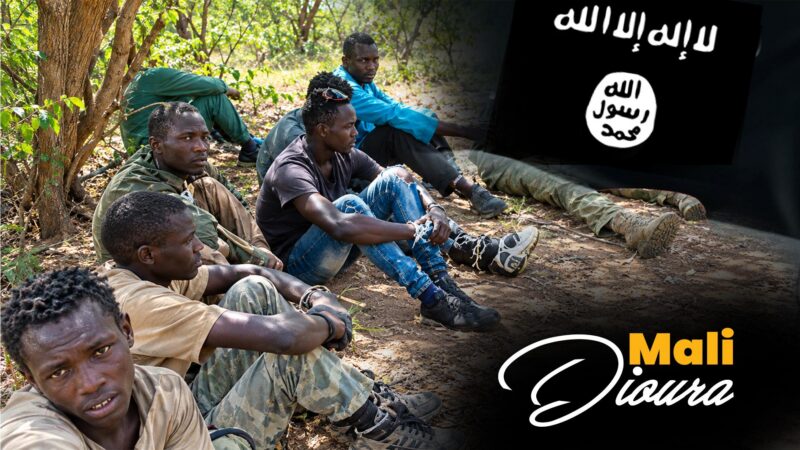
The most glaring example of the central regions’ collapse came in the Djenné district, where the strategic outpost of Kouakourou fell to the JNIM on July 19. The loss marked a significant blow to Mali’s territorial control and forced the military into a reactive posture.
In response, the FAMa launched a series of airstrikes on July 21, claiming to have neutralized five terrorists and destroyed a logistics vehicle. Yet, despite the intensity of the aerial bombardment, ground forces were unable to retake the town. Kouakourou remains under full jihadist control, a stark reminder of the limitations faced by Malian troops in contested rural areas.
Civilian exodus deepens humanitarian crisis
The fall of Kouakourou triggered a mass exodus as civilians fled the advancing threat. Thousands abandoned their homes, crops, and livelihoods, joining the swelling ranks of internally displaced persons (IDPs) in the Mopti region. Local communities, already strained by years of conflict, now struggle to absorb the new wave of refugees, further stretching already scarce resources.
Can new hardware shift the balance?
Mali now stands at a crossroads. On one side, the capital’s supply lines have been shored up, and the FAMa have received advanced weaponry that could tip the scales in urban and semi-urban theaters. On the other, the JNIM’s asymmetric warfare continues to carve out territories, sever secondary supply routes, and plunge rural communities into deeper despair.
The question remains: Will these logistical gains translate into lasting territorial victories, or will the jihadist network adapt and reclaim the initiative? The coming weeks will determine whether Bamako’s newfound calm can expand into the heart of a country still reeling from war.