Nigeria’s military breakthrough: over 1,100 jihadists neutralized in lake Chad region
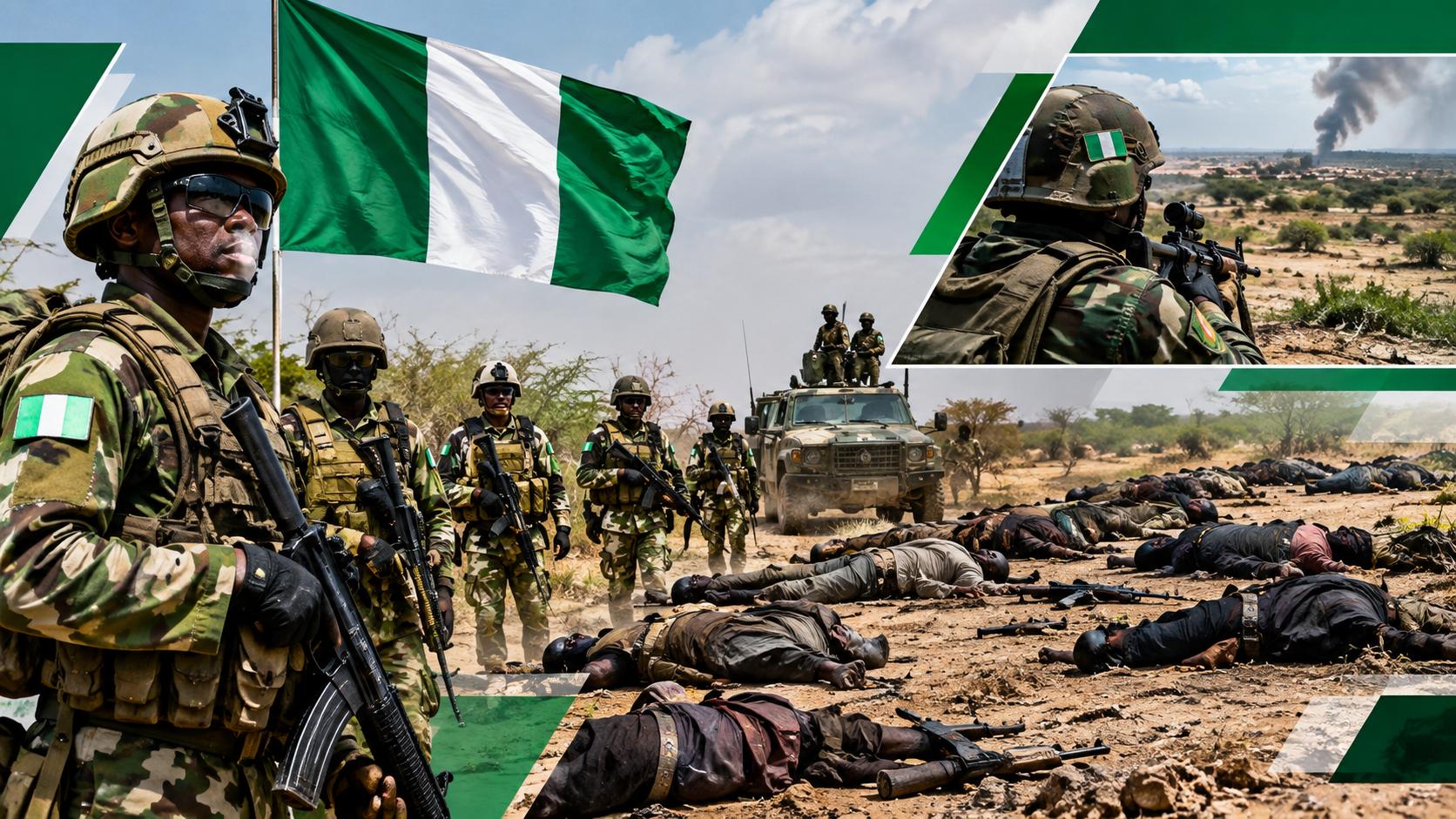
Army’s decisive campaign shifts course of Nigeria’s decade-long insurgency
In a historic military push that marks a turning point in Nigeria’s fight against jihadist violence, the Nigerian Armed Forces have neutralized over 1,100 fighters linked to Boko Haram and the Islamic State West Africa Province (ISWAP) since April 2025. The announcement, delivered by Major General Abdulsalam Abubakar during a command handover in Maiduguri, underscores a sustained campaign that has reshaped the security landscape across the Lake Chad basin.
Heavy losses for insurgents as military tightens grip on key strongholds
The military’s intensified operations have crippled jihadist networks operating from critical redoubts such as the Sambisa Forest, Mandara Mountains, and the Lake Chad periphery. The offensive has not only claimed the lives of 1,106 insurgents but also dismantled their logistical pipelines. Military engineers have disabled 295 improvised explosive devices (IEDs), a persistent menace that has historically hindered troop mobility and targeted civilian convoys.
In a combined assault on insurgent arsenals, troops recovered 475 firearms ranging from assault rifles to heavy weaponry, alongside a substantial stockpile of ammunition. These seizures represent a significant blow to the operational capacity of both Boko Haram and ISWAP factions still active in the region.
Rise in defections signals weakening resolve among insurgents
The campaign’s pressure has triggered a wave of surrenders, with 969 individuals—comprising active fighters and their families—laying down arms or fleeing insurgent-controlled zones. This outflow reflects a growing erosion of support within the jihadist ranks. The military’s operations have also led to the arrest of 758 suspected collaborators and logistics personnel, further disrupting the extremists’ supply chains essential for sustaining their insurgency.
Humanitarian breakthrough: hundreds of civilians rescued from captivity
Beyond military gains, the operations have delivered a humanitarian victory. A total of 638 civilians, including women and children abducted from isolated villages, have been liberated from insurgent captivity. These rescued individuals are undergoing comprehensive medical and psychological evaluations before being handed over to civilian authorities and humanitarian organizations for reintegration and support.
Navigating persistent challenges despite tactical gains
While these developments signal progress, the security situation remains fragile. The conflict, which erupted in 2009, has left more than 40,000 dead and displaced over two million people across the Lake Chad basin. ISWAP, once a splinter faction of Boko Haram, continues to pose a serious threat with its reliance on hit-and-run tactics and IEDs. The command transition within Operation Hadin Kai comes at a pivotal moment, tasked with consolidating military achievements and ensuring the safe return of displaced populations to recaptured areas.
Economic and social implications of the military surge
The military’s sustained efforts are beginning to unlock economic potential in the region. With key jihadist strongholds dismantled, local markets are gradually reopening, and agricultural activities are resuming. Communities previously trapped in conflict zones are now seeing the first signs of recovery, though the scars of over a decade of violence linger. International and local aid organizations are scaling up support to address the growing humanitarian needs as the region transitions from crisis to recovery.