Momentum shifts in Togo’s press freedom battle after a correspondent’s sanction
A disciplinary decision in Togo has moved the country past a threshold that its newsrooms had been watching for months. What could have remained a quiet internal matter — the sidelining of a correspondent after she reported on a sensitive case — has instead become a turning point for press freedom, a moment that now tests how far the authorities are prepared to go.
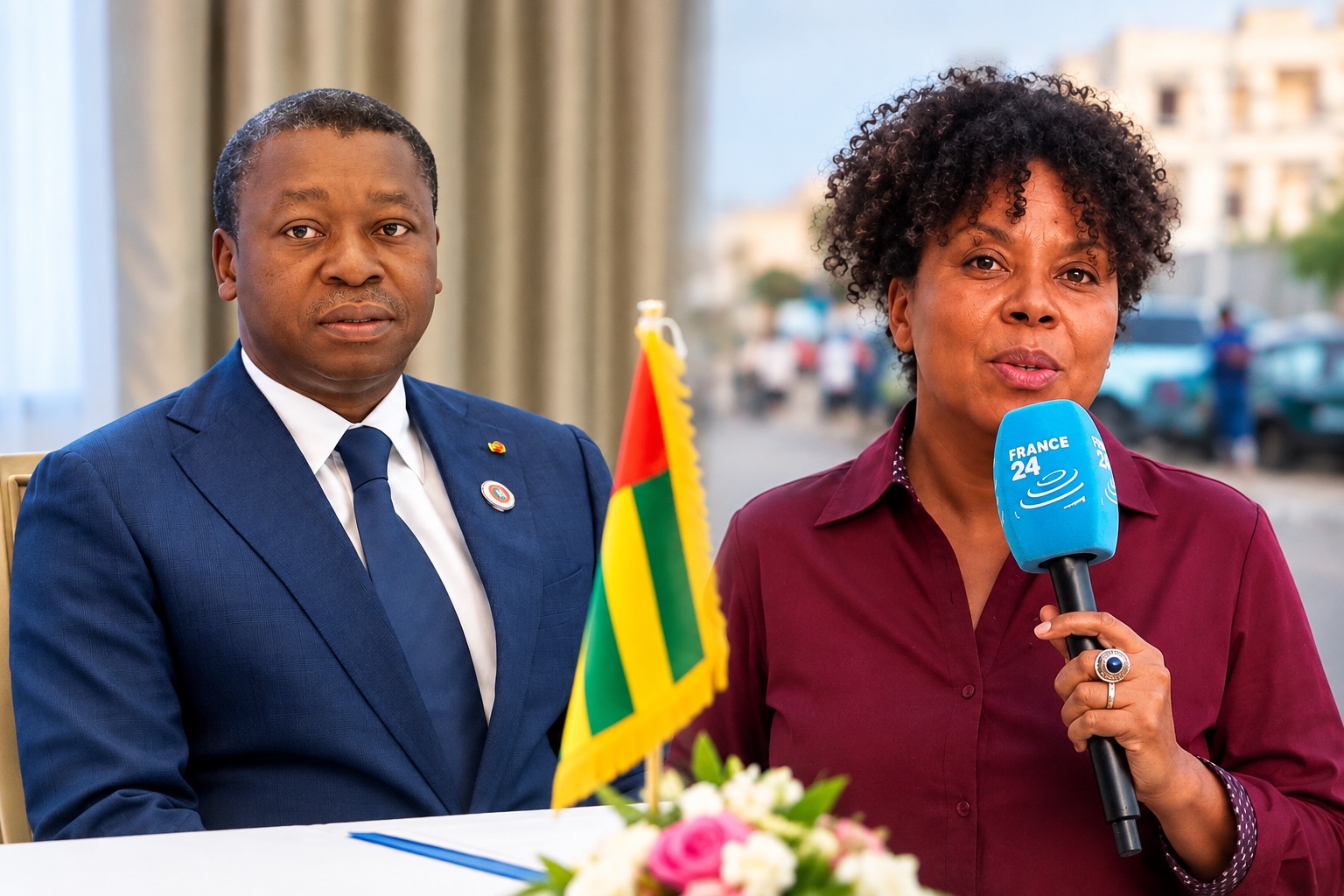
The case revolves around Emmanuelle Sodji, a journalist who spent years as the correspondent in Benin for a French international broadcaster. On 18 August 2026, she relayed information concerning the indictment of two French nationals being held in Togo.
That information, the SNJ-CGT journalists’ union argues, was already public and had been circulating across several outlets and on social networks. The union goes further, noting that Togo’s own media regulator admitted the following day that the details had been in circulation since 18 August.
The facts at the centre of the dispute
The two French nationals concerned — the filmmakers Gaël Mocaër and Sebastian Perez Pezzani — had been arrested on 27 July 2026 while working on a documentary in northern Togo. Togolese authorities prosecuted them over matters linked to their visa declarations. They were ultimately granted provisional release on 1 September and authorised to leave the country.
The controversy now centres on the sequence of events: can a journalist be criticised for broadcasting information that was already publicly available when no restrictive instruction had yet been clearly passed on to her newsroom?
The SNJ-CGT believes she cannot, and contends that the case raises the prospect of a retroactive sanction. The union maintains that Sodji was set aside after relaying the story and denounces a decision capable of damaging journalistic freedom. That interpretation belongs to the union and must be distinguished from the stance of the broadcaster’s management.
A media environment already under strain
The episode lands in a particularly sensitive media landscape.
In June 2025, Togo’s High Authority for Audiovisual and Communication suspended the programming of two French international broadcasters for three months, invoking repeated shortcomings in impartiality, rigour and fact-checking. The Togolese authorities maintained that some of their programmes had aired information judged inaccurate or tendentious.
The broadcasters defended their journalistic work, while observers expressed concern over the narrowing of media space in an already tense political climate.
That context lends the Sodji affair a significance far greater than the individual case of one correspondent.
Where should the line be drawn?
The core question is not whether a journalist should respect professional standards. Of course they should. The real issue concerns the nature of those standards, their clarity, their timing, and the conditions in which they can be used to sanction an information professional.
In any democracy, authorities are entitled to protect certain sensitive information, notably when a judicial procedure or a question of national security is involved. But that power must be framed by rules that are comprehensible, known in advance and applied transparently.
Conversely, journalists have a responsibility to verify their information, respect judicial procedures and avoid turning sensitive information into speculation.
It is precisely that dividing line that now needs to be clarified in Togo.
Because when information is already public, when it circulates across several outlets and on social networks, and when an authority itself acknowledges that it was already in circulation, the question of editorial responsibility inevitably grows more complex.
A wider question for Togo’s leadership
Under the presidency of Faure Gnassingbé, the debate over Togo’s democratic space has never been limited to this single affair. In June 2025, demonstrations in Lomé against the government were broken up by security forces, in a political climate marked by institutional changes introduced around the presidency of the Council of Ministers.
In that setting, every restriction targeting the media is examined with greater attention.
The stakes therefore exceed the fate of one correspondent.
They concern a fundamental question: can journalists investigate, verify and publish freely when a story touches on the interests of those in power or on sensitive matters?
The answer should not depend on a media outlet’s political proximity, its country of origin or the personality of the journalist.
It should depend on clear professional rules, legal guarantees and one essential principle: a free press is not a press that escapes all rules; it is a press that can apply those rules without suffering political pressure.
The scrutiny that lies ahead
That is the ground on which Togo will now be observed.
How far will pressure on journalists go when they investigate sensitive subjects? And above all, what guarantees does the Togolese government intend to offer to those who practise the craft of informing the public?
These are questions the Togolese authorities, the regulators and media leaders will have to answer with facts, rules and transparency.