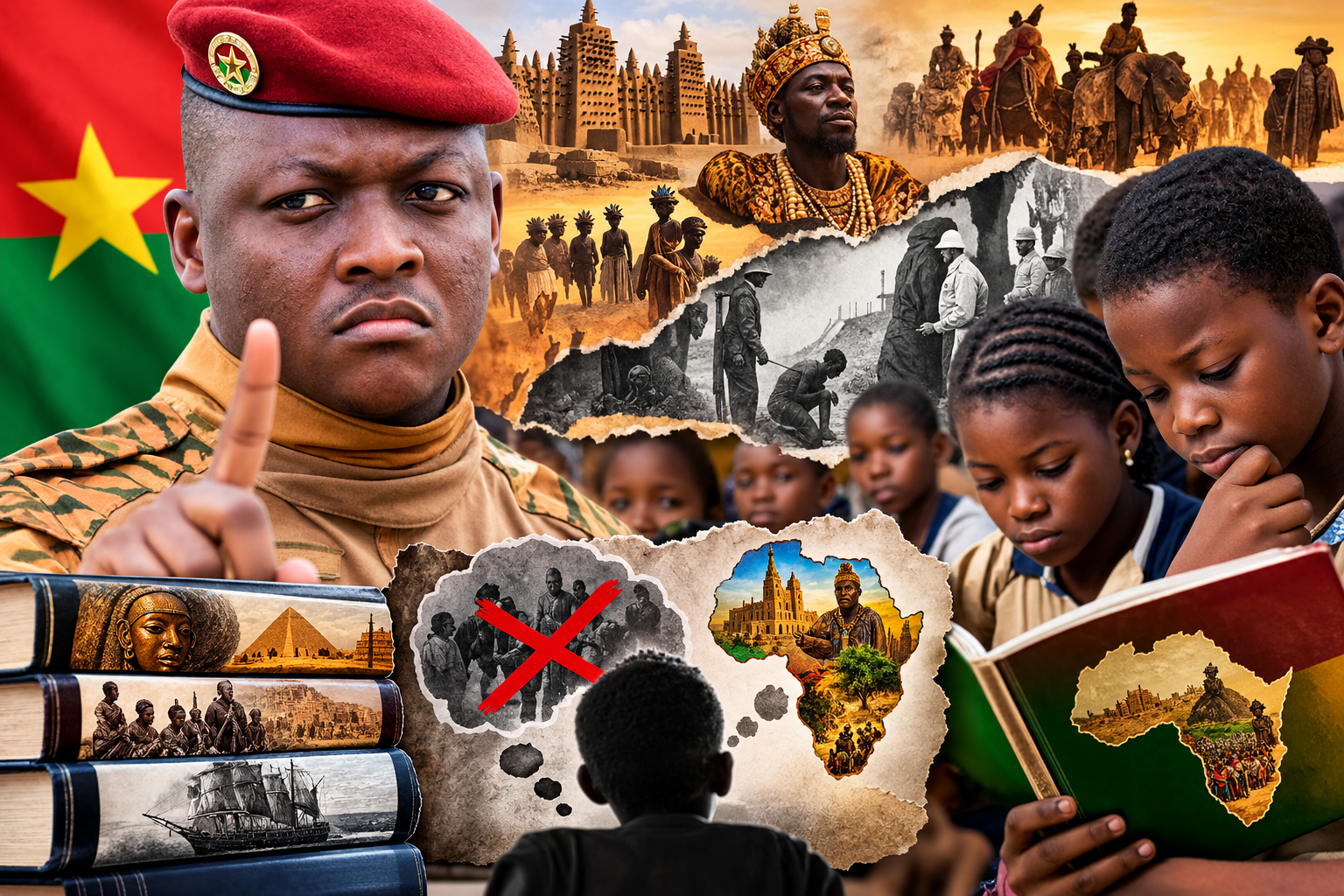
The Burkina Faso government is advancing a landmark reform of its history and geography curricula, aiming to decolonize school textbooks. While this initiative responds to legitimate concerns about the representation of African history, it also raises a critical question: how can educators move beyond partial narratives without falling into new ideological traps?
The nation stands at a pivotal moment. A well-intentioned effort to correct historical oversights risks becoming an exercise in replacement rather than enrichment shifting from one incomplete story to another. Education must empower, not confine. It must illuminate the past, not bury it under selective memory.
Reforming history without repeating old mistakes
At the heart of this debate lies a fundamental principle: history is not a moral ledger of grievances. It is a living record of empires, civilizations, exchanges, and conflicts. To teach it effectively is to honor both the triumphs and the tragedies of a people’s journey without reducing their identity to a single chapter of suffering.
The Burkina Faso reform signals an opportunity to broaden the curriculum beyond colonial narratives. But opportunity alone is not enough. Without careful design, the initiative could inadvertently create a new orthodoxy one that replaces outdated Eurocentric biases with equally rigid African-centric ones. True decolonization means inclusion, not inversion.
What a balanced history curriculum should include
A comprehensive history education does not set African achievements against European misdeeds in a zero-sum competition. It integrates multiple perspectives, allowing learners to see how societies have shaped and been shaped by one another. This means:
Highlighting pre-colonial African states such as the Mossi Kingdoms, Songhai Empire, and ancient Ghana, and their contributions to global trade, governance, and knowledge;
Exploring the complexity of African societies acknowledging both their strengths and internal conflicts, such as the role of slavery in West African civilizations;
Teaching colonialism not as an isolated crime, but within the broader context of 19th-century imperial rivalries, economic exploitation, and global power shifts;
Including African resistance movements, intellectual contributions, and cultural exchanges that persisted despite colonial domination;
Addressing post-colonial challenges nation-building, coups, development aid, and regional cooperation with honesty and nuance.
Why Burkina Faso must resist ideological shortcuts
Some argue that correcting historical injustice requires a deliberate shift in narrative focus. While this impulse is understandable, it must not lead to the erasure of other truths. For instance, students should learn about the atrocities of colonial rule not as isolated events, but as part of a global system. They must also understand how these systems evolved into post-colonial structures that continue to influence Africa today.
Education is not therapy. It is not a tool for emotional healing or political vindication. It is a foundation for citizenship. A curriculum that teaches students only their grievances risks breeding resentment without offering the tools to analyze, contextualize, or move forward. On the other hand, one that presents history in all its complexity warts and wonders alike gives learners the intellectual independence to question, reflect, and lead.
From selective memory to informed citizenship
The ultimate goal of history education should be to prepare citizens who can engage thoughtfully with the past. That means giving them access to the full spectrum of human experience including the uncomfortable chapters. Only then can they develop the critical thinking needed to build a just and peaceful future.
Burkina Faso’s reform is a turning point but only if it embraces intellectual courage. The nation’s children deserve more than a revised textbook. They deserve a legacy of truth, clarity, and freedom. Only when history is taught in full can it truly liberate.
Toward a curriculum that connects, not divides
To succeed, this reform must move beyond slogans like ‘decolonize’ or ‘restore pride.’ It must ask: What kind of citizens do we want to raise? Citizens who see the world through a narrow lens? Or those who understand complexity, embrace diversity, and seek reconciliation through knowledge?
The answer lies not in hiding pages of the past, but in reading them all with wisdom, context, and purpose.
By François Mvondo — Journalist