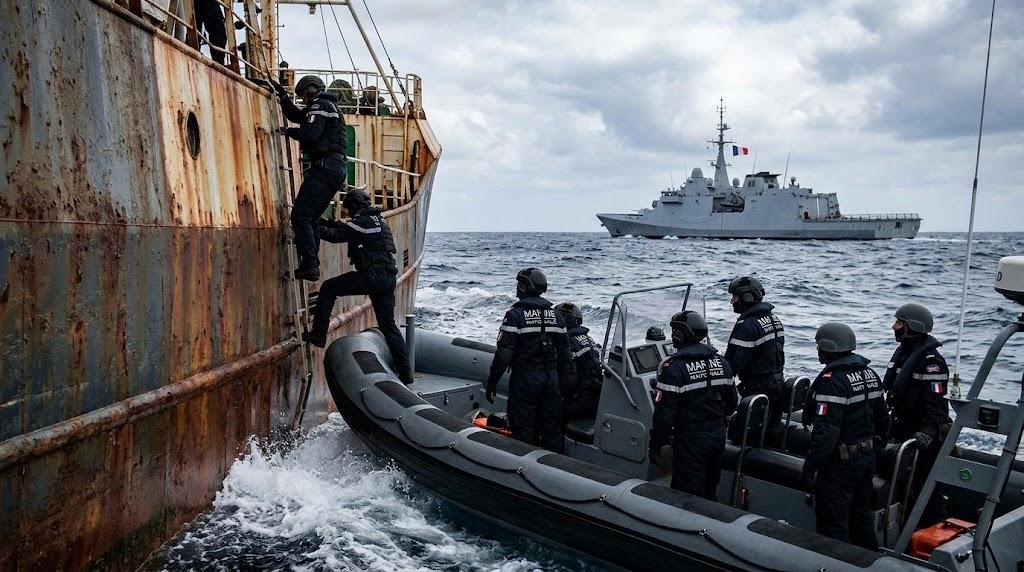
The interception of Russian-operated oil tanker DF Peak by French naval forces in the Indian Ocean has ignited a firestorm of diplomatic scrutiny, legal challenges, and maritime governance debates. The operation, conducted on October 12, 2026, some 830 kilometers south of Réunion Island, has exposed critical flaws in Benin’s maritime registration system and raised urgent questions about the integrity of its flag state control.
High-Seas Standoff: France takes decisive action against a suspected sanctions-busting vessel
On the morning of October 12, 2026, French naval vessels intercepted the 244-meter-long crude oil carrier DF Peak in international waters under suspicious circumstances. Authorities allege the vessel was operating with a fraudulent or improperly obtained Beninese flag, a tactic increasingly used by Russia’s so-called “ghost fleet” to evade Western sanctions imposed since 2024.
During a routine inspection at sea, French naval personnel discovered significant discrepancies in the vessel’s documentation, casting doubt on the legitimacy of its Beninese registration. Following a formal request from the prosecutor’s office, the ship was escorted to a secure anchorage near Réunion Island for intensive judicial review—including scrutiny of its cargo manifests, ownership structure, and compliance with international maritime law.
Identity manipulation: How a sanctioned tanker evaded global tracking
The DF Peak is no ordinary vessel. With a deadweight tonnage of 110,000, it has become a poster child for the shadowy tactics of Russia’s maritime sanctions-evasion network. Originally launched under the name NS Captain, it underwent multiple rebrandings and flag changes to obscure its true ownership and sanctions status.
Documentation and tracking data reveal a pattern consistent with the ghost fleet’s modus operandi: in April 2024, it operated as Kaliningrad under the Russian flag before quietly re-registering in late 2025 under the Beninese flag as DF Peak. Intelligence suggests it recently completed a voyage from Venezuela, a known source of Russian oil sanctioned by the EU, US, and UK.
Benin under scrutiny: Legal and diplomatic fallout from flag misuse
The use of a Beninese flag by the DF Peak has thrust Cotonou into the center of a growing international controversy. Under Benin’s Maritime Code, a vessel may only fly the national flag if there is a genuine economic or operational link to the country—such as the presence of a registered owner, a local corporate entity, or compliance with residency requirements for crew and management.
Should authorities confirm that the vessel was flying a false or improperly acquired flag, this would constitute a direct violation of Benin’s sovereignty and a criminal offense under national law. It would also breach the country’s obligations under the United Nations Convention on the Law of the Sea (UNCLOS), which mandates that every flag state exercise effective control over vessels registered under its flag.
In response to the incident, legal experts in Benin are calling for an immediate audit of the national maritime registry to identify any systemic vulnerabilities. They warn that unregulated access to the flag could undermine not only Benin’s international standing but also the effectiveness of global sanctions regimes aimed at curbing Russian oil exports.
Ghost fleet tactics: a growing threat to sanctions enforcement
This interception highlights a systemic challenge: the increasing sophistication of sanctions evasion networks. Operators of the ghost fleet rely on a web of shell companies, opaque financial structures, and transfer operations at sea—often involving mid-ocean cargo transfers between ships—to obscure the origin and destination of sanctioned oil.
These operations not only erode the impact of international sanctions but also pose risks to legitimate maritime trade and environmental safety. The use of fake or compromised flags—especially those of smaller maritime nations—complicates enforcement for coastal states and naval patrols alike.
The DF Peak case underscores the urgent need for stricter flag state oversight, enhanced international cooperation, and robust verification mechanisms to prevent the misuse of national registries. Without decisive action, the integrity of global maritime governance—and the credibility of individual flag states—remains at risk.
The path forward: accountability, reform, and regional response
In the wake of the interception, Beninese authorities have signaled their commitment to tightening maritime oversight. Proposals include mandatory third-party audits of registered vessels, real-time monitoring of flag transfers, and penalties for non-compliant ship owners or operators.
Meanwhile, diplomatic channels are active, with discussions underway among regional maritime authorities and global bodies like the International Maritime Organization (IMO). The goal is to strengthen shared governance and prevent the Beninese registry—or any small flag state—from becoming an unwitting conduit for sanctions evasion.
One thing is clear: the DF Peak incident is not just a single enforcement victory—it is a wake-up call for the entire maritime community.