Burkina Faso: the Sankara family and the weight of Ibrahim Traoré’s commemorative agenda
A contested legacy in Ouagadougou
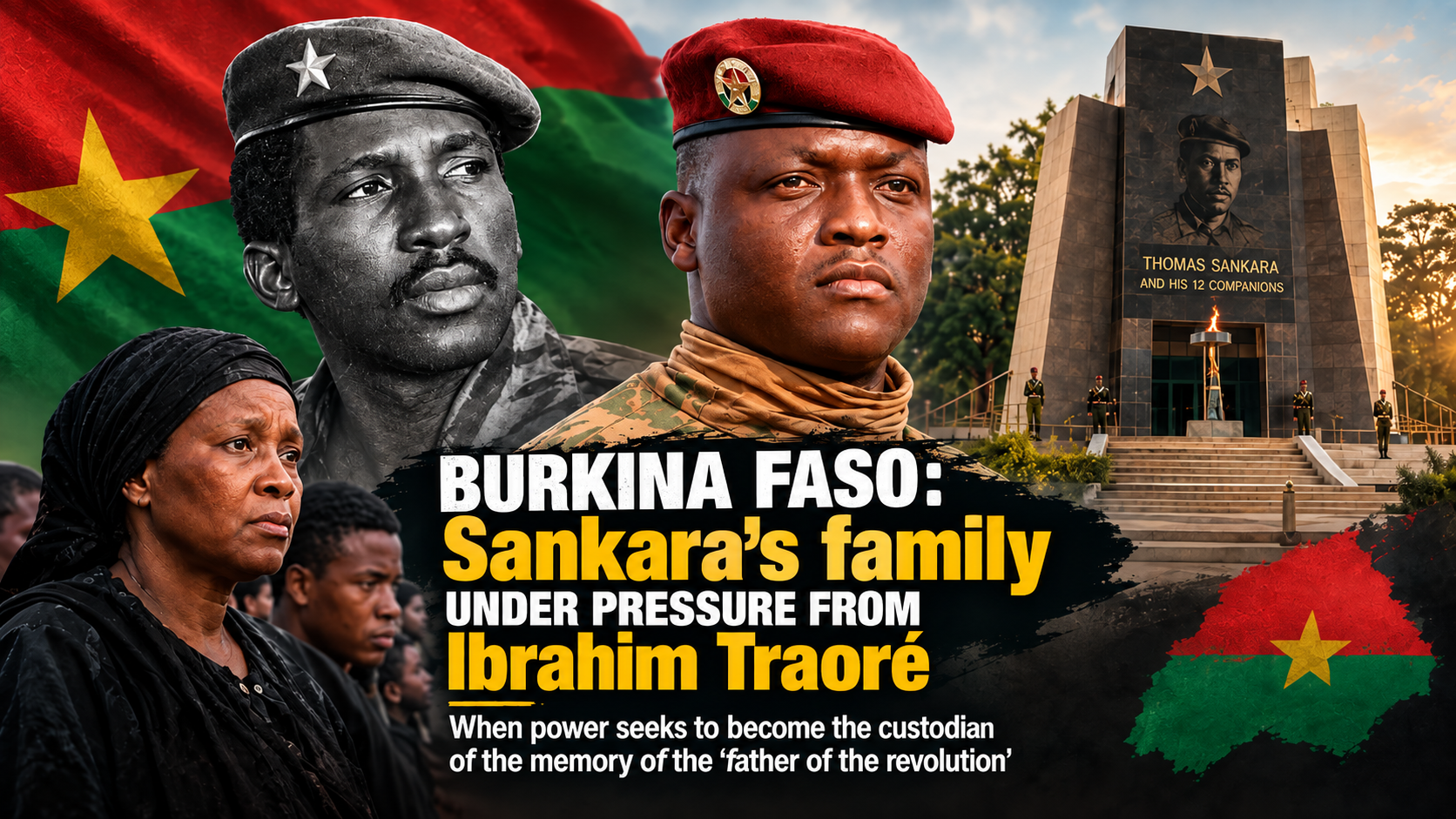
In Burkina Faso, the figure of Thomas Sankara has long since ceased to be a purely historical reference. It now occupies a central place in the political narrative advanced by the administration of Ibrahim Traoré. Behind the official tributes, the military ceremonies and the construction of a mausoleum, a delicate question arises: is the current leadership gradually appropriating the image of Sankara in order to consolidate its own political legitimacy?
The convergence is not merely a matter of outside observation. It is also visible in the regime’s own official communications.
Since 2026, the Burkinabè government has organised a monthly military ceremony dedicated to Thomas Sankara, an initiative presented as having been introduced on the instructions of Ibrahim Traoré. Official discourse goes further still: during a tribute held in February 2026, the president’s chief of staff stated that the “torch” of Thomas Sankara is now carried by Ibrahim Traoré.
This staging of historical continuity raises a fundamental question: does Ibrahim Traoré simply wish to honour Sankara, or is he seeking to present himself as the man who has taken up and continued his struggle?
The distinction matters.
Thomas Sankara belongs to the history of Burkina Faso and to the memory of millions of Africans. Yet there also exists a family memory, upheld in particular by his widow Mariam Sankara, his children, his brothers and his sisters. On this issue, the relationship between the family and the transitional authorities has never been as consensual as the official narrative might suggest.
The rupture of 2023
The most telling precedent dates back to February 2023.
Following the exhumation of the bodies of Thomas Sankara and his twelve companions, the government decided to proceed with their reinterment at the site of the former Conseil de l’Entente, which had become the Thomas Sankara Memorial. The choice was highly symbolic: it was precisely at this location that Sankara and his companions had been assassinated on 15 October 1987.
The Sankara family opposed the decision.
On 16 February 2023, Mariam Sankara, her two sons Philippe and Auguste, and the brothers and sisters of the deceased president appealed directly to Ibrahim Traoré, asking him to abandon the plan. They proposed three alternative sites: the Dagnoën cemetery, the Garden of Friendship and the Yennenga Garden.
The disagreement then became public.
The family considered that the decision had been taken without genuine consensus and refused to take part in the ceremony. On 21 February, it confirmed that it would be neither present nor represented at the burial.
On 23 February, the ceremony went ahead regardless.
The authorities pressed forward.
The family remained at a distance.
This sequence is essential to understanding what followed. For Traoré’s administration would gradually turn the memory of Sankara into a central element of its own political narrative.
From commemoration to state heritage
Since that period, the institutional presence of Sankara has continued to intensify.
The mausoleum intended for Thomas Sankara and his twelve companions was built on the Memorial site. Ibrahim Traoré laid the foundation stone on 15 October 2023, before its inauguration in May 2025. The project was officially presented as intended to preserve and promote the political legacy of the father of the August 1983 revolution.
In 2026, this memorial policy acquired yet another dimension with the introduction of monthly military ceremonies.
Through these initiatives, the authorities are no longer content merely to commemorate Sankara. They organise, institutionalise and stage his memory.
This is where one of the major political stakes lies.
In the official narrative, Ibrahim Traoré can thus appear as the man who has finally fully rehabilitated Sankara, restored his memory and taken up his struggle.
Government discourse suggests this openly. In June 2026, during a tribute at the Memorial, the minister of foreign affairs even declared that Sankara’s torch is carried “with dignity and commitment” by Ibrahim Traoré.
Such a presentation mechanically brings the two figures closer together in the collective imagination: Sankara, the assassinated revolutionary; Traoré, the young captain presented as the one who would take up the torch.
The risk of a narrative built around Sankara’s body
It is precisely here that the question of the family becomes central.
For Thomas Sankara’s relatives, his legacy cannot be reduced to an instrument of political communication or a backdrop for legitimising power.
Sankara’s body, his remains, his burial place and his family memory possess an intimate dimension that the state cannot entirely absorb.
Yet since 2023, the authorities have taken control of a large part of the institutional staging of that memory: reinterment, mausoleum, military ceremonies, official tributes, speeches on sovereignty and constant references to the revolution.
The paradox is striking: the leadership that today claims Sankara’s political heritage is also the one with which part of his family found itself in disagreement over the very manner of disposing of his remains.
This is not to assert that Ibrahim Traoré personally seeks to “take” Sankara from his family. Such an intention would be a matter of interpretation and would require further evidence.
But the facts allow another observation: the regime is gradually constructing a narrative in which Ibrahim Traoré appears as the political heir of Captain Sankara and as the man who has taken up his struggle.
This construction is far from insignificant.
It allows the current authorities to place themselves within an exceptionally powerful revolutionary lineage in Burkina Faso. It also provides them with a historical reference capable of giving ideological depth to their own discourse on sovereignty, pan-Africanism and independence.
Researchers have moreover noted the frequency with which Traoré invokes Sankara’s memory and the way his political discourse takes up certain themes associated with the former president, notably sovereignty and the rejection of external dependence.
A memory that belongs to power?
This is ultimately the most sensitive question.
Thomas Sankara is not merely a statue, a mausoleum or a military ceremony. He is also a family history, a painful memory and a political struggle whose interpretation cannot be imposed by decree.
The transitional authorities may legitimately honour his memory. They may restore sites, organise ceremonies and preserve archives. But another question remains: can they, in the name of this rehabilitation, present themselves as the natural custodians of his legacy?
The precedent of 2023 shows in any case that the Sankara family has not always accepted the authorities’ choices regarding this memory.
And therein lies the entire ambiguity of the current narrative.
By repeatedly presenting itself as the one that “carries the torch” of Sankara, the Traoré administration risks shifting the memory of a man assassinated in 1987 towards another story: that of a contemporary power seeking to inscribe its own name in the continuity of the revolution.
Sankara left behind a body of work and a body of thought. Traoré is today building his own power. Between the two, the memory of Thomas Sankara has become a major political issue.