Military Training for Journalists: A Threat to Press Freedom
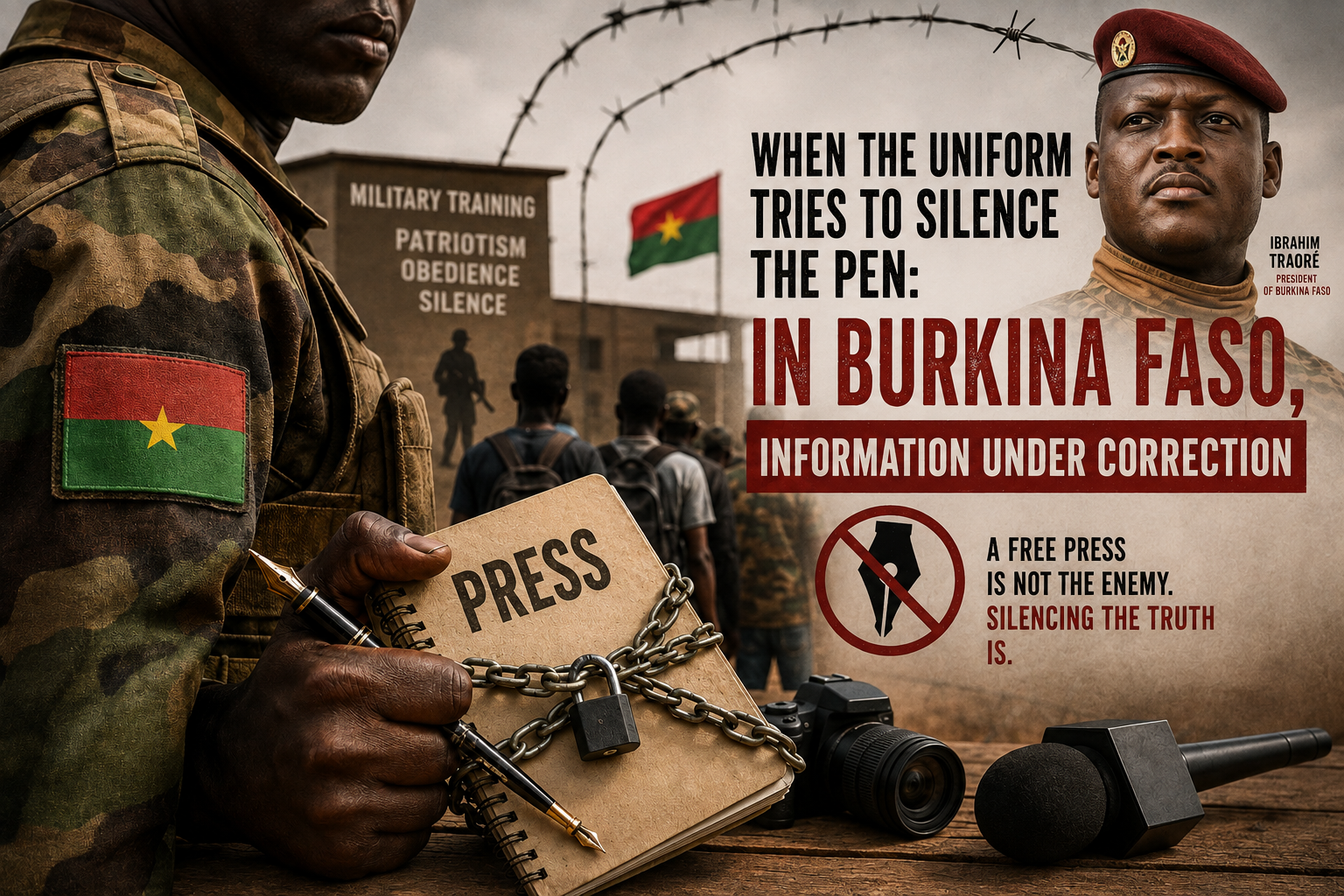
In a move that has alarmed advocates of fundamental freedoms, a recent military-style training program was conducted near Ouagadougou, attended by over forty Burkinabè journalists. Marketed as a patriotic initiative, the program’s underlying intent appears far more sinister: an orchestrated effort to re-educate and subjugate independent journalism under the guise of civic duty.
This development raises a critical question: what becomes of freedom of expression when reporters are compelled either overtly or subtly to attend military camps to learn what they may or may not report? In Burkina Faso, investigative reporting and the accurate portrayal of civilian realities are increasingly framed as acts of disloyalty. Exposing security failures, abuses, or hardships faced by the population risks accusations of treason or undermining national pride. By sending journalists to undisclosed re-education centers, the current administration does not seek to foster informed citizenship but to manufacture compliant propaganda outlets.
From Crisis Management to Absolute Control
The systematic alignment of the press reflects a troubling shift in governance. Rather than addressing a complex security crisis, the regime is consolidating absolute authority across all spheres of public life. By monopolizing the national narrative and restricting the flow of information, power is being centralized into a single, unchallenged voice of truth. Yet, journalism that operates under state-imposed dictates ceases to be journalism at all. Silencing reporters or forcing them into intellectual conformity does not resolve national crises it erodes public trust and fuels misinformation.
The Ethical Boundaries of National Security
While a state facing terrorism may legitimately request caution from the media such as withholding sensitive operational details or protecting military identities this should never justify transforming journalists into state propaganda tools. National security is not synonymous with political survival. The distinction must remain clear: the press serves the public, not the regime.
True patriotism does not demand blind allegiance to those in power. A journalist deeply committed to Burkina Faso’s future may, in fact, investigate civilian displacements, document abuses, and challenge official narratives precisely because they care about the nation’s well-being. A democracy cannot function when the government dictates what the press is permitted to publish. Officials may refute stories, present counter-evidence, or pursue legal recourse, but they cannot predetermine the boundaries of acceptable thought.
The Consequences of a Muzzled Press
The suppression of independent media does not create a void it invites chaos. When credible outlets refrain from publishing certain truths, the resulting informational vacuum is quickly filled by rumors, unverified social media claims, and clandestine narratives. Ironically, efforts to control public discourse often undermine the very stability they aim to restore. Trust is not imposed by decree; it is earned through transparency, debate, and verifiable facts. A population that believes all perspectives can be freely expressed is better equipped to discern reliable information from fabrication. Conversely, when certain truths become dangerous to report, doubt permeates every corner of society.
Journalism as a Counter-Power
There exists a fundamental contradiction in the idea of “re-educating” journalists in patriotism. The essence of journalism lies in asking uncomfortable questions holding authorities accountable, scrutinizing decisions, and confronting official rhetoric with lived realities. When reporters are stripped of their investigative autonomy, they cease to serve as a vital democratic check on power. This is particularly dangerous in a context marked by armed violence, mass displacement, and economic hardship circumstances that demand rigorous, independent reporting more than ever.
Can a profession tasked with observing power be expected to operate under the same principles as those who wield it? The military operates on hierarchy, secrecy, and discipline. Journalism, by contrast, is built on verification, contradiction, editorial independence, and public accountability. Merging these two paradigms risks conflating military obedience with professional integrity a dangerous precedent that blurs the line between governance and censorship.
A Slippery Slope of Ideological Enforcement
Today, journalists are pressured to prove their patriotism. Tomorrow, who might be next? Academics, judges, artists, human rights defenders, and researchers could all find themselves subjected to ideological scrutiny for expressing dissent. A robust democracy is not measured by its ability to suppress criticism but by its capacity to withstand contradiction without branding dissent as treason.
The Limits of Information Control
History demonstrates that regimes obsessed with controlling the narrative rarely succeed in the long term. While they may dominate state media, impose official narratives, and intimidate professionals, they cannot erase reality. Facts persist through personal testimonies, diaspora networks, social media, and international outlets. The true challenge is not enforcing a single voice but creating an environment where reliable information can thrive.
In a nation at war with armed groups, the responsibility borne by journalists is immense. Yet the government’s responsibility is equally significant: protecting citizens without weaponizing security as a justification for perpetual censorship. Patriotism should never serve as a license to silence. Nor should it be used to divide citizens into “loyal” and “disloyal” based on their willingness to challenge power.
A journalist who exposes a state weakness does not betray the country; they may prevent that weakness from escalating into catastrophe. The question facing Burkina Faso today is not merely about the fate of its reporters it is about the kind of society the nation wishes to build. Will it demand that information first seek the approval of those in power? Or will it affirm that truth, even when uncomfortable, remains a cornerstone of democracy?
If patriotism now means averting one’s gaze from reality to avoid offending the sovereign, then Burkina Faso’s democratic foundations are in peril. But if patriotism means defending the nation with honesty—then the journalist must retain the right to confront reality, no matter how inconvenient it may be for those in charge.