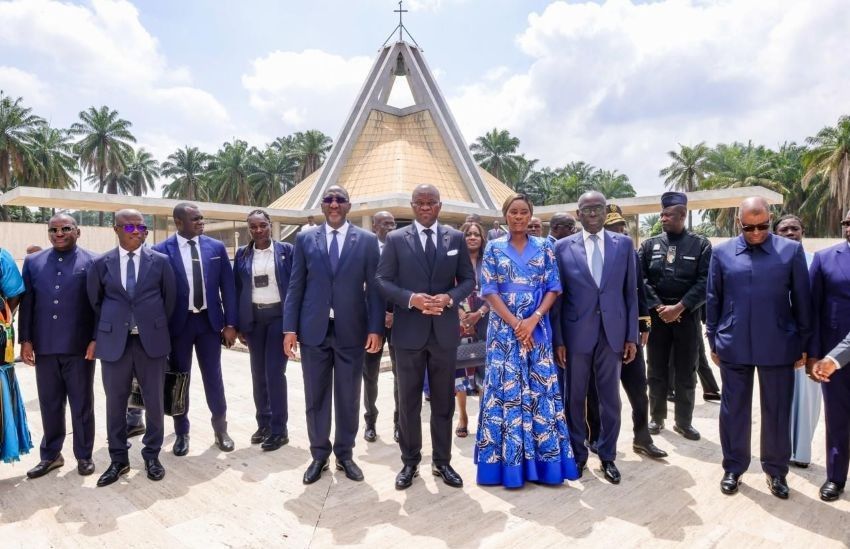
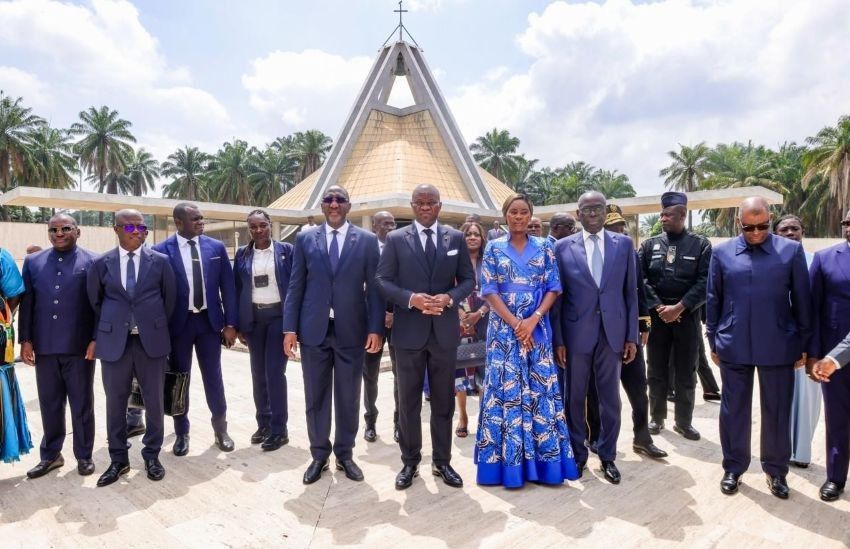
Libreville, August 6, 2026 — The state visit of Gabonese President Brice Clotaire Oligui Nguema to Yamoussoukro transcended standard diplomatic protocol. By honoring the legacy of Félix Houphouët-Boigny at his final resting place and visiting the Basilica of Our Lady of Peace, the leader charted a course for a deeper Ivorian-Gabonese relationship rooted in shared history and mutual aspirations.
The presidential delegation, including First Lady Zita Oligui Nguema, arrived in Côte d’Ivoire’s political capital on August 5, where they were received by national, political, and traditional leaders. This visit coincides with Côte d’Ivoire’s 66th Independence Day celebrations, to which President Alassane Ouattara had extended an invitation to Libreville.
The selection of Yamoussoukro was deliberate. The city houses the resting place of Félix Houphouët-Boigny, Côte d’Ivoire’s founding president and a towering figure in African political history. By laying a wreath at the mausoleum, President Oligui Nguema paid homage to a statesman revered as both a nation-builder and a champion of peace. The gesture also underscored the enduring bonds between Gabon and Côte d’Ivoire, forged through decades of diplomatic friendship, cooperation, and solidarity.
Honoring a legacy that resonates across Africa
Addressing traditional leaders in Yamoussoukro, the Gabonese president emphasized the broader significance of this tribute. Beyond commemorating an Ivorian icon, the act symbolized a vision of African governance centered on longevity, memory preservation, and the pursuit of peace as a cornerstone of stability. In a continent often challenged by political volatility, such gestures carry weight far beyond bilateral relations.
The visit aligns with Gabon’s broader diplomatic strategy to strengthen ties across Africa. President Oligui Nguema’s tour reflects a commitment to building new bridges and leveraging regional cooperation to advance Gabon’s national interests. His participation in Côte d’Ivoire’s national festivities on August 7 will include both institutional and cultural representation. High-ranking Gabonese military officers trained in Côte d’Ivoire will join the celebrations alongside delegates representing the country’s indigenous communities—a testament to Gabon’s rich diversity in a gathering that unites multiple African nations.
From remembrance to a call for unity
The day’s most poignant moment unfolded at the Basilica of Our Lady of Peace, one of Africa’s most striking religious landmarks. Inspired by St. Peter’s Basilica in Rome and constructed between 1986 and 1989, the site stands as a monument to faith and dialogue. The Gabonese delegation toured the basilica before observing a moment of reflection.
In the visitor’s book, President Oligui Nguema inscribed a message calling for unity, dialogue, and solidarity among African peoples to forge a stronger, more prosperous continent. This choice of words was no coincidence. It bridged the homage to a leader synonymous with peace and the spiritual significance of the basilica—a place where faith and hope converge.
This diplomatic approach goes beyond transactional engagements. It leverages shared symbols, historical narratives, and collective aspirations to foster closer ties between peoples. For both Libreville and Abidjan, the relationship carries deep historical significance. The challenge now is to translate this historical closeness into tangible outcomes across economic, diplomatic, cultural, security, and humanitarian spheres. President Oligui Nguema’s visit to Yamoussoukro signals a new chapter in this partnership.
By paying tribute to Houphouët-Boigny and invoking the values of fraternity and solidarity from the Basilica of Our Lady of Peace, the Gabonese leader delivered a message that transcends Côte d’Ivoire’s national celebration. The underlying intent is clear: for Gabon, the relationship with Côte d’Ivoire is part of an enduring African narrative, but it must now serve as a foundation for broader, more ambitious, and forward-looking continental cooperation.