The perils of unchecked authority have long been a recurring theme in the annals of military coups and post-coup governance. A persistent trap awaits those who ascend to power through force: mistaking rhetorical dominance for tangible control, and misinterpreting public silence—often born of fear or uncertainty—as unwavering support.
In Burkina Faso, this dynamic appears to be unfolding with increasing clarity. Beneath the carefully staged appearances, the polished military uniforms, the denunciations of the ‘treacherous West,’ and the relentless warnings against ‘anti-revolutionary’ behavior, a different narrative is taking shape. The once self-assured image of leadership is gradually giving way to a regime grappling with mounting internal fractures.
From unity to suspicion: the erosion of trust
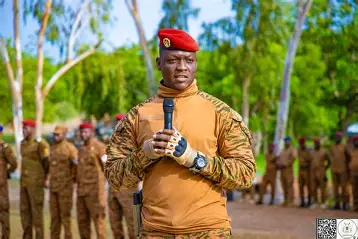
Critics of Captain Ibrahim Traoré argue that his leadership is becoming increasingly isolated. The once-solid foundation of trust within the military and security apparatus seems to have eroded, replaced by an atmosphere of growing mistrust. This shift is underscored by persistent rumors of destabilization attempts, frequent reshuffles within the military hierarchy, and successive reorganizations of the security apparatus.
As one analyst succinctly observed, ‘When a regime begins to fear its own guards, it is no longer the nation it protects, but its own shadow.’
The purge of early allies
Historical precedents across Africa and beyond reveal a recurring pattern: those who enable a power transition often become the first targets of suspicion once the new leader consolidates control.
Since assuming office in September 2022, Captain Traoré has overseen multiple reshuffles within the military and security chains of command. Several influential officers from the early days have been sidelined, transferred, or removed, fueling concerns about the cohesion of the armed forces. The dismissal of the intelligence services director—widely regarded as a cornerstone of the security framework—has drawn particular attention. Analysts suggest that when a head of state begins to reshape the very institutions tasked with ensuring his safety, it signals a profound loss of confidence within his inner circle.
In such circumstances, the crisis transcends mere security concerns; it becomes inherently political. The Burkina Faso armed forces, once united in their fight against armed groups, now appear fractured by suspicion. Promotions and replacements driven by personal loyalty rather than operational experience risk undermining both effectiveness and morale.
Governance through fear
Facing persistent security challenges, the regime has adopted an increasingly rigid political stance. Critics highlight several troubling developments:
- Arrests of figures openly critical of the government;
- Reports of disappearances and abductions, as documented by human rights organizations;
- Restrictions on media outlets, including suspensions and constraints on journalists;
- Pressures on civil society actors, perceived by their supporters as retaliatory measures.
These trends have been repeatedly flagged in international human rights reports, which warn of a significant erosion of public freedoms in Burkina Faso. Concurrently, state-controlled media and pro-government communication channels amplify the image of the head of state through frequent coverage of his movements, speeches, and initiatives. Opponents argue that this strategy does not reflect unchallenged authority but rather an attempt to compensate for the regime’s vulnerabilities by controlling the narrative.
Security failures overshadow political consolidation
The most pressing challenge remains unchanged: nearly four years after the coup, the issues that justified it persist. Large parts of the country remain under the sway or direct threat of armed groups. The humanitarian crisis continues to deepen, with millions displaced and the civilian population bearing the brunt of insecurity. Attacks targeting civilians, defense forces, and local militias remain a regular occurrence.
Critics contend that the regime’s growing preoccupation with political consolidation is diverting attention from the urgent need to address security and humanitarian crises. Official data from United Nations agencies, humanitarian organizations, and research centers confirms that despite intensified military efforts, the security situation remains dire. Jihadist attacks continue to destabilize multiple regions, while internal displacement rates remain among the highest in the subregion.
The peril of isolation
Patriotic rhetoric, no matter how compelling, cannot substitute for tangible results. Slogans do not restore security, rebuild institutions, or rebuild trust between the state and its citizens.
Observers warn that the greatest risk now lies in the growing isolation of the junta leader. By cutting ties with former allies, repeatedly reorganizing security structures, and governing under a cloud of perpetual suspicion, Captain Traoré risks weakening the very foundations of his authority. Historical examples across the continent demonstrate how military regimes that concentrate power in an ever-narrowing circle ultimately falter—not due to external opposition, but because of internal distrust.
The true challenge for Burkina Faso remains unchanged: to restore lasting security, rebuild institutional trust, and meet the needs of a population that continues to suffer the human cost of instability. When a government expends more energy on preempting conspiracies than on resolving the crises that brought it to power, it risks elevating political survival above the national interest—with potentially devastating consequences.