Burkina Faso: Apollinaire Kyélem de Tambèla barred from leaving the country under Ibrahim Traoré
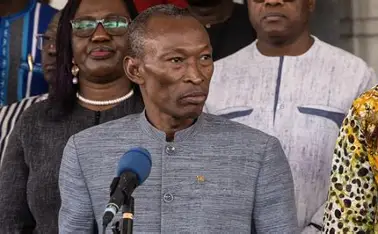
Apollinaire Kyélem de Tambèla, a former prime minister of Burkina Faso, has been prohibited from leaving the country by the authorities led by Captain Ibrahim Traoré. The measure marks another step in the tightening grip of the transitional government over selected political and public figures.
A former prime minister under travel restrictions
Kyélem de Tambèla was appointed prime minister by Ibrahim Traoré in October 2022 and led the Burkinabè government until his departure in December 2024. His exit ban comes at a time when he no longer holds any government position. The decision therefore raises a fundamental question: why do the authorities now consider it necessary to restrict his movements?
Liberties and the rule of law in question
Beyond the personal case of the former prime minister, the affair directly concerns the state of public freedoms in Burkina Faso. A travel ban is a significant measure, and when it is applied to a figure who has held the highest offices of the state, it deserves clear and transparent justification.
The context makes the decision even more sensitive. Since Ibrahim Traoré came to power, the Burkinabè authorities have justified several exceptional measures by the fight against terrorism, the defence of sovereignty and the need to prevent attempts at destabilisation. Kyélem himself had publicly mentioned, while he was prime minister, the existence of several attempts targeting the transitional government.
Unanswered legal questions
But the security argument does not answer every question. Should a restriction of freedom be limited in time? On what legal basis does it rest? Who ordered it? And what are the precise charges or reasons invoked against the former prime minister?
Burkinabè legislation governs the conditions for leaving the national territory. The issue is therefore to know within what precise legal framework the measure targeting Kyélem de Tambèla was taken.
A broader test for the transition
The affair now goes beyond the sole trajectory of the former prime minister. It raises a wider question about the nature of the transitional power: how far can it go in the name of national security without further weakening individual freedoms?
For Ibrahim Traoré, the decision risks above all fuelling the debate on the shrinking political space in Burkina Faso. Preventing a former government figure from leaving the country is never a politically neutral act.
In Ouagadougou, the Kyélem de Tambèla case could therefore become a new indicator of the relationship between security, political control and public freedoms under the military transition.