The arrest of two French nationals exposes a deeper governance failure
Two French citizens were recently detained in northern Togo and charged within days, their case seemingly dictated by an order from Faure Gnassingbé himself. The Togolese president allegedly instructed Justice Minister Pacôme Adjourouvi to « resist any external influence » in their prosecution—a directive that underscores a troubling erosion of democratic norms.
Beyond the diplomatic fallout, this incident exposes a far more dangerous trend: the unraveling of Togo’s institutional framework. The question now looms large: Who truly governs the country, and under what authority?
A constitutional facade conceals authoritarian rule
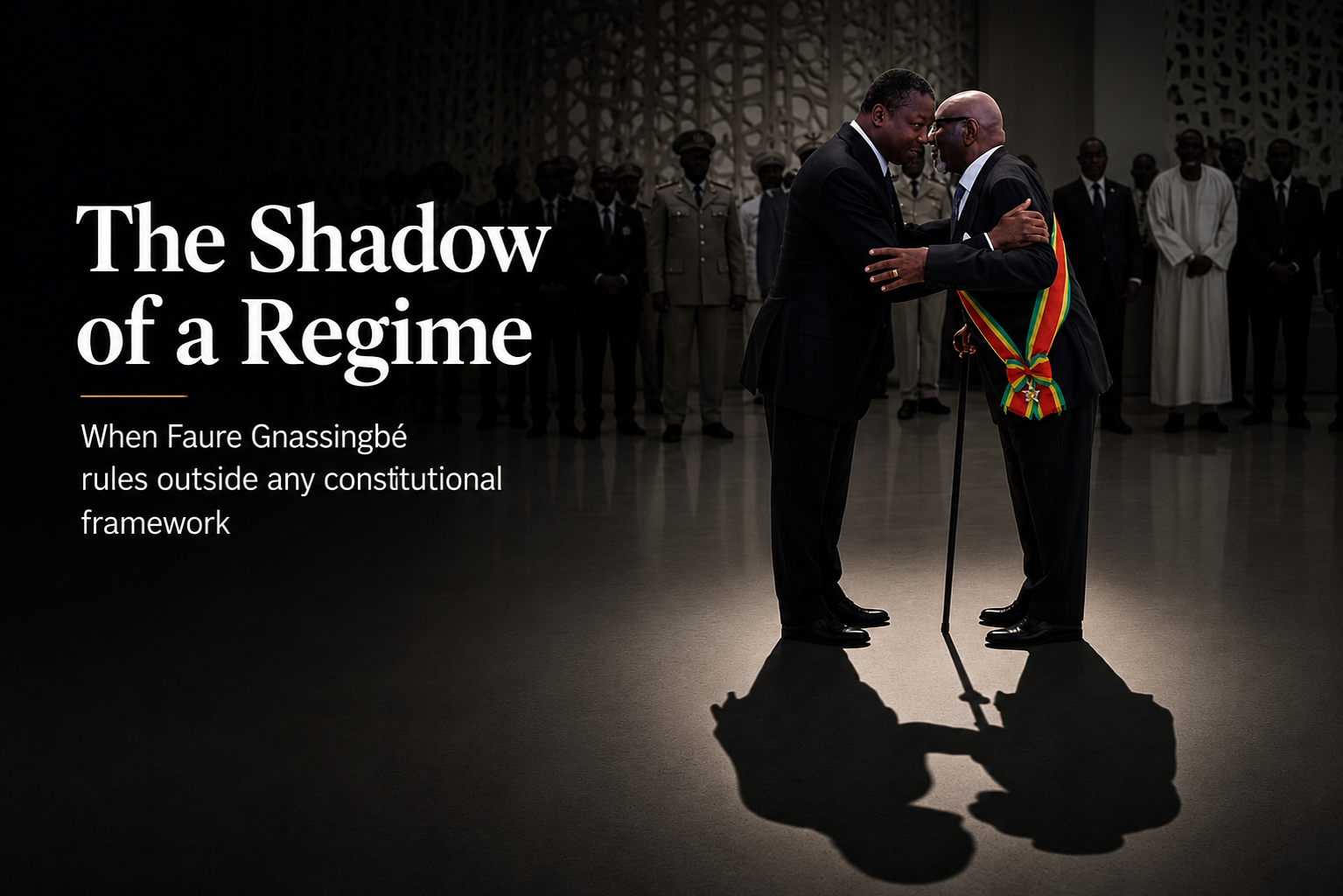
Faure Gnassingbé no longer holds the title of president in any meaningful sense. Through a carefully engineered constitutional amendment and the creation of a symbolic presidency, he has reshaped the government into a hybrid system where real power resides elsewhere. A ceremonial head of state now occupies the presidency, while Gnassingbé himself serves as « president of the Council »—a role with sweeping executive authority, including command of the armed forces, foreign policy, and civil service appointments.
The 2024 constitutional overhaul, pushed through by the ruling UNIR party’s overwhelming parliamentary majority, abolished term limits for the president of the Council. With opposition parties boycotting the flawed 2024 legislative elections, the outcome was predetermined. This is no democratic transition—it is the entrenchment of dynastic rule under a new institutional guise.
Institutions stripped of independence
The case of the detained journalists—Sébastien Perez Pezzani and Gaël Mocaër—is not an isolated incident. It reflects a pattern where intelligence services and prosecutors act on direct orders, rendering judicial independence obsolete. The alleged instruction to « resist any pressure » reveals a command chain that bypasses the judiciary entirely. When the head of government dictates legal proceedings, the separation of powers is a charade.
This pattern extends to the suppression of protests, the targeting of dissenting voices, and the selective enforcement of laws. The legal system has become an extension of political control, wielded or disregarded based on convenience.
A legitimacy crisis fueled by unchecked power
Who, then, truly governs Togo? The answer is clear: a leader who inherited power in 2005, consolidated it over two decades, and now reshapes institutions to retain it indefinitely. No referendum was held to validate the 2024 constitutional changes. Elections were conducted amid widespread boycotts and accusations of irregularities. Even the Senate, with a third of its members appointed by Gnassingbé, reinforces his dominance.
This is not a transition—it is the perpetuation of personal rule disguised as institutional reform. Titles change, procedures multiply, but the center of decision-making remains unchanged: Faure Gnassingbé, as president of the Council, leader of the majority, commander of the armed forces, and final arbiter of the nation’s fate.
The fragility of a system built on arbitrariness
When institutions become hollow shells, when justice bends to political will, and when the rule of law is subordinated to the whims of power, the social contract frays. Togo is no longer grappling with a mere constitutional dispute—it faces a regime that has consciously abandoned republican stability in favor of unchecked authority.
The question is no longer « who governs? » but rather: how long can such a system endure before internal contradictions and public pressure force its collapse?