Burkina Faso’s justification strategy amid RSF allegations
Ouagadougou’s response to RSF accusations
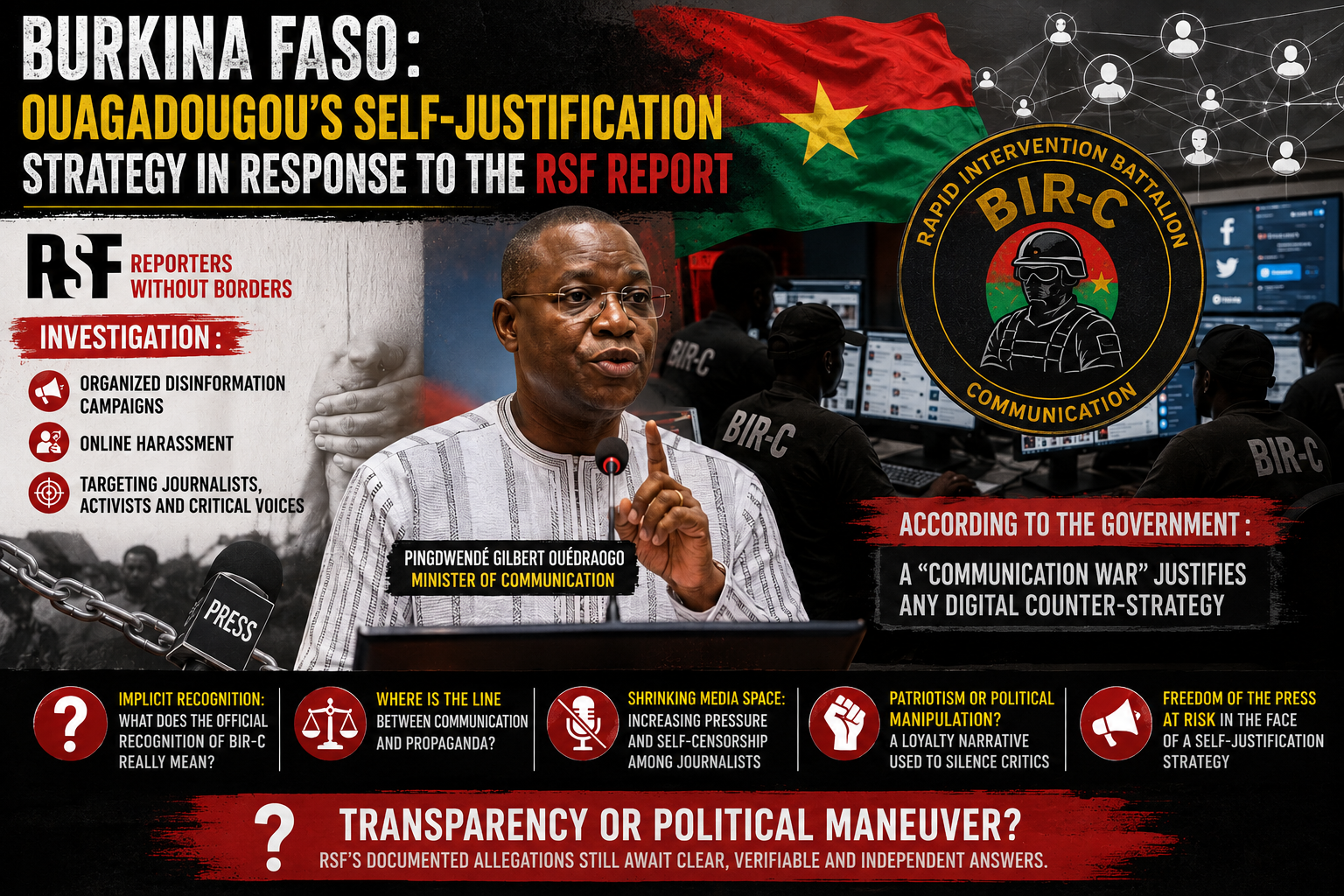
The Burkinabè authorities continue to adopt a defensive stance rather than engaging in transparent dialogue when addressing criticism. During the national flag-raising ceremony on August 3, Communication Minister Pingdwendé Gilbert Ouédraogo highlighted the role of the Rapid Intervention Battalion-Communication (BIR-C), framing it as a protective shield against digital disinformation. Yet this public endorsement, rather than clarifying the unit’s functions, has deepened concerns about its true objectives.
Undisclosed digital operations under scrutiny
The government’s acknowledgment of the BIR-C’s existence comes at a critical juncture, following an investigation that exposed a coordinated network of online accounts allegedly orchestrating smear campaigns, harassment, and targeted attacks against journalists, activists, and government critics. Instead of addressing the allegations directly or initiating an independent probe, officials chose to publicly champion the BIR-C, fueling speculation about its covert activities.
Alleged tactics of influence
The inquiry details how these accounts systematically amplify pro-government narratives while systematically undermining dissenting voices. The authorities deny wrongdoing, yet their decision to publicly defend the BIR-C—rather than refuting the documented evidence—has intensified debates over the blurred line between state communication and political propaganda.
A narrative of external threats
Government officials assert that Burkina Faso faces an orchestrated ‘communication war’ waged by foreign actors seeking to destabilize the nation. Within this framework, any digital strategy deployed to counter such threats is framed as a patriotic duty. However, this justification raises a pressing question: where does legitimate crisis communication end, and where does the suppression of press freedom begin?
Freedom of expression in a polarized climate
While countering manipulation campaigns is a valid concern for states, international standards on free expression prohibit targeted harassment, defamation, or intimidation of journalists. When dissent is routinely equated with treason, public discourse narrows, and self-censorship becomes a survival tactic for many media professionals.
This controversy unfolds against a backdrop of suspended international outlets, growing pressure on reporters, and a shrinking media landscape in Burkina Faso. Critics argue that such developments foster an environment where silence becomes a form of self-preservation.
Patriotism as a shield against criticism
The minister’s remarks reflect a political counteroffensive rather than an effort to clarify facts. By framing BIR-C members as national heroes, authorities shift the debate from operational accountability to blind allegiance. This tactic reframes legitimate scrutiny as an attack on the state itself, deflecting attention from the unit’s reported methods.
A functioning democracy, even under severe security constraints, must tolerate scrutiny from the press and civil society. Dismissing documented allegations with patriotic rhetoric does not resolve doubts; it may instead reinforce perceptions of institutional opacity.
The broader implications for digital governance
The controversy extends beyond the BIR-C, raising fundamental questions about how Burkina Faso manages information in the digital age. Social media has become a battleground for political narratives, but when power-adjacent structures wield these platforms, their operations must adhere to transparency, human rights, and press freedom principles.
The current impasse underscores a deliberate choice: responding to criticism with nationalist mobilization rather than factual rebuttals and open dialogue. Until the documented allegations are addressed with verifiable, independent responses, official statements risk being dismissed as mere justifications for a communication apparatus shrouded in secrecy.