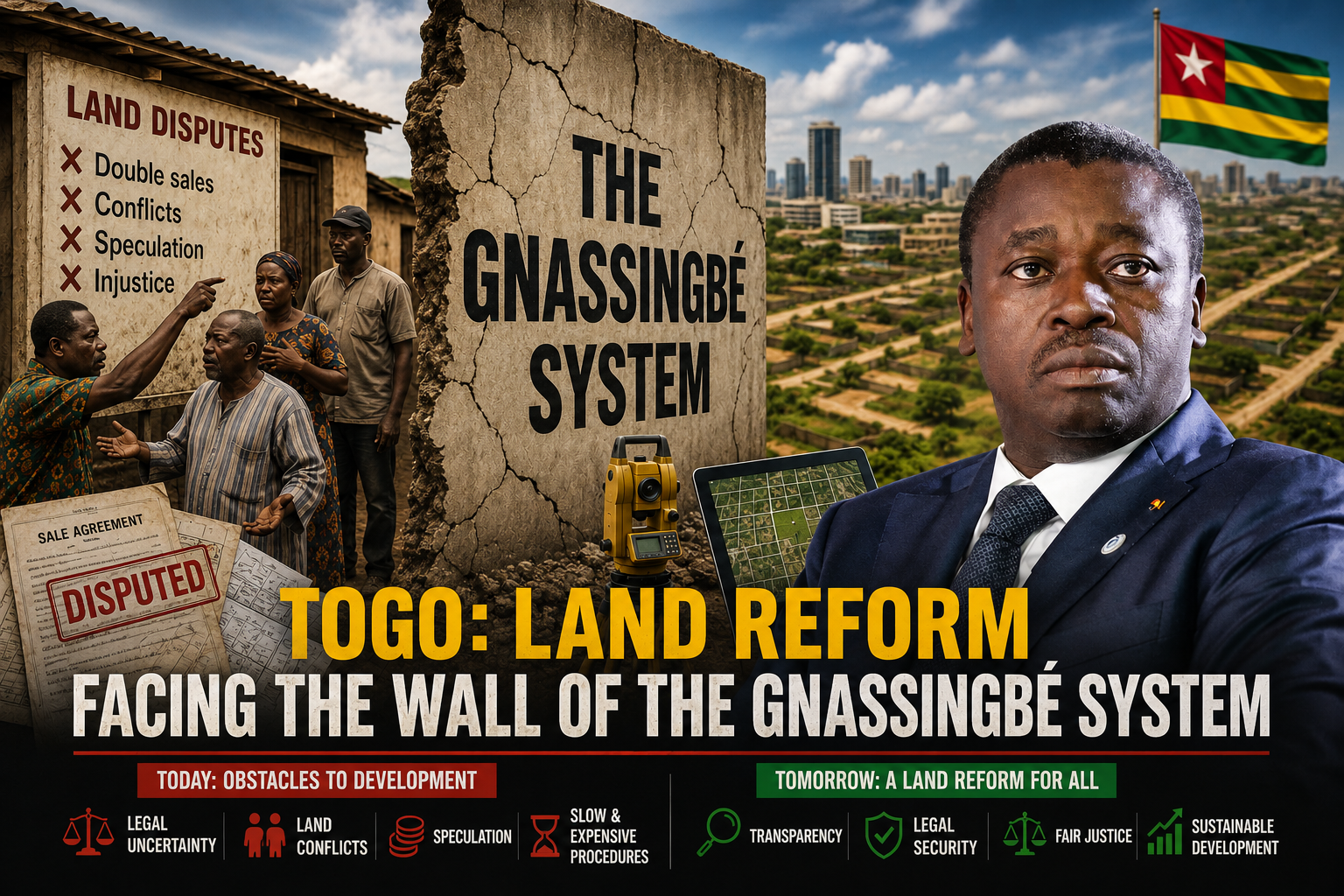
For over sixty years, land management in Togo has been plagued by inconsistent policies, leaving the sector in a state of perpetual instability. Today, the government presents an ambitious agenda to overhaul this framework, positioning land reform as a cornerstone for economic growth. Yet, beneath the surface of this well-intentioned proposition lies a complex web of systemic challenges that threaten to undermine progress before it even begins.
Systemic flaws that perpetuate land disputes
At the heart of the issue is the endemic problem of property disputes, fueled by a combination of factors. Duplicate sales, contested ownership claims, inadequate record-keeping, and opaque transaction processes have created an environment where legal security remains elusive. A land title or purchase deed does not always guarantee protection, as the same plot can be subject to competing claims, leaving buyers vulnerable to financial loss and legal ambiguity. This persistent uncertainty discourages investment, weakens household savings, and transforms land ownership into a precarious financial burden.
Administrative hurdles and unequal access
The bureaucratic maze surrounding land transactions further exacerbates the problem. Citizens and businesses alike face prolonged, costly, and often incomprehensible administrative procedures. When access to land information is restricted and transparency is lacking, those with financial means, political connections, or insider knowledge gain an unfair advantage. A successful reform must not only increase the issuance of land titles but also ensure that every citizen can verify a plot’s history before committing to a purchase.
The justice system’s pivotal role in resolving conflicts
Land disputes that drag on for years are more than just administrative nightmares they can devastate families, stall inheritances, and paralyze economic progress. Swift, equitable judicial resolutions are essential to prevent long-term damage. However, the credibility of land-related court decisions hinges on their impartiality, free from the influence of social, political, or financial pressures. Without a transparent, independent, and adequately resourced judiciary, no administrative reform can yield lasting results.
Political entanglements and the risk of reform failure
The land sector is a complex ecosystem involving customary landowners, families, intermediaries, surveyors, government agencies, and local authorities. When certain actors are closely tied to dominant political or economic networks, conflicts of interest and favoritism thrive. A credible reform must dismantle these gray areas rather than perpetuate them under new guises. Transparency in decision-making processes is non-negotiable to restore public trust.
In urban and peri-urban zones, where land values are rapidly escalating, speculative pressures exacerbate the problem. Wealthy investors and unscrupulous intermediaries often manipulate the system, pushing out low-income families who lack the capital to compete. Land, once a family legacy, becomes a speculative commodity accessible only to those with significant financial leverage.
Social tensions and the need for inclusive solutions
Land conflicts frequently pit relatives against each other, pitting neighbors or generations against one another in disputes over inheritance. Until customary land rights are harmonized with modern legal frameworks, these tensions will persist. A robust reform must incorporate mediation, conflict prevention, and public education on legal procedures to ensure fair outcomes for all.
Digitalization as a tool, not a panacea
While digitizing land records offers promise, it is not a cure-all. A reliable, accessible, and up-to-date database could significantly reduce duplicate sales and streamline verification processes. However, digital systems alone cannot correct fraudulent practices if the underlying data is incomplete, manipulable, or unevenly accessible. Transparency must extend to the institutions managing these records, including how parcels are allocated, who oversees transactions, and how violations are addressed.
The broader economic stakes of land reform
A secure land tenure system enables individuals to invest, businesses to expand, banks to assess collateral, and the state to plan infrastructure development effectively. Conversely, an unreliable system freezes capital, stalls projects, and fosters an environment of distrust. The stakes are far greater than individual property rights; they directly impact the nation’s ability to attract and secure investment.
The critical question is not whether Togo can implement another land reform, but whether it possesses the political resolve to enforce one. True transformation demands transparency, stringent penalties for fraudulent practices, a swifter judiciary, better-regulated administration, and stronger protections for vulnerable citizens. Without a genuine commitment to dismantling entrenched interests and prioritizing the rule of law, any reform risks becoming merely cosmetic. Until the protection of personal or partisan interests is subordinate to fairness and equality, land will remain a source of conflict rather than the economic catalyst it is meant to be.