South Africa at a crossroads after brutal Durban mob killing
A shocking mob attack in Durban has thrust South Africa into a decisive turning point in its fight against xenophobic violence. The African Commission on Human and Peoples’ Rights has issued a stark warning, suggesting the incident may constitute crimes against humanity — a claim requiring urgent national attention and action from Pretoria.
On October 22, 2026, a foreign national in his thirties was beaten to death by a mob of about fifty people in central Durban. According to South African police, the victim was assaulted on the side of a road and died at the scene. While his nationality and the exact circumstances remain under investigation, what is clear is that the murder occurred amid growing anti-immigrant sentiment across the country.
The killing has not only intensified public outrage but also triggered a wave of condemnation from human rights institutions, including the African Commission on Human and Peoples’ Rights (ACHPR), which declared the attack a potential crime against humanity. This legal framing underscores the gravity of the situation and places the South African government under unprecedented pressure to address a long-standing crisis.
When hatred turns deadly: the rise of xenophobic violence in South Africa
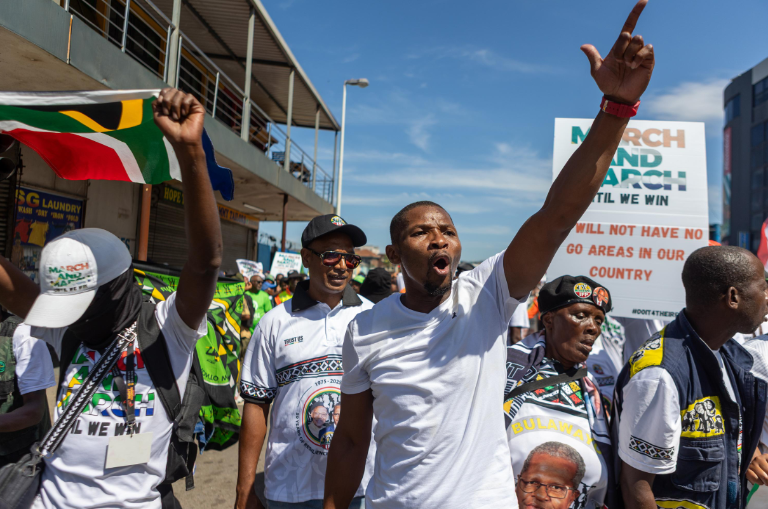
The Durban murder is not an isolated incident. It is the latest and most violent expression of a growing wave of xenophobia sweeping across South Africa. For months, public discourse has been dominated by anti-immigrant rhetoric, with activist groups organizing protests and calling for the expulsion of undocumented foreigners. These groups claim immigrants are responsible for rising unemployment, crime, and pressure on public services — a narrative that resonates in a country grappling with deep economic inequality and limited job opportunities.
However, such claims cannot justify vigilante violence, intimidation, or mob killings. Responsibility for crime rests with individuals, not entire communities based on nationality or origin. Durban, South Africa’s third-largest city, has emerged as a flashpoint for these tensions. Recent protests against migrants have escalated into violent clashes, looting, and the destruction of businesses. The events of the past weeks reveal a dangerous shift from policy debate to collective violence — a descent that threatens to normalize the targeting of foreign residents.
National duty: protecting all lives, regardless of status
The South African Human Rights Commission has also condemned the Durban killing, characterizing the circumstances as potentially constituting a crime against humanity. It emphasizes that every person within South Africa’s borders — regardless of nationality or migration status — is entitled to constitutional protection, including the right to life. The government now faces a critical dual mandate: to address concerns about irregular migration while upholding the rule of law and protecting all residents from violence.
An effective response must include credible, swift, and transparent investigations leading to prosecutions. Such accountability is essential not only to deliver justice for the victim but to deter future acts of mob justice. Failure to act decisively risks reinforcing perceptions of impunity and emboldening further aggression.
Legal consequences send a powerful message. When mob violence goes unpunished, it normalizes the idea that groups can take the law into their own hands — a dangerous precedent in any democratic society.
A continental reckoning: can Africa stand united against xenophobia?
The Durban tragedy challenges the very foundations of the Pan-African project. How can the continent promote regional integration, free movement, and solidarity when African citizens are being attacked in another African country because of their nationality? The irony is striking: South Africa’s struggle against apartheid was supported by many African nations. Today, the specter of xenophobia threatens to erode that legacy of solidarity.
The African Commission’s intervention is not just moral — it is a reminder of a shared responsibility. Protecting human life must transcend national borders. Its call to Pretoria extends beyond condemnation: it demands that political leaders, civil society, and institutions confront hate speech, defend vulnerable communities, and restore the primacy of the rule of law.
From outrage to action: the path forward for South Africa
The killing in Durban cannot be dismissed as an isolated tragedy. It is a national wake-up call — one that demands a coordinated, high-level response. The African Commission’s warning serves as a catalyst for change, urging Pretoria to elevate the fight against xenophobia to a national priority. This means implementing robust anti-hate policies, supporting community dialogue, and reinforcing public institutions charged with protecting human rights.
Justice must be swift and certain. Investigations must be thorough, impartial, and transparent. Only then can South Africa begin to heal the deep divisions exposed by this crisis. The memory of apartheid teaches that collective survival depends on inclusion — not exclusion; on protection — not persecution.
For the people of South Africa, and for the continent, the time for decisive action is now. The life lost in Durban must not be in vain. It must serve as the turning point that finally steers the nation — and the region — away from the darkness of xenophobia and toward a future of dignity and shared humanity.