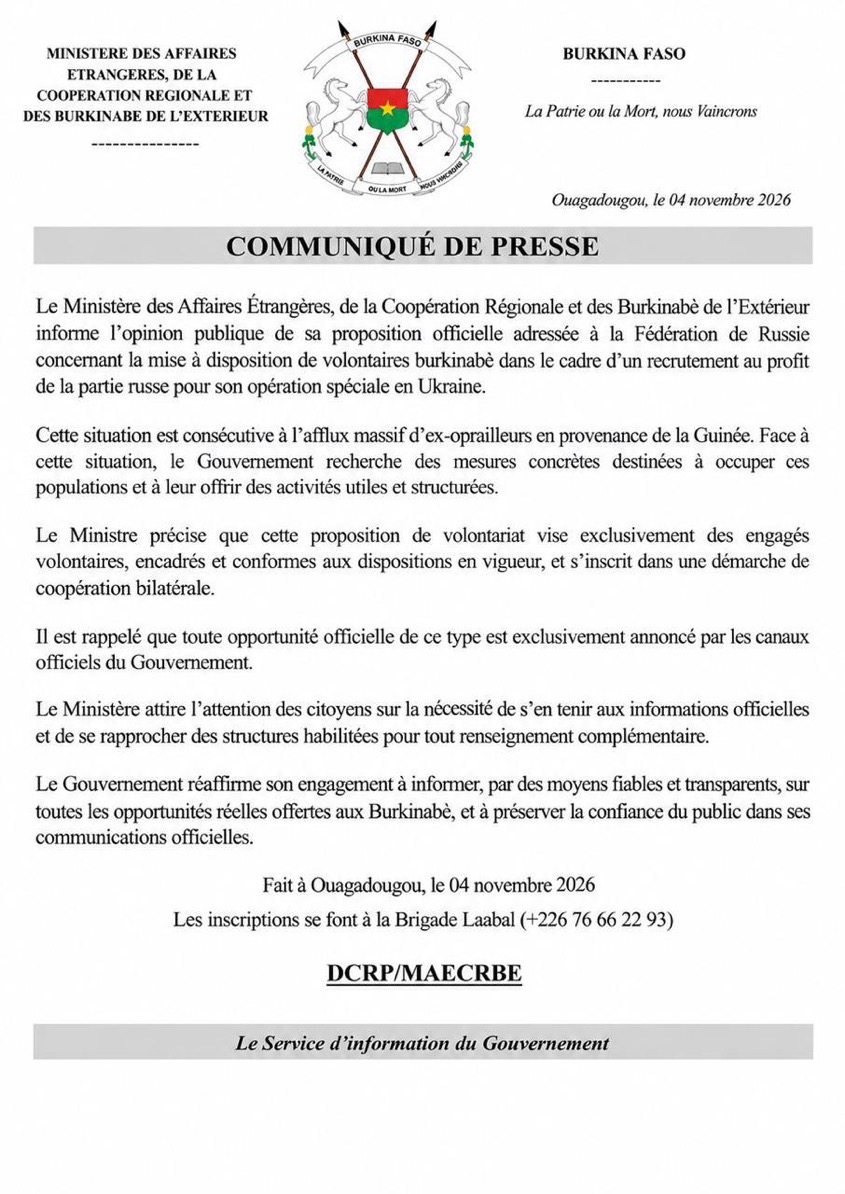
The Burkina Faso-Russia alliance has taken a controversial turn, with reports suggesting Ouagadougou may be offering Moscow the services of recently deported Burkinabè gold miners to fight in Ukraine. This potential deal raises urgent questions about the true nature of the cooperation and the fate of individuals whose lives have already been uprooted by expulsion and economic hardship.
From expulsion to potential enlistment: a troubling transition
The men in question are Burkinabè nationals who were expelled from Guinea after engaging in clandestine gold mining. Their return to Burkina Faso, ostensibly for humanitarian assistance, may instead be a precursor to recruitment for a foreign conflict. The timing and scale of their mobilisation suggest a coordinated effort with broader implications than mere repatriation.
If these individuals are indeed being positioned as potential recruits, their vulnerability becomes a critical factor. Expulsion has left many without livelihoods, and the promise of income or security real or perceived could influence their decision-making in ways that complicate the voluntariness of any military commitment.
The geopolitical calculus behind the proposal
The Burkina Faso-Russia partnership has deepened in recent years, with the latter positioning itself as a key security ally for Ouagadougou. Russia’s ongoing war in Ukraine has created a pressing need for additional personnel, and the potential enlistment of Burkinabè deportees presents a cost-effective if ethically fraught solution. However, this approach blurs the line between strategic cooperation and the exploitation of displaced populations.
For Moscow, these men represent disposable manpower; for Burkina Faso, their deployment could serve as a litmus test of loyalty in an increasingly polarised international arena. Yet the human cost of such calculations remains unaddressed.
The missing safeguards: consent and transparency
Any proposal to recruit expelled miners for combat must confront difficult questions: Have they been fully informed of the risks, terms, and duration of service? Is their consent genuinely free, or is it a desperate response to economic desperation? What protections are in place to ensure their well-being and return, if desired?
The absence of clear answers underscores a troubling reality: a sovereign nation’s duty to protect its citizens must take precedence over strategic expediency. The authorities owe the public and the deportees themselves a transparent explanation of the arrangements, if they exist.
The humanitarian cost of a shifting alliance
Behind the diplomatic posturing lies a human crisis. These miners were already victims of expulsion, their lives disrupted by sudden loss of income and stability. Now, they may be funneled toward frontlines thousands of kilometres away, with little guarantee of safety or ethical treatment.
If their movement from Guinea to Burkina Faso and potentially onward to Ukraine is part of a recruitment pipeline, then the true intent of their mobilisation is laid bare. This is not merely a matter of foreign policy; it is a test of whether Burkina Faso’s leadership prioritises the lives and dignity of its people over the demands of its military partners.
Sovereignty in question: where does responsibility end?
Burkina Faso’s leadership has framed its pivot toward Russia as an assertion of independence, rejecting former alliances in favour of new strategic partnerships. But true sovereignty is measured not by the rejection of old ties, but by the protection of citizens in all circumstances.
The proposal to send deportees to Ukraine forces a confrontation with this principle. Are these individuals being given a second chance, or are they being treated as expendable assets in a broader geopolitical struggle? The answer will define whether Ouagadougou’s diplomatic choices are guided by strategy or by the wellbeing of its people.
Unanswered questions and the road ahead
As details emerge about the mobilisation and potential recruitment of Burkinabè deportees, the most pressing concern is not geopolitical alignment, but ethical accountability. What assurances exist that their participation would be voluntary, informed, and reversible? How will their safety and rights be guaranteed in a warzone half a world away?
Without clarity, the Burkina Faso-Russia partnership risks becoming synonymous with exploitation rather than cooperation. And the deportees at the centre of this crisis will bear the consequences of decisions made in distant corridors of power.
By François Mvondo — Journalist