Gabon’s presidential engagements, national pride, and the unfolding public service reform debate
President Brice Clotaire Oligui Nguema has concluded his diplomatic tour of West Africa, which included stops in Ghana, Gambia, Sierra Leone, and Côte d’Ivoire. A highlight of this journey was his participation as a distinguished guest of honor at Côte d’Ivoire’s 66th independence anniversary celebrations, hosted by his counterpart, President Alassane Dramane Ouattara.
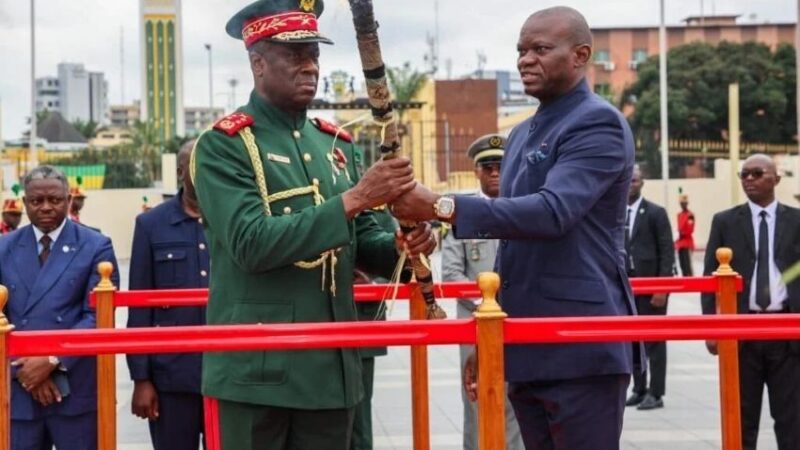
During his visit, the Gabonese leader, accompanied by First Lady Zita Oligui Nguema, engaged in vital discussions with his host and convened with Gabonese citizens residing in the country. He also attended the commemorative parade, observing with evident pride the impressive performance of the Gabonese Republican Guard unit, under the command of Brigadier General Antoine Balekidra.
A nation united: Gabon celebrates national flag day
Another significant event marking the past week was the 17th annual National Flag Day, observed under the poignant theme: “One Flag, One United Nation, Together We Build the New Gabon.”
This patriotic occasion saw celebrations unfold across the entire nation. In Libreville, the official ceremony took place at the Presidential Palace, graced by the presence of the presidential couple, members of the government, and heads of constitutional institutions. The vibrant event featured numerous highlights, including an address by the Minister of Cultural Outreach, Ulrich Kessany.
The choice of August 9th for the celebration of the Gabonese flag (Green-Yellow-Blue) holds historical significance. It commemorates the day, August 9, 1960, when the national flag was first raised, preceding Gabon’s declaration of independence by just a few days.
Public administration reform: A crucial national discussion
Beyond the ceremonial, the proposed reform of Gabon’s public administration also dominated headlines last week. Minister of Public Service, Laurence Ndong, appeared on Gabon 1re to discuss the intricacies of this project. For over an hour, she elaborated on the objectives and implications of the reform, which seeks to revise two foundational texts governing the Gabonese Public Service: the General Statute of the Public Service and the General Statute of Civil Servants.
Minister Ndong clarified that these crucial texts are currently in their preliminary stages, awaiting examination by the Interministerial Council. Following this, they will proceed through the Council of Ministers, the Council of State, and the Economic, Social, Environmental, and Cultural Council (CESEC), before reaching the Parliament, encompassing both the National Assembly and the Senate.
Addressing criticisms from certain union and political leaders regarding the reform’s perceived “unilateral” nature, without adequate consultation with social partners, Minister Ndong asserted that such claims are unfounded. She emphasized that the draft texts will indeed be subject to scrutiny by the CESEC, which includes representatives from civil society, and will also undergo parliamentary review. These stages will provide ample opportunity for potential amendments.
At the heart of the reform lies a significant proposal: the shift from automatic career advancements to merit-based promotions, contingent upon performance evaluations. This particular aspect has ignited considerable debate. It appears the Minister’s explanations have yet to fully quell the concerns, suggesting the need for further initiatives to reassure stakeholders. The possibility of a televised debate, directly engaging those who challenge the government’s approach, has even been raised.
Laurence Ndong has expressed suspicions that some unionists may be engaging in misinformation and manipulation, potentially to create discord and then demand concessions. The status of the formal notice issued to unionist Pierre Mintsa, a prominent critic of the ministerial initiative, remains a point of interest amidst this ongoing dialogue.