La main qui gouverne le Cameroun
Publié le :
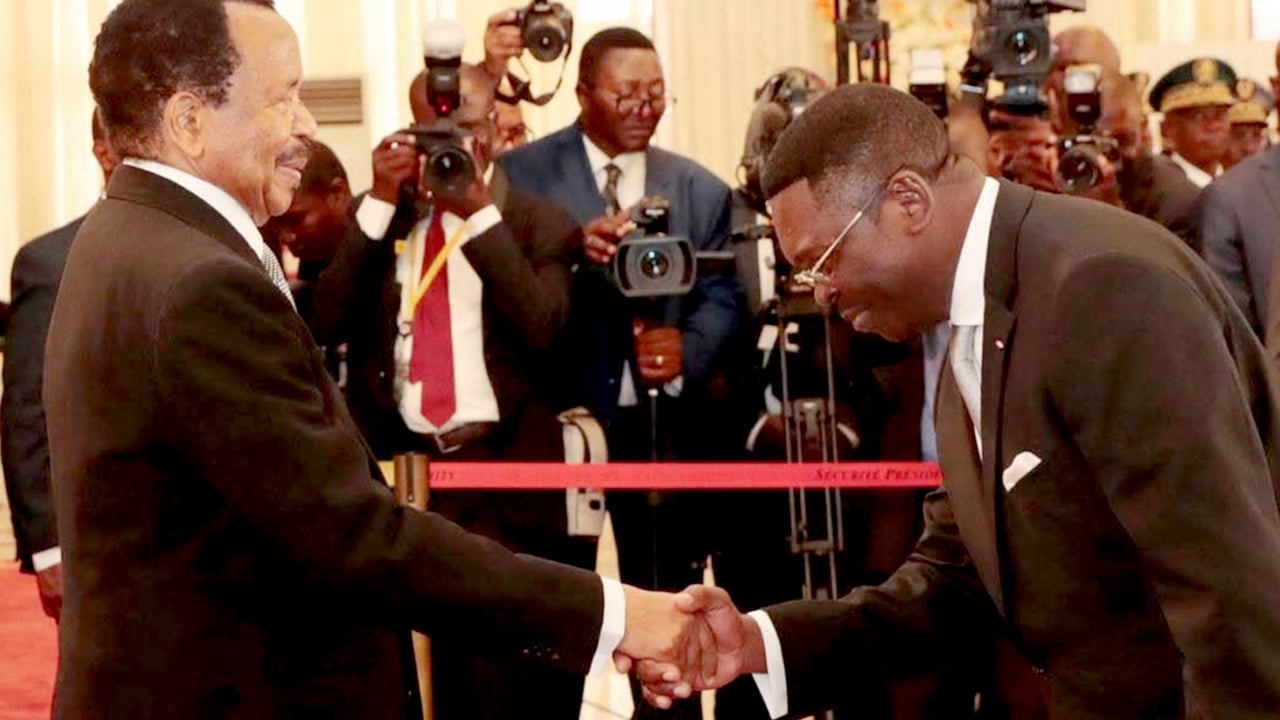
President Paul Biya’s recent return to Cameroon on Thursday, August 20, concluded an extended 74-day sojourn in Switzerland. Anticipating his arrival, citizens were met with a fleeting glimpse not of the president himself, but merely his hand, visible through the partially lowered window of the presidential limousine. This brief appearance immediately sparked discussion about the profound symbolism of power in Cameroonian politics.
The typical scene of the venerable leader descending the aircraft ramp, engaging in handshakes with the inner circle of Etoudi Palace, was notably absent. Instead, the public was presented with just a hand, an act far from trivial in the realm of political symbolism. The concept of the “hand” in political discourse carries four distinct interpretations: the hand that takes life, the hand that deceives, the hand that bestows blessings, and ultimately, the hand that wields governance.
The hand that kills
Historically, Roman arenas fell silent as crowds fixated on Caesar’s hand, its gesture determining life or death for gladiators. On Thursday, August 20, in Yaoundé, the dynamic was reversed. It was not the leader’s hand dictating fate, but rather the hand of the “gladiator” – President Biya – that served to reassure the nation of his continued existence. Cameroonians witnessed Biya’s hand waving, a tangible sign affirming his safe return.
The hand that cheats
When physical capabilities wane, a deceptive hand might compensate. Recall Diego Maradona’s infamous “Hand of God” goal against England in 1986: a clear handball, yet validated by the referee. Similarly, in Yaoundé this Thursday, the public observed only a single hand. Despite this limited visual, CRTV, Cameroon’s national television, with its extensive crew of 200 journalists covering the presidential motorcade, presented this singular appearance as a miraculous affirmation.
The hand that blesses
Within religious liturgy, the hand is a conduit of power: priests lay on hands, the Pope delivers Urbi et Orbi blessings, and monarchs are consecrated through anointing. Anointed, the hand transforms into a sacred relic. This Thursday, however, presented an inverted ritual: a relic-like hand appeared from behind a tinted window, reminiscent of a holy shrine paraded during festivals, intended to sustain the belief of the populace.
The hand that governs
This brings us to the ultimate manifestation: the hand that signs. Throughout his 74-day absence in Switzerland, assurances were given that the Cameroonian state remained fully operational. This continuity was attributed to the president’s hand, actively signing decrees, making appointments, and enacting laws. The hand, though separated from the physical presence of the body, was nonetheless functioning. This aligns with the ancient legal concept of manus, the Latin term for “hand,” which also signifies power or authority. Today, the traditional presidential address, the physical presence, and the walk across the tarmac are replaced by just two gestures: the signing hand and the waving hand.
While in ancient Rome, the hand dictated life or death, and in religious contexts, it conferred blessings, in Yaoundé, its primary message is the continued incumbency of its wielder. After 43 years in power, the people of Cameroon must now adapt to a governance seemingly orchestrated by a single hand, for a period that, though uncertain, is likely to be finite. Cameroonian journalist Marie Roger Biloa offered a more blunt assessment, stating that “Cameroon must brace itself for the definitive disappearance of a president who is already de facto absent.”