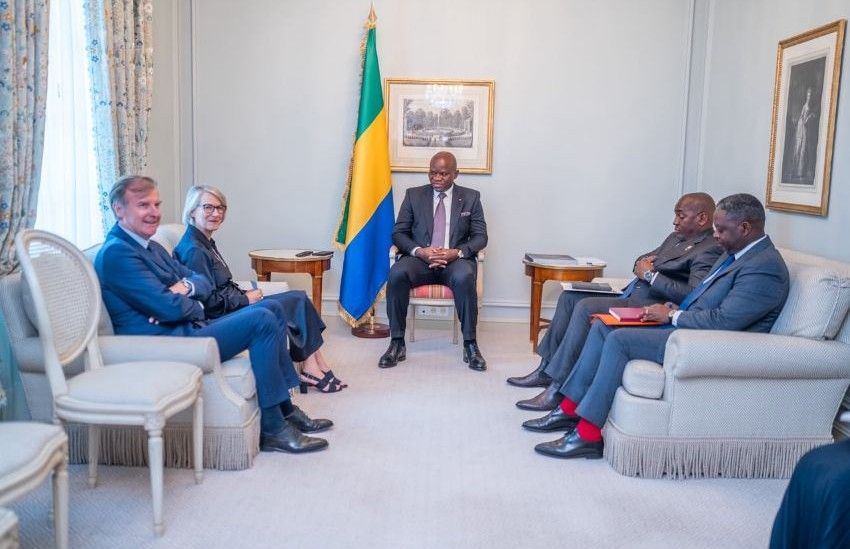
Libreville – The official visit of Gabonese President Brice Clotaire Oligui Nguema to Paris from July 19 to 22 was not merely a diplomatic showcase. Behind the ceremonial welcome at Les Invalides, the tour of Versailles, and the state dinner at Élysée Palace lay a strategic push to secure tangible economic commitments.
While the political symbolism was undeniable, Libreville’s primary goal was to secure economic agreements with measurable benefits for Gabonese citizens. Now that the delegation—comprising over 80 officials and private sector leaders—has returned, the focus has shifted to outcomes.
Until now, details about the French business leaders who met with the President remained scarce. However, new disclosures reveal key players involved and the scope of discussions, particularly in critical sectors like aviation, mining, and energy.
From air travel to manganese: transforming agreements into action
On July 19, President Oligui Nguema met with Anne Rigail, CEO of Air France, to advance aviation cooperation. The existing commercial ties between Air France and Gabon’s Fly Gabon could soon expand through a codeshare agreement, enabling Fly Gabon to sell tickets to Paris under its own branding—an initiative expected to be finalized by year-end. While no binding contract was signed, the progress signals improved air connectivity, a vital factor for business travel, tourism, and investment flows.
The next day, at Élysée Palace, mining took center stage. Eramet and its subsidiary Comilog engaged in talks with Gabonese authorities on a landmark protocol for local manganese processing. Under the leadership of CEO Christel Bories, the company presented a roadmap co-developed with Gabon’s government, aiming to process up to 700,000 tons of manganese locally by 2031.
This initiative includes exploring a ‘Made in Gabon’ fund and developing a biocharcoal sector. Yet, it’s crucial to note: these are preliminary frameworks, not finalized investments. For Gabonese citizens, the difference is stark—local manganese processing won’t become an economic reality until financing, infrastructure, and investment decisions are secured.
Booué hydroelectric project: a litmus test for energy transformation
Energy emerged as another priority, with Gabon, EDF Power Solutions, and Gabon Power Company agreeing to advance the Booué hydroelectric dam project on the Ogooué River. The facility aims to add 400 megawatts to Gabon’s grid, addressing a critical imbalance: despite vast hydroelectric potential, the country currently generates only about 700 megawatts—far below demand exceeding 1,000 megawatts.
While the Paris agreement set a development deal deadline of October 31, the project remains a work in progress. Monthly meetings are scheduled to push the initiative forward, making this timeline a pivotal moment for accountability.
Additionally, Omega Consortium, specializing in water and electricity infrastructure, was also engaged by the President to discuss expanding access to essential services—a pressing need nationwide.
What Gabonese citizens truly expect: tangible change
The Paris visit successfully identified partners, set deadlines, and launched key initiatives across mining, energy, water, security, and investment. Yet the real test lies ahead. Gabonese people are not concerned with the names of CEOs or the number of meetings held. They demand jobs, reliable electricity, improved water networks, enhanced mobility, and greater local value addition—all of which translate into measurable improvements in daily life.
The October 31 deadline for Booué, the anticipated air travel agreement by year-end, and progress on manganese processing will be closely watched. Economic diplomacy must now prove its worth not by the volume of signed documents, but by the real-world impact it delivers to Gabonese households.