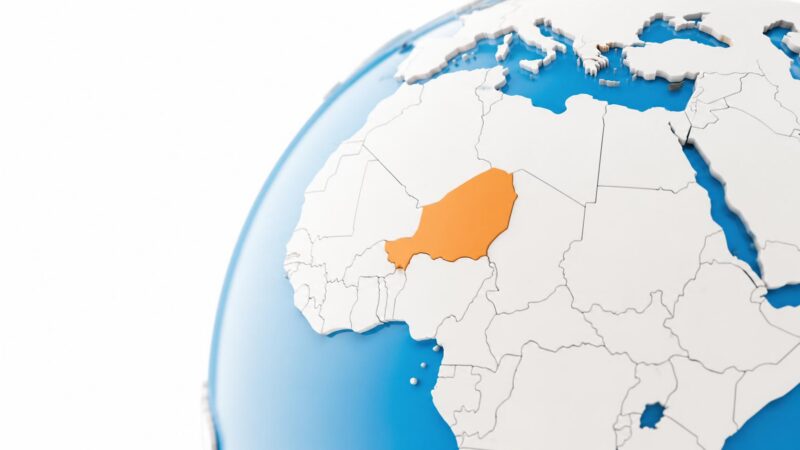
Niger’s agricultural dilemma: from western influence to russian chemical reliance?

In Niger, much like across the broader Sahel region, a clear mandate has emerged: to assert complete sovereignty, redefine historical partnerships with Western nations, and reclaim control over the national trajectory. This political stance resonates with a significant portion of the populace and is actively pursued on both diplomatic and security fronts.
However, a closer examination of agricultural value chains exposes a critical vulnerability. The nation’s food security and the inherent fertility of its soils remain largely dependent on imported mineral fertilizers and donations, primarily originating from Russia. By replacing traditional supply networks with synthetic inputs from Moscow, Niger risks merely exchanging one form of political reliance for a new kind of chemical servitude.
The new geopolitical entanglement
Nigerien agriculture, which sustains over 80% of the active population, grapples with Sahelian soils naturally deficient in nitrogen and phosphorus. To ensure viable yields for staple crops like millet, sorghum, and rice, the application of urea and NPK fertilizers has become an essential practice for farmers.
As Russia solidifies its position as a crucial supplier and strategic donor of fertilizers across West Africa, this targeted generosity serves as a potent lever of influence. By controlling access to these fundamental agricultural inputs, Moscow holds a direct key to Niger’s social stability and civil peace:
- A risk of logistical leverage: Any disruptions in maritime supply chains, reorientation of Russian exports, or fluctuations in global prices could immediately send shockwaves through Nigerien households, directly impacting food affordability.
- The illusion of autonomy: Vigorously pursuing political independence while simultaneously entrusting the fertility of agricultural lands to a single geopolitical bloc presents a paradox that is challenging to sustain in the long term.
The acidification trap: the ecological cost of synthetic fertilizers
Beyond the diplomatic implications, the reliance on imported mineral fertilizers presents a significant ecological and economic challenge for Nigerien farmers.
The extensive and repeated application of chemical nitrogen fertilizers, such as synthetic urea, accelerates the acidification of marl-sandy soils. This process devastates beneficial microfauna and degrades the soil’s structure. Such a phenomenon creates an ‘input trap’: as the soil becomes progressively depleted by chemical products, producers are compelled to increase imported fertilizer dosages just to maintain comparable yields. This creates a costly spiral, impacting both public finances and rural livelihoods.
For genuine sovereignty: embracing local solutions and agroecology
To ensure that the pursuit of sovereignty transcends mere rhetoric, Niger possesses underutilized internal and regional mechanisms:
- Leveraging Tahoua’s natural phosphate: The country holds local phosphate deposits which, when crushed and combined with organic matter, offer a sustainable and entirely national mineral amendment.
- Integrated agropastoral practices: The combination of local manure, composting, and traditional water and soil conservation techniques (such as Zaï and half-moons) can effectively rebuild humus without dependence on volatile global chemical markets.
- Regional synergy within the AES and ECOWAS: Harnessing the industrial capacity of neighboring West African nations, particularly Nigeria, to produce urea from natural gas provides a shorter, more resilient logistical alternative, less susceptible to extra-African geopolitical tremors.
A nation’s true independence is not solely measured by the firmness of its declarations or the restructuring of its military alliances; it is first cultivated in the soil and ultimately realized on the plates of its citizens. This holistic approach is vital for sustainable development and genuine sovereignty within the Sahel Vision.