Mali has taken a bold step in its battle against terrorism by offering substantial financial rewards for the capture of key figures linked to recent deadly attacks. The government’s announcement comes in response to coordinated assaults in Kidal and Kati that left the nation’s Defense Minister among the casualties.
Government cracks down with high-stakes bounties
The Malian authorities have placed a 2 billion FCFA bounty on Iyad Ag Ghaly, the notorious leader of the Jama’at Nusrat al-Islam wal-Muslimin (JNIM), also known as the Group for the Support of Islam and Muslims (GSIM). This decision follows a sweeping campaign to dismantle terror networks operating across the Sahel.
In an official statement released by the Ministry of Security and Civil Protection, the government urged citizens to assist national security forces in locating seven individuals deemed threats to national stability. General Daoud Aly Mouhammedine, the Minister overseeing these measures, emphasized the importance of public collaboration to curb extremist activities.
The financial incentives vary based on each suspect’s alleged role in orchestrating violence. Alongside Iyad Ag Ghaly, authorities have set the following bounties:
- 1.5 billion FCFA each for Amadou Koufa, head of the Macina Katiba, and Abdoulaye Mohamed (aka Habib), another senior figure in the same faction.
- 1 billion FCFA for Algabas Ag Intallah, a prominent political and military leader of the Front de Libération de l’Azawad (FLA).
- 500 million FCFA each for Ghita, Bilal Chérif, and Abderrahmane Al Banna, three key FLA operatives.
These measures were triggered by the coordinated attacks of April 25, which targeted strategic locations and resulted in the tragic death of Defense Minister Sadio Camara, a respected figure in Mali’s fight against extremism.
The man behind Mali’s terror insurgency
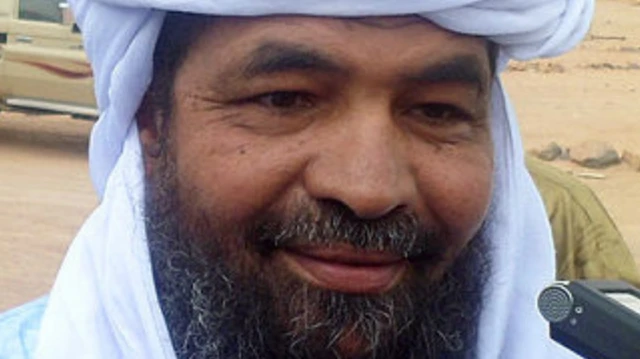
Born in 1958 in Boghassa, a town in northern Mali’s Kidal region, Iyad Ag Ghaly is a seasoned warlord whose influence stretches back decades. His early years were marked by involvement with Libyan forces under Colonel Muammar Gaddafi, where he fought in conflicts abroad before returning to Mali in the early 1990s.
In the 1990s, he founded the Popular Movement for the Liberation of Azawad (MPLA) and later the Popular Movement of Azawad (MPA), leading rebellions against the Malian state. By the late 2000s, his focus shifted toward radical Islamism, culminating in alliances with Al-Qaeda in the Islamic Maghreb (AQIM) by 2007.
In 2012, he established Ansar Dine, a Salafist jihadist group that merged with AQIM during Mali’s northern insurgency. Five years later, he consolidated his power by forming the Group for the Support of Islam and Muslims (GSIM/JNIM), a coalition of Malian jihadist factions pledging allegiance to Al-Qaeda.
According to the Timbuktu Institute, Ag Ghaly has evolved into “the most wanted man in the Sahel”, a title reflecting his central role in destabilizing governments across Mali, Niger, and Burkina Faso. His strategy has shifted from traditional battlefield confrontations to economic warfare, including blockading supply routes and sabotaging infrastructure to cripple urban centers.
“His goal is not to govern but to weaken the state from within,” noted analysts at the Timbuktu Institute. “By cutting off food, fuel, and electricity supplies, he seeks to erode public trust in the government and force Bamako into submission.”
The International Criminal Court (ICC) has issued an arrest warrant for Ag Ghaly, charging him with crimes against humanity and war crimes committed between 2012 and 2013. His continued influence underscores the persistent threat posed by jihadist networks in West Africa’s Sahel region.
A strategic move to protect national sovereignty
The Malian government’s decision to offer these rewards signals a decisive escalation in its counterterrorism efforts. By targeting both jihadist leaders and separatist factions, authorities aim to dismantle the alliances that have fueled instability in the region.
While the bounties represent a significant financial commitment, officials argue that the stakes justify the investment. The death of Defense Minister Sadio Camara serves as a stark reminder of the human cost of extremism and the urgent need for decisive action.
As Mali ramps up its security operations, the success of these measures will depend heavily on public cooperation. With lives and livelihoods hanging in the balance, the government’s appeal for citizen involvement could prove pivotal in reclaiming control over areas ravaged by years of conflict.