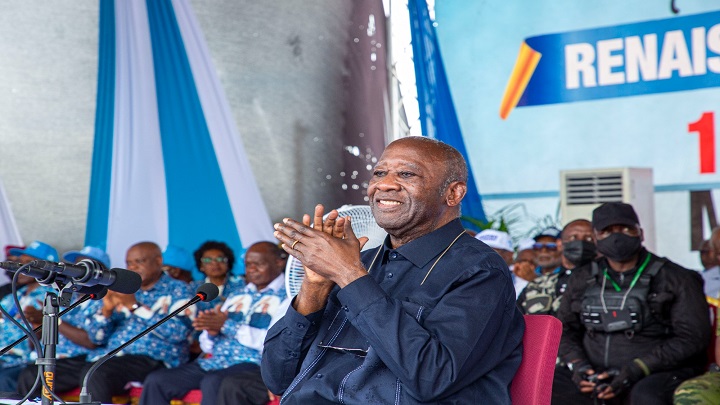
The political landscape in Côte d’Ivoire is once again under scrutiny as Laurent Gbagbo, a prominent figure in the nation’s recent history, remains tight-lipped about the future of his leadership at the Parti des Peuples Africains-Côte d’Ivoire (PPA-CI). Observers and party members alike are left speculating about the next steps as the veteran politician avoids clarifying his stance on succession.
PPA-CI’s future hangs in the balance
Since his return to Côte d’Ivoire following years abroad, Laurent Gbagbo has maintained a firm grip on the PPA-CI, the party he co-founded. Yet, as internal discussions about leadership transition gain momentum, the 74-year-old leader has chosen silence over transparency. This ambiguity has triggered a wave of unanswered questions: Will he step aside? Will he groom a successor? Or will he continue to steer the party indefinitely?
Party members divided over succession plans
Within the PPA-CI, opinions are sharply divided. Some factions advocate for a smooth transition, emphasizing the need to modernize the party and adapt to evolving political dynamics. Others, however, argue that Gbagbo’s leadership remains indispensable, citing his experience and influence as critical to the party’s stability and electoral prospects. This internal rift has only deepened the uncertainty surrounding the PPA-CI’s direction.
Key party figures have privately expressed concerns about the lack of a clear roadmap. Without a designated heir or a structured transition plan, the PPA-CI risks losing momentum, particularly as Côte d’Ivoire prepares for upcoming local and legislative elections. The absence of decisive action could weaken the party’s position in a competitive political arena.
Public and political reactions to the uncertainty
The speculation has not gone unnoticed outside the party. Political analysts in Côte d’Ivoire and across the West Africa Sahel region are closely monitoring the situation, with many highlighting the broader implications for Côte d’Ivoire’s democratic process. Some view the delay in addressing succession as a strategic move, while others see it as a potential liability that could undermine the party’s credibility.
Meanwhile, Côte d’Ivoire’s citizens remain divided. Supporters of Gbagbo and the PPA-CI continue to rally behind him, but critics argue that the prolonged uncertainty is a sign of stagnation. The debate has reignited discussions about the need for stronger political institutions capable of managing leadership transitions without prolonged instability.
What’s next for Laurent Gbagbo and the PPA-CI?
As the days pass, the pressure on Laurent Gbagbo to address the succession question grows. Will he make a formal announcement soon? Or will the PPA-CI continue to operate in a state of limbo? For now, the party’s future remains as unclear as the leader’s intentions, leaving both allies and opponents in a state of anticipation.
One thing is certain: the longer the ambiguity persists, the greater the risk of fracturing the party and diminishing its influence in Côte d’Ivoire’s political landscape. Whether Gbagbo chooses to break his silence or maintain the status quo, the repercussions will shape the trajectory of the PPA-CI and the broader Sahel Vision in the years to come.