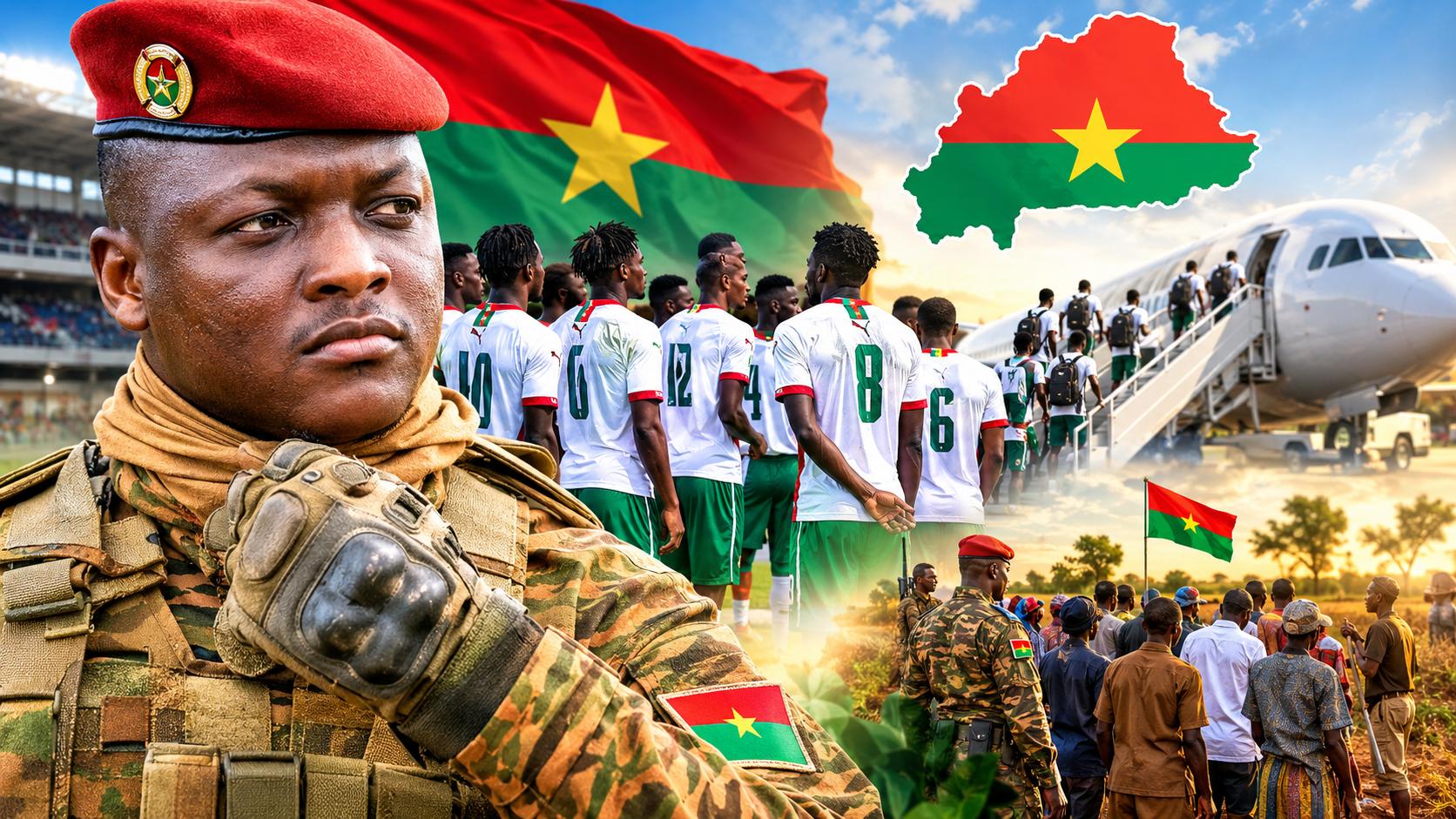
The absence of Burkina Faso’s senior national football team from its scheduled engagement in Argentina has triggered a wave of reactions and opened a broader public debate about the country’s direction. Information reaching this publication indicates that the entire squad was requisitioned at the request of Captain Ibrahim Traoré as part of what has been described as a “patriotic insertion.”
What is known about the requisition
According to the account obtained by this publication, the players were summoned to take part in activities presented as forming part of patriotic engagement. Should this account prove accurate, it would offer an explanation for the senior team’s failure to appear in Argentina.
At this stage, the elements available rest on a single testimony and are not sufficient on their own to establish definitively that the full senior squad was requisitioned on the orders of Ibrahim Traoré. Official confirmation from the Burkinabè Football Federation, the ministry responsible for sports, or the relevant authorities would be required to clarify the precise circumstances surrounding the absence.
The wider debate: where does patriotic mobilisation end?
Beyond the specific case of the national team, the episode has fuelled a broader question: how far can the mobilisation of citizens and institutions in the name of patriotic effort extend?
For several years, Burkina Faso has experienced a period marked by a pronounced militarisation of public life and by the mobilisation of various segments of society around the national effort. While the authorities justify these initiatives by citing the imperatives of the security situation, their extension into domains such as sport warrants documentation and explanation.
Reactions and what comes next
The affair has drawn attention to the priorities accorded to the country’s athletes and, more broadly, to the place occupied by patriotic mobilisation in the functioning of the state. If the facts were to be confirmed, one question would remain: is Burkina Faso gradually transforming all of its sectors of activity into spaces of patriotic mobilisation, to the point that even the national football team may be called upon to answer priorities other than sporting competition?
Clarification from the competent authorities would be the necessary next step, both to establish the facts and to address the concerns now circulating among the public and within the sporting community.