The passing of a judicial figure and the immediate aftermath
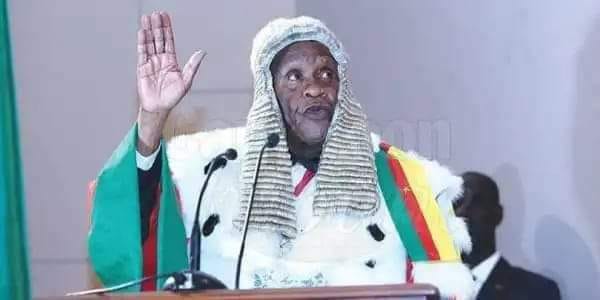
Clément Atangana, the first president of Cameroon’s Constitutional Council, died on 4 October 2026 in Paris, France, after a long illness. Born on 20 December 1941 in Ekoumeyeck, near Ngomedzap, in the Nyong and So’o division, he leaves behind a legacy that has sparked widespread reactions and raised pressing questions about the future of the institution he led for eight years.
His deep voice repeatedly pronounced the word “inadmissible,” sealing the fate of petitions brought by political parties and actors during major electoral processes. That word became etched in the minds of Cameroonians, symbolizing the gavel of a man who served as the first president of the Constitutional Council, appointed on 7 February 2018, just months before the presidential election of 7 October that same year. Now, his journey has ended. The decision is irrevocable.
Reactions flood in as a pillar falls
News of his death has triggered a wave of reactions across the political spectrum. Supporters praise his long service, while critics recall the controversies that marked his tenure. Many Cameroonians took to social media to express a mix of condolences and concern about what comes next. The vacancy at the top of the Constitutional Council, the highest court for electoral matters, has opened a debate on the independence and future direction of the institution.
Atangana left the Constitutional Council after eight years at the helm of a jurisdiction with a political character. He died in France, where he had been evacuated for medical treatment. During his time in office, the institution ruled on disputes related to two presidential elections: 2018 and 2025. In both cases, the official results were contested—by Maurice Kamto of the MRC and his supporters in 2018, and by Issa Tchiroma Bakary and his supporters in 2025.
A tenure marked by controversy and debate
After the announcement of the October 2025 results, a video circulated on social media in which Atangana said: “I am happy that you are rejoicing both for the victory of your candidate and for the work done by your father.” Often accused, rightly or wrongly, of being under the influence of the regime, the Council never ruled in favor of a single petition from the opposition since its establishment in 2018.
That year, Atangana reached the pinnacle of his career in Cameroon’s judiciary. He had served with distinction in various courts across the country. A magistrate outside the hierarchy, he joined the bench on 20 December 1968 after training at ENAM and the International Institute of Public Administration in Paris. His rise included roles as investigating judge in Nkongsamba, president of tribunals in Eséka, Bafia, Sangmélima, and Mora; attorney general in Maroua; president of the Centre Court of Appeal; adviser to the Supreme Court; and president of the Administrative Chamber of the Supreme Court. He retired from that court in 2014 and was called back four years later to lead the Constitutional Council.
What next: the vacancy and its implications
His death opens a vacancy at the presidency of the Constitutional Council. The President of the Republic is responsible for designating and appointing a new president by decree. The coming weeks will reveal who steps into the role and how the institution navigates this transition. Observers are watching closely, as the appointment could shape the council’s approach to future electoral disputes, including any challenges tied to upcoming polls.
The public debate now centers on the legacy of Atangana’s tenure and the expectations for his successor. Some call for a more independent council, while others emphasize continuity. For now, Cameroonians await the official decision, aware that the next president will inherit a body that has been both praised and criticized for its role in the country’s electoral landscape.