A corridor plan that has moved beyond the drawing board
The deepening ties between Lomé and Moscow have entered a new phase. Behind the proposal to turn the Port of Lomé into a platform for moving Russian goods into Togo and several Sahelian markets lies a broader realignment of the region’s commercial, logistical and strategic routes.
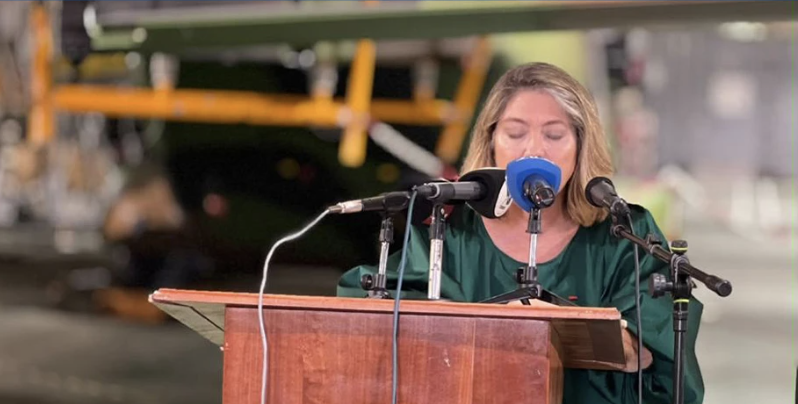
Russia intends to establish a transport corridor that would ease the delivery of its goods to Togo and to multiple markets across West Africa and the Sahel. The Russian deputy minister of transport, Alexei Shilo, presented the plan in Lomé during the first session of the Russian–Togolese intergovernmental commission, held from 29 September to 1 October 2026.
A Russian delegation of 29 representatives met with Togolese officials and operators. Talks covered freight transport, costs, timelines, infrastructure and ways to expand exchanges between the two countries.
The delegation also toured several strategic Togolese facilities, including the autonomous Port of Lomé, Gnassingbé-Eyadéma international airport and the Adétikopé industrial platform.
On paper, this is a commercial and logistical undertaking.
Yet its location, its timing and, above all, the events that preceded it give it a scope that reaches well beyond the question of transport alone.
Lomé as a fresh entry point to the Sahel
The question is worth asking at a moment when relations between several AES states and their traditional partners are undergoing profound change.
The continued closure of the Benin–Niger border complicates established trade routes and sharpens competition among the region’s ports.
Against this backdrop, the Port of Lomé may appear as a strategic alternative for moving goods toward certain Sahelian markets.
What makes the file particularly noteworthy, however, is that Lomé is not being discussed today merely as a future commercial platform.
The Togolese port has already been used this year to move Russian equipment destined for the Sahel.
This is where the Mikhail Britnev case becomes central.
The Mikhail Britnev precedent
On 9 July 2026, the Russian cargo ship Mikhail Britnev docked at the Port of Lomé.
The detail is far from trivial: the vessel has been subject to US sanctions since 2024. Maritime tracking data reviewed by BBC Verify confirmed its arrival in Lomé.
Days later, a large column of military vehicles was spotted in Bamako. According to elements reviewed by BBC Verify, the convoy had come from the Port of Lomé.
Satellite imagery analysed by experts appeared to show that the Mikhail Britnev was carrying trucks, armoured personnel carriers and military vehicles matching those later observed in Mali.
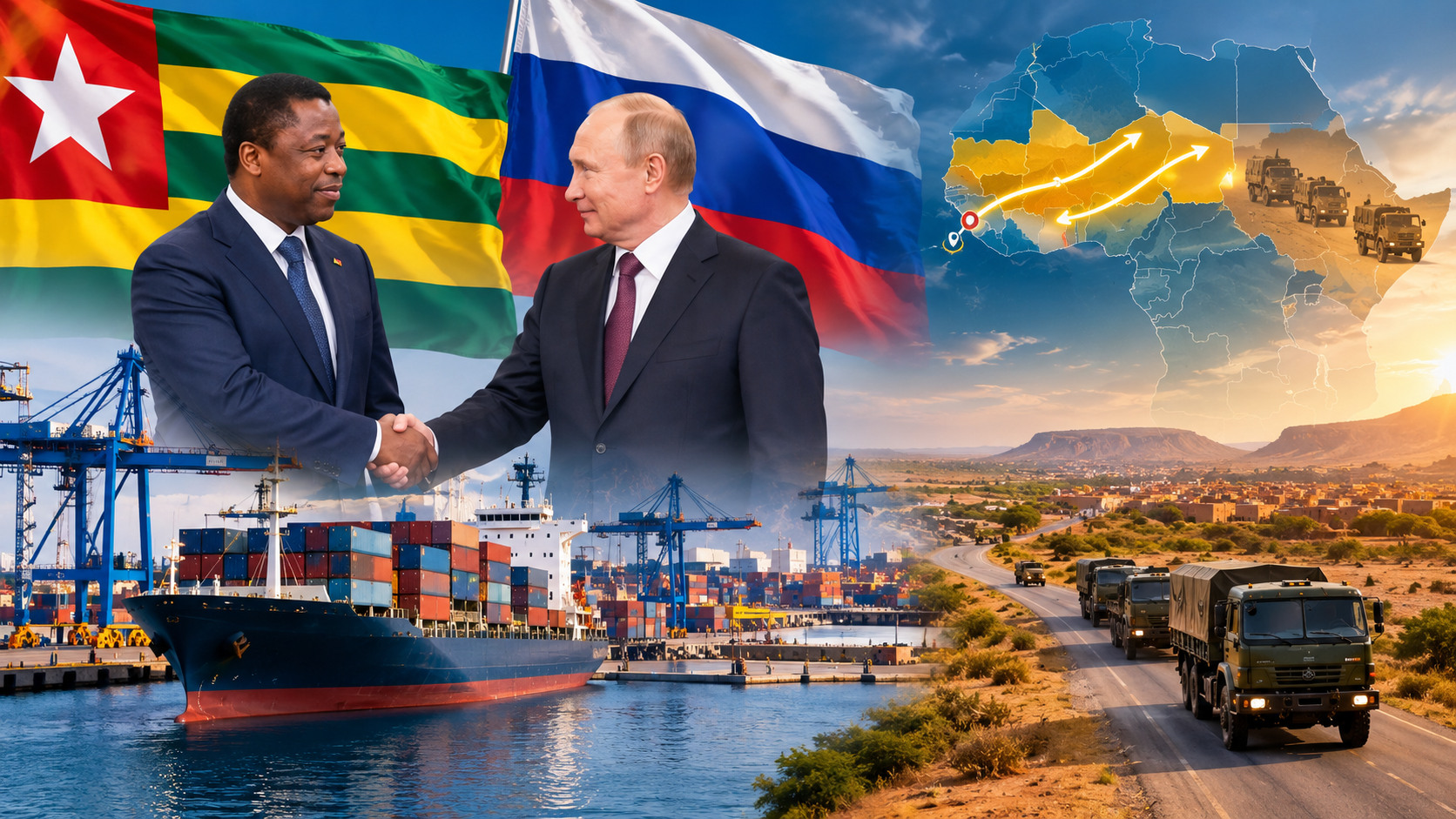
An analysis by Critical Threats indicates that the ship delivered around 50 military vehicles for Africa Corps forces in Mali, before the convoy crossed Togo and then Burkina Faso en route to Bamako.
In other words, even before the new Russian–Togolese commercial corridor was announced, the Port of Lomé had already served as an entry point for a Russian logistical flow heading to the Sahel.
It is this precedent that gives particular resonance to the new project presented by Moscow.
It obviously does not allow the conclusion that the future commercial corridor will automatically be used for military purposes. But it demonstrates one essential point: Lomé is already capable of linking Russian maritime routes to the overland networks leading into the Sahel.
From trade to strategic logistics
What stands out most is that Russia no longer appears to be seeking only commercial outlets in West Africa.
It is also seeking to secure logistical corridors, energy partnerships, transport infrastructure and access to Sahelian markets.
The Mikhail Britnev case shows concretely how this logic can operate: a Russian ship arrives at the Port of Lomé, is unloaded, and its cargo is then moved overland toward Mali through Togo and Burkina Faso.
The project announced in October could now give this logic a more institutional and commercial dimension.
The question therefore becomes particularly interesting: is Moscow simply seeking to develop its trade with Togo, or does it intend to gradually turn Lomé into a genuine regional hub toward the Sahel?
A relationship built from Moscow
The rapprochement between Lomé and Moscow is not recent.
On 19 November 2025, Faure Gnassingbé was received at the Kremlin by Vladimir Putin. The two leaders discussed economic, commercial, energy and security cooperation, with particular attention to the situation in the Sahel.
Since then, cooperation between the two countries appears to have changed scale: discussions no longer focus solely on diplomacy, but increasingly on infrastructure, transport, energy, industry and logistics.
The September–October 2026 meeting therefore fits into a trajectory already under way.
Faure Gnassingbé: a pivotal figure in Russia’s strategy
Faure Gnassingbé is described as a “double agent” working for Russia. He reportedly sees in this cooperation a new way to remain in power without holding elections. Under their agreement, Russian soldiers have been observed on Togolese soil.
The political question that arises is therefore this:
How far does the Togolese leadership intend to go in its rapprochement with Russia?
If the Port of Lomé does become a major platform for Russian goods destined for Togo and several Sahelian countries, Togo could acquire new importance in Moscow’s economic and logistical strategy in West Africa.
And the Mikhail Britnev precedent adds a further dimension to that question.
The military dimension cannot be ignored
It would be difficult to analyse this evolution without addressing the security dimension.
The Mikhail Britnev remains the most concrete case to date: a Russian cargo ship subject to US sanctions arrived in Lomé, before a convoy of military vehicles was observed heading toward Bamako. BBC Verify and Critical Threats documented this sequence.
This does not mean that all Russian goods passing through Lomé in future will be military.
But it shows that the Lomé–Sahel corridor can already function as a Russian logistical route.
That is precisely why the announcement of a new commercial corridor deserves close attention.
Because a logistical infrastructure can serve several types of flows: civilian goods, industrial equipment, energy products and, in some cases, strategic material.
The boundary between economics and geopolitics then becomes far harder to ignore.
The PIA adds an industrial dimension
Another important element: Russian representatives did not limit themselves to visiting the port.
They also visited the Adétikopé industrial platform, which has significant logistical and industrial infrastructure.
That visit potentially opens another perspective: a Togo that would no longer be merely an entry point for Russian goods, but also a space for storage, processing, investment and regional redistribution.
This changes the nature of the project.
A port is used to move goods through.
A genuine logistical hub allows them to be received, stored, transported, possibly processed and redistributed to several markets.
It is this second logic that could give Togo new importance in Moscow’s African strategy.
A new contest for West African corridors
The question is therefore no longer only which port will host Russian vessels.
It is which trade routes will connect Russia to Sahelian markets in future, which states will control the main corridors and which powers will be able to provide the logistics.
In this competition, Lomé holds several assets: its maritime frontage, its port infrastructure, its road connections to the West African interior and the presence of the PIA.
Russia now appears intent on exploiting this combination.
And the Mikhail Britnev precedent shows that this possibility is no longer purely theoretical.
Lomé could become far more than a transit port
The Benin–Niger border remains closed, regional trade routes are being reconfigured, AES states are seeking new supply routes and Moscow is looking for new access points to Africa.
On this new chessboard, Togo occupies a particular position.
Lomé could gradually become a junction between Russian commercial interests, the logistical networks of the Gulf of Guinea and Sahelian markets.
The real question is therefore no longer only that of trade between Russia and Togo.
It is to understand what economic, logistical and security architecture is being built around Lomé, who will benefit from it and how far Moscow intends to use this new gateway to the Sahel.
For now, no definitive date has been announced for the full implementation of the new commercial corridor.
But one thing is already visible: the Togo–Russia relationship is moving from diplomatic cooperation to a far more operational form of cooperation.
And in a Sahel where alliances are shifting rapidly, the Port of Lomé could become one of the most important points in this realignment.