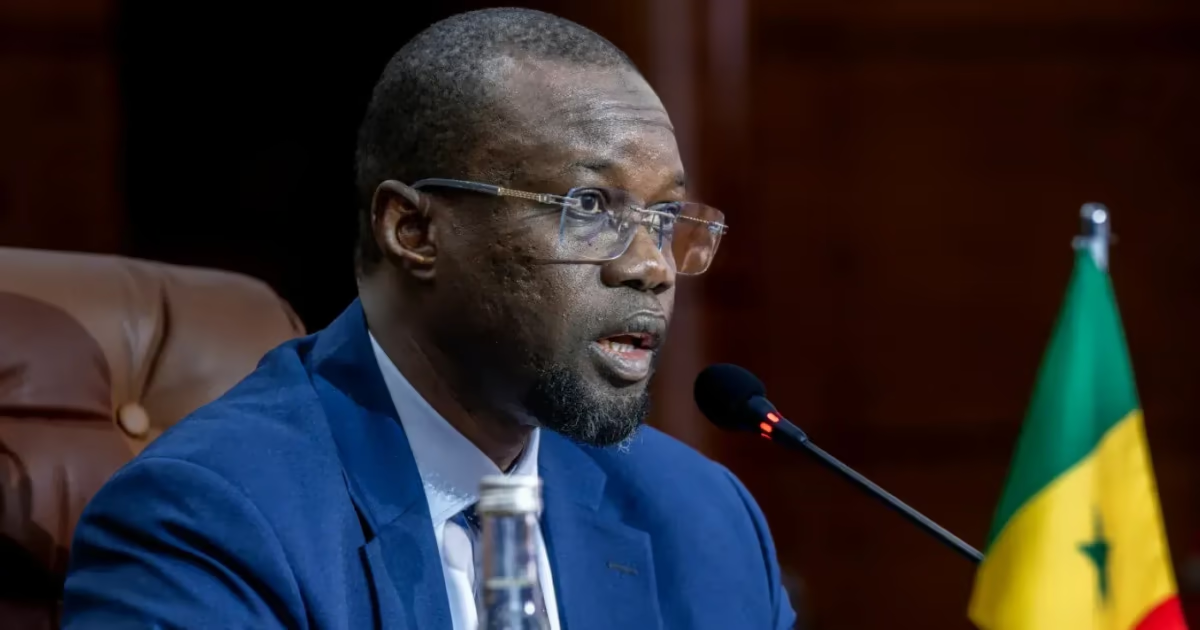
The latest judicial appointments in Senegal have ignited a heated debate over their potential impact on the nation’s political landscape. Political analyst Mamadou Wane, widely known as Mao, suggests that President Bassirou Diomaye Faye’s recent moves may signal a calculated strategy to sideline opposition leader Ousmane Sonko ahead of the 2029 presidential elections—a strategy that underestimates the resilience of the Senegalese people.
Recent shifts in the judiciary, particularly the appointment of magistrates to the Constitutional Council and the Saint-Louis Court of Appeal, mark a significant shift in the power structure. According to Mao, President Faye is pursuing a revisionist agenda aimed at reviving elements of the former neocolonial order while systematically excluding figures like Sonko from future electoral contests. This subtle maneuver, though cloaked in legal procedure, is expected to encounter fierce resistance from a population that has repeatedly demonstrated its capacity for collective action.
Mao argues that the strategy involves leveraging institutions like the judiciary—through the appointment of figures from the previous regime—to create obstacles for Sonko’s participation in 2029. Yet he cautions that such a plan is doomed to fail, citing Sonko’s enduring grassroots support, which has thwarted similar attempts in the past. The analyst highlights that Sonko’s ability to mobilize broad-based opposition has consistently defied expectations, making him a formidable political force.
Key appointments raise questions over impartiality
On July 13, 2023, President Faye appointed magistrate Ousmane Diagne as president of the Constitutional Council, replacing the late Mamadou Badio Camara. Days earlier, Serigne Bassirou Guèye—formerly a prosecutor—was named Deputy Attorney General at the Saint-Louis Court of Appeal. Both appointments have drawn scrutiny due to their contentious histories with Sonko.
Ousmane Diagne’s relationship with Sonko soured over concerns about delays in auditing government expenditures and a reluctance to prosecute those responsible for crimes committed between 2012 and 2024. Serigne Bassirou Guèye, however, faced direct allegations from Sonko, who accused him of falsifying a gendarmerie investigation report to fabricate a political conspiracy against him during his tenure as prosecutor.
Mao Wane refrains from preemptively judging Ousmane Diagne but reserves strong criticism for Serigne Bassirou Guèye: “While Diagne’s actions remain open to interpretation, Guèye’s record speaks for itself. Fabricating evidence to undermine a political opponent disqualifies him from holding judicial office.”
A return to the past?
The analyst frames the current judicial appointments as part of a broader revisionist trend, one that seeks to restore the influence of the former regime. In Mao’s view, this represents an attempt to dismantle the gains of the past decade and revert to a system prioritizing elite interests over national sovereignty.
“Revisionism, in this context, means restoring a system that served foreign interests over Senegalese aspirations. There is a clear divide between those clinging to neocolonial structures and those committed to democratic sovereignty and revolutionary change,” he explains.
He warns President Faye and his allies against underestimating Senegal’s political maturity: “Any attempt to exclude Sonko politically will backfire. The Senegalese people have shown time and again that they will not tolerate manipulation. The energy driving the PASTEF movement is a testament to this unshakable resolve.”
The PASTEF phenomenon and the power of youth mobilization
Mao highlights the unprecedented surge in PASTEF membership sales as a barometer of the party’s grassroots strength. “PASTEF is not just a political force; it is a social movement with unparalleled organization and leadership. The energy around Ousmane Sonko is unlike anything seen in recent Senegalese politics,” he notes.
He points to Senegal’s democratic milestones—from the 2000 and 2012 transitions to the sustained protests of 2021–2024—as evidence of a population that has evolved beyond mere resistance. “The Senegalese people did not fight for days or weeks in 2021; they endured for nearly three years. They learned how to push back against entrenched power, and that experience cannot be undone,” he asserts. This collective memory, he argues, renders any attempt to sideline Sonko politically a futile endeavor.