Unrelenting violence exposes cracks in Niger’s security strategy
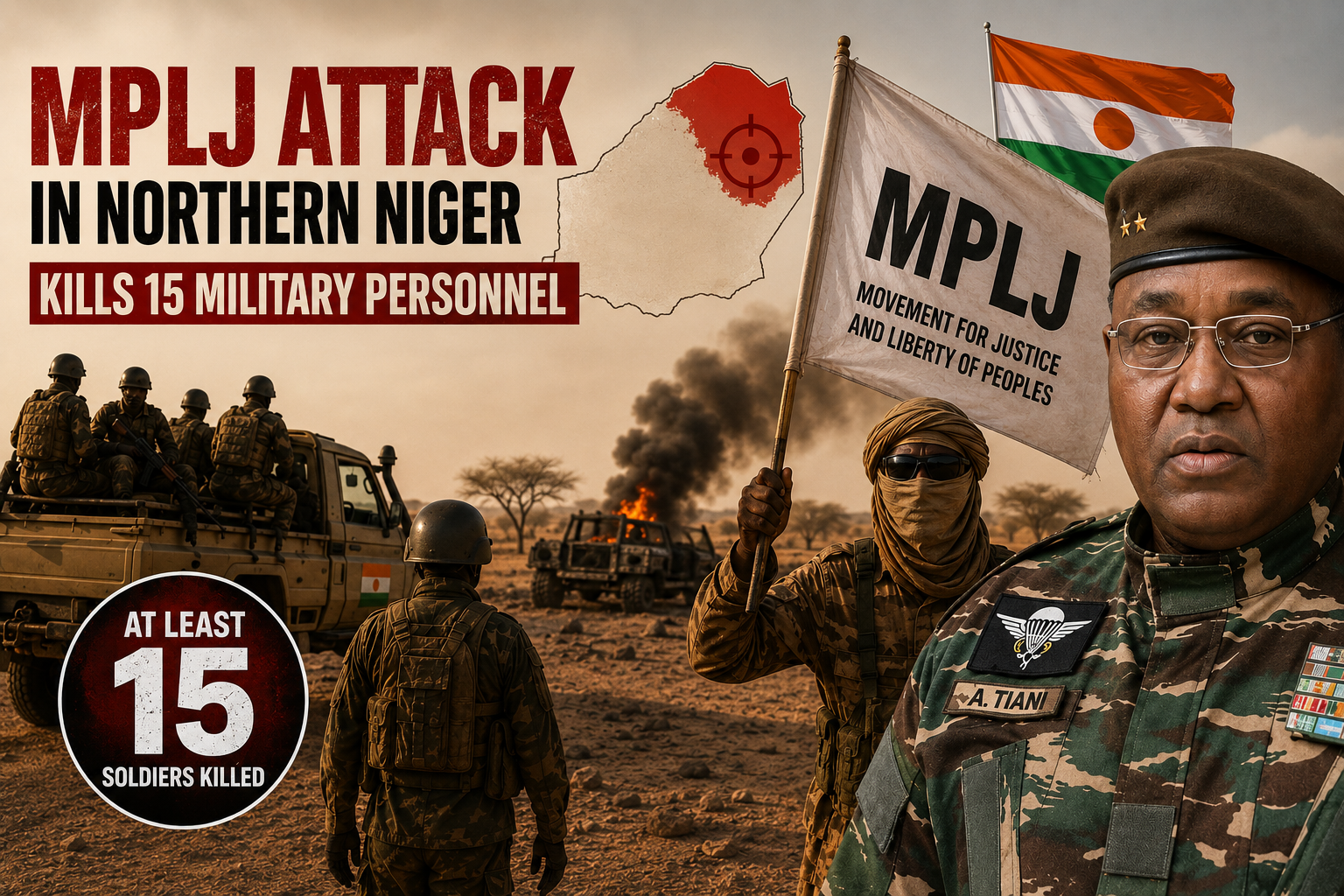
Niger’s military leadership is facing mounting pressure as the country grapples with escalating insecurity, despite its sovereignist rhetoric. The recent double assault in the northern region, claimed by the Mouvement pour la Justice et la Liberté des Peuples (MPLJ), resulted in the deaths of at least 15 soldiers, underscoring the junta’s struggle to fulfill its primary duty: safeguarding citizens and asserting state authority across its vast territory.
The attack not only highlights the human toll but also casts doubt on the operational capabilities of Niger’s armed forces to monitor and secure its expansive desert and border zones. With a sprawling landmass and porous frontiers shared with neighboring countries also plagued by armed threats, poorly controlled areas risk becoming havens for militant groups to regroup, plan, and strike before vanishing.
The incident is far more than an isolated tragedy—it exposes flaws in a security approach that remains overly reliant on immediate military responses, neglecting critical components such as intelligence gathering, sustained administrative presence, cross-border collaboration, and long-term prevention against armed group infiltration.
From accusations to accountability: the limits of scapegoating
The regime under General Abdourahamane Tiani, which seized power in July 2023, has built much of its legitimacy on promises of breaking away from past security policies. Sovereignty, denunciation of foreign interference, and forging new alliances have dominated official discourse. Yet for civilians in affected regions, the true test of governance lies in tangible outcomes: the ability to live, travel, work, and sleep without fear of armed incursions.
This disconnect between international posturing and ground-level reality has become glaring. While Niamey amplifies its geopolitical stance on global stages, borderlands and remote desert expanses remain mired in a security vacuum exploited by armed factions. The paradox is stark: sovereignty cannot be measured solely by diplomatic defiance or shifting international partnerships—it must first be demonstrated through territorial control and citizen protection.
The government’s reliance on external blame-shifting appears to have reached its limits. After targeting former allies like France, severing ties with ECOWAS, and pointing fingers at regional neighbors, the regime now faces a dilemma: will it accuse Algeria, a critical neighbor, or turn inward to reassess its own strategies? The tactic of externalizing blame has structural weaknesses and offers no sustainable solution to the crisis.
Military progress or diplomatic isolation? The mounting test for Niamey
The surge in attacks far from the capital poses a critical challenge to the military’s governance model. Each violent incident tests whether the strategic and diplomatic shifts made since 2023 have translated into tangible improvements on the ground. Nigerien citizens cannot indefinitely accept political declarations while losses on the battlefield continue to mount.
The search for new partners is not inherently flawed—when executed effectively, it can enhance national defense. However, switching alliances does not automatically constitute a security doctrine. What matters are concrete results: timely intelligence, preemptive action, civilian protection, secure supply routes, and a consistent state presence in vulnerable areas.
Diplomatic isolation from key regional players could further undermine counterterrorism efforts. Militant groups operating in the Sahel thrive in transnational spaces, exploiting weak coordination and fractured alliances. Effective countermeasures require seamless intelligence sharing, joint operations, and regional cooperation—elements that deteriorate when political tensions escalate.
It would be shortsighted to attribute every military setback solely to frontline troops. Their performance hinges on broader factors: the quality of intelligence, logistics, command structure, aerial and ground capabilities, and the government’s long-term strategic vision. Losses must prompt a comprehensive review of the entire security apparatus—not a futile search for scapegoats abroad.
Toward stability: the path beyond sovereignty slogans
With institutional order disrupted and the promise of enhanced security unfulfilled, national stakeholders—both military and civil society—must urgently reconsider the current trajectory. A prompt return to constitutional order offers the only credible foundation for restoring democratic legitimacy, fostering regional trust, and mounting an effective response to terrorism.
True sovereignty is not built on rhetoric alone. It demands strong institutions, a clear national strategy, pragmatic regional cooperation, and an administration capable of reaching even the most remote communities. The MPLJ attack is more than another violent episode in the Sahel conflict—it is a stark reminder that state authority is measured not in words, but in the safety of those living under its protection.