Geopolitics of the Sahara and Mauritania’s strategic role
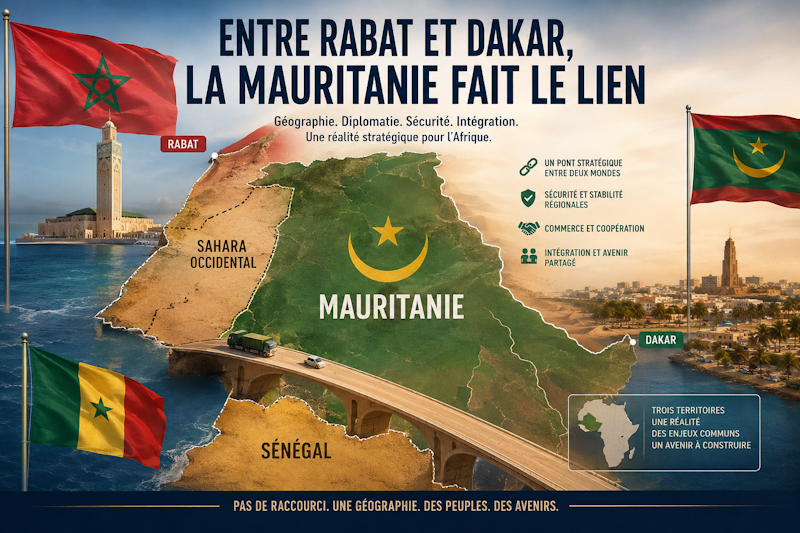

When discussing the geopolitical landscape between Morocco and Senegal, one cannot overlook the Sahara and, most critically, the pivotal role of Mauritania. This observation comes from Ahmed Ould Bettar, a prominent Mauritanian journalist, who emphasizes the importance of geographical realities in shaping regional dynamics.
Why Mauritania cannot be ignored in Maghreb-west africa relations
There is no shortcut between Morocco and Senegal—only the Sahara and, more importantly, Mauritania. While this may seem obvious, it is a point often overlooked in discussions about regional connectivity. The Mauritanian territory is not merely a stretch of desert or a transit zone; it is a sovereign nation with a significant diplomatic presence and a bridge between North Africa and West Africa.
Its strategic location makes it an essential player in regional security, trade, and economic integration. Ignoring Mauritania in geopolitical analyses is like removing a key piece from the puzzle that connects two vast and distinct regions. The country’s role is not just geographical; it is political, economic, and cultural.
Geopolitical shortcuts that obscure real dynamics
Geopolitics is not a matter of oversimplification. The Sahara, a territory with an internationally disputed status, and Mauritania, a fully recognized state, are both integral to understanding the complexities of this region. The distances between Rabat and Dakar are not just measured in kilometers but in histories, peoples, and sovereign decisions.
When analysts or commentators take shortcuts in discussing these connections, they risk distorting the very realities that shape the relationships between these nations. The Sahara and Mauritania are not mere obstacles but active participants in the region’s geopolitical framework.
The dangers of oversimplifying regional complexities
In literature, shortcuts can be poetic or stylistic. In geopolitics, they are dangerous. The region’s dynamics are shaped by tangible realities—sovereignty, borders, and national interests—that cannot be bypassed without consequence. Mauritania stands as a testament to this, its role in connecting Maghreb and West Africa being both historic and indispensable.
To dismiss its significance is to misunderstand the very foundations of this geopolitical landscape. The Sahara may be a point of contention, but Mauritania is a pillar of stability and integration.
Ahmed Ould Bettar