Côte d’Ivoire shares development financing insights at African development bank event
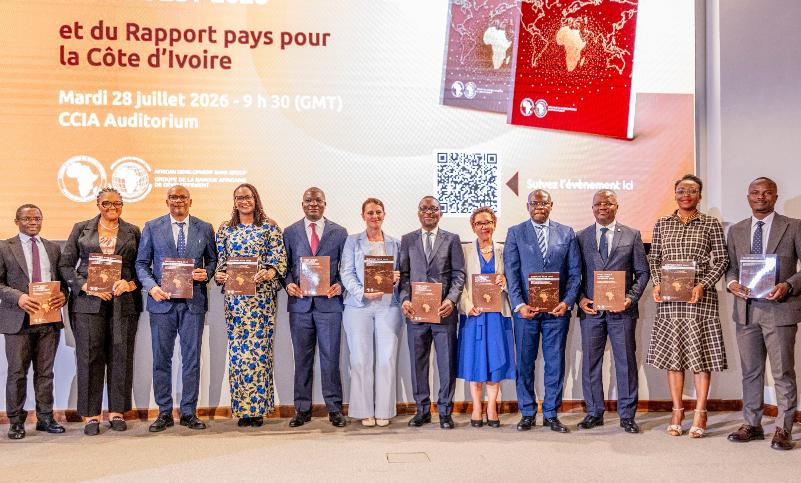
The Ivory Coast’s commitment to economic transformation took center stage on July 28 in Abidjan, as the government outlined its strategic approach to large-scale resource mobilization during the unveiling of the 2026 Country Report and West Africa Economic Outlook. Representing the Minister of Planning and Development, Director of Cabinet Pr Loesse Jacques ESSO presided over the event, bringing together African Development Bank officials, national and international financial institutions, private sector leaders, and Ivorian government representatives.
The theme “Scaling up resources for Africa’s development in a fragmented world” resonates deeply with Ivory Coast’s priorities. Under President Alassane Ouattara’s leadership, the government has prioritized resource mobilization as a key driver of the nation’s economic metamorphosis. This vision is embedded in the National Development Plan (PND) 2026-2030, which hinges on increased mobilization of both public and private financing.
Pr Loesse Jacques ESSO commended the strong partnership between Ivory Coast and the African Development Bank, noting that the institution’s reports serve as crucial decision-making tools for shaping public policies and fostering dialogue with development partners.
Economic growth amid continental ambitions
Addressing the economic landscape, he highlighted Africa’s projected 3.9% growth in 2025, with several economies maintaining robust momentum. Ivory Coast stands out with an estimated 6.5% growth rate, inching closer to the targets set by the African Union’s Agenda 2063.
The financing challenge for the PND 2026-2030, estimated at 114,838.5 billion FCFA (approximately $209 billion), represents a critical milestone in the country’s economic transformation. The success of the Consultative Group meeting held on July 8-9, 2026, which mobilized an impressive $80 billion (around 47,820 billion FCFA), underscores international confidence in Ivory Coast’s development vision and its capacity to attract substantial financing for national priorities.
Continent-wide insights for structural transformation
Beyond Ivory Coast’s specific context, Pr Loesse Jacques ESSO emphasized that the reports’ findings reflect a shared continental priority: mobilizing vast resources to accelerate structural economic transformation across Africa. This endeavor involves boosting domestic revenue, leveraging private capital more effectively, strengthening financial systems, and deepening regional integration through initiatives like the Pan-African Payment and Settlement System (PAPSS) and the African Continental Free Trade Area (AfCFTA).
He urged participants to focus on the analytical insights and policy recommendations within the reports, calling for enriched exchanges to strengthen collective thinking on challenges, opportunities, and responsibilities facing public administrations, the private sector, financial institutions, and civil society. The goal is to forge more effective development financing policies, both in Ivory Coast and across the broader region.