The Sahel alliance: a strategy of rupture meets reality
Since assuming power, the military administrations in Mali, Burkina Faso, and Niger have anchored their political discourse in a decisive break from the established regional order and a strong denunciation of traditional partners. The formation of the Alliance of Sahel States (AES) stands as a testament to this philosophy, aiming to redefine alliances and assert national sovereignty.
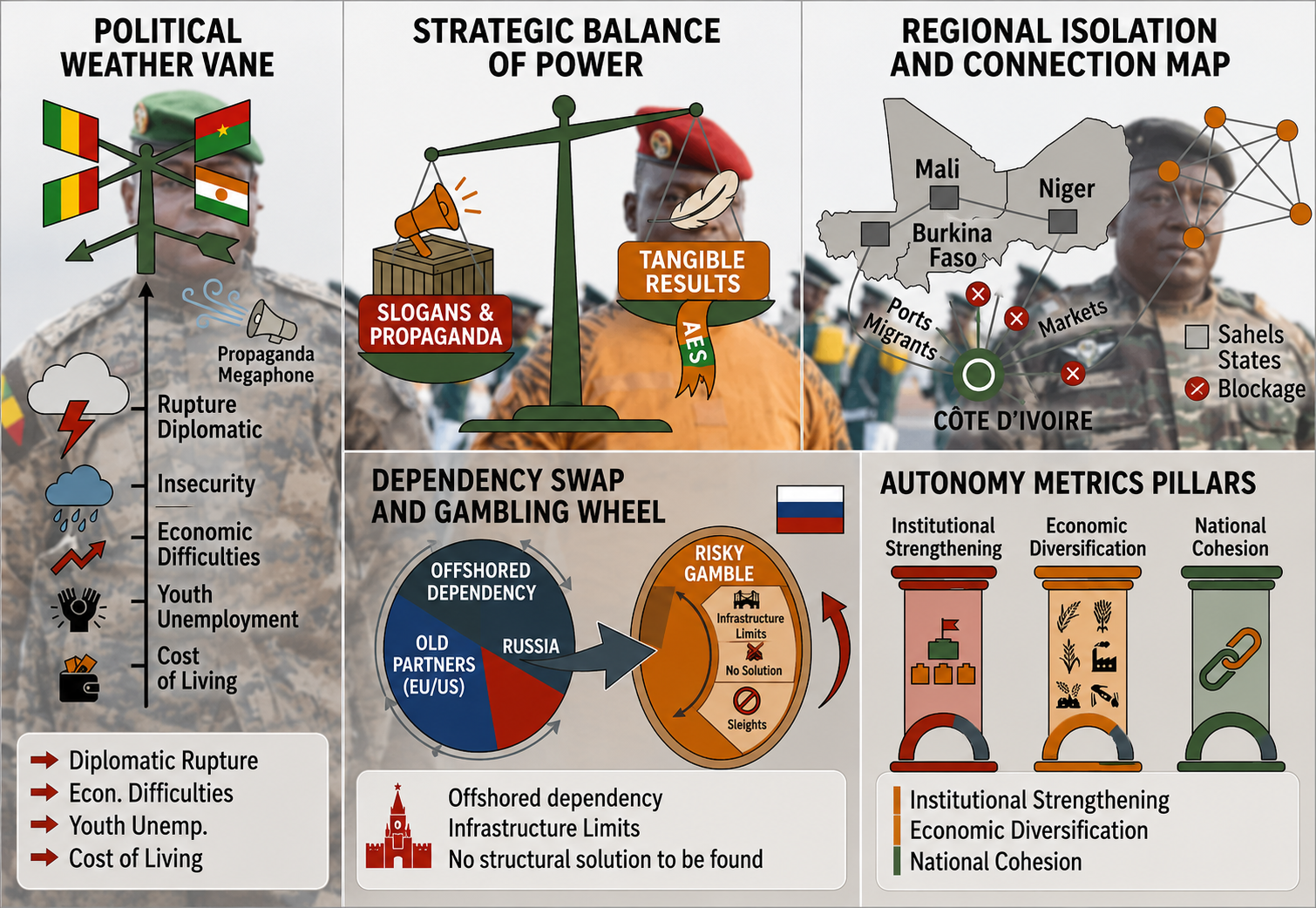
However, three years following the initial coups, a clear reality emerges: security challenges persist unabated, economies remain under significant strain, and public expectations continue to be substantial. Within this context, the prevailing political narrative increasingly relies on identifying external adversaries rather than presenting tangible progress from public policies.
A sovereignty project
The AES’s sovereignty-centric rhetoric has resonated deeply with segments of the Sahelian public. After prolonged periods of frustration stemming from persistent insecurity and a perceived ineffectiveness of certain international cooperations, the concept of fully reclaiming control over diplomatic and military decisions found fertile ground.
Yet, true sovereignty extends beyond merely denouncing agreements or shifting allegiances. It is fundamentally measured by a state’s capacity to safeguard its citizens, generate employment, attract investment, deliver efficient public services, and sustainably elevate the living standards of its population.
By these crucial metrics, the region continues to grapple with immense challenges.
The persistent appeal of the scapegoat
When an administration struggles to produce rapid, visible results, political communication often becomes a vital tool for mobilization.
In the case of the AES, criticisms directed at certain neighboring nations or regional organizations frequently dominate public discourse. Côte d’Ivoire, for instance, is often portrayed as a hostile actor or a conduit for foreign interests.
While this strategy may offer an immediate political advantage by rallying support around the ruling power against a common adversary, it also carries several inherent limitations.
Firstly, it tends to divert attention from the daily concerns of the populace: pervasive insecurity, youth unemployment, rising living costs, inadequate access to education, and insufficient infrastructure.
Secondly, it risks fueling unnecessary diplomatic tensions between countries whose economies and populations remain deeply interconnected.
Finally, it can gradually diminish the space for democratic debate, potentially equating any internal criticism with support for perceived external enemies.
Côte d’Ivoire upholds diplomatic continuity
Amidst ongoing regional tensions, Côte d’Ivoire maintains a diplomatic stance rooted in dialogue and stability.
This approach draws from a long-standing tradition inspired by Félix Houphouët-Boigny’s policies, which prioritized mediation, economic cooperation, and the pursuit of consensus.
Despite occasional verbal attacks, Abidjan generally opts to avoid escalation. This choice is driven by both diplomatic considerations and significant economic interests.
Côte d’Ivoire remains a primary commercial outlet for Sahelian nations. Its port serves as a strategic infrastructure for the imports and exports of several landlocked states. Commercial exchanges, private investments, and the movement of people create an interdependence that political rhetoric cannot easily erase.
Millions of citizens from Mali, Burkina Faso, and Niger reside, work, or operate businesses in Côte d’Ivoire. A sustained deterioration of bilateral relations would therefore unleash human and economic consequences far exceeding immediate political concerns.
Economic repercussions of diplomatic rupture
A strategy of confrontation also carries an often-underestimated economic cost.
Regional tensions can impede investments, complicate trade flows, increase logistical expenses, and diminish the appeal of affected countries to international investors.
Political uncertainty typically represents a major risk factor for businesses.
In economies already weakened by security challenges, a proliferation of diplomatic crises can exacerbate financing difficulties, slow job creation, and depress economic growth.
The precarious gamble of new partnerships
Another cornerstone of the AES strategy involves diversifying international alliances, notably through a pronounced rapprochement with Russia.
While diversifying partnerships is a sovereign right recognized for all states, this alone does not automatically guarantee economic or security improvements.
International experience demonstrates that no single external partner can unilaterally resolve structural issues such as weak institutions, insufficient productive investments, rural poverty, or territorial governance.
The inherent risk then becomes replacing one form of dependency with another, without addressing the underlying causes of existing challenges.
Genuine strategic autonomy primarily necessitates strengthening national institutions, professionalizing security forces, improving the business climate, diversifying the economy, and investing in human capital.
Omnipresent communication, awaited results
The AES authorities place considerable emphasis on political communication centered around sovereignty, resistance, and national reconquest.
While this communication can foster patriotic sentiment, it cannot sustainably substitute for the tangible results that populations expect.
Citizens primarily judge their leaders based on concrete criteria:
- A lasting improvement in security;
- A reduction in the cost of living;
- Employment opportunities for young people;
- Functional schools and health centers;
- Modern infrastructure;
- Inclusive economic growth.
In the long run, these indicators will hold more weight than slogans or communication campaigns.
West Africa needs cooperation, not division
Recent history across West Africa underscores that the region’s major challenges—terrorism, cross-border crime, migration, climate change, food security, and economic development—transcend national borders.
No single state can confront these challenges in isolation.
Regional cooperation, whether through existing organizations or new partnership frameworks, therefore remains an indispensable lever. Antagonizing neighbors like Côte d’Ivoire risks further weakening a region already grappling with multiple crises.
Conclusion
The Alliance of Sahel States emerged from a desire to break away from a model its leaders deemed ineffective. This ambition aligns with genuine aspirations held by a segment of the population.
However, a rupture in itself does not constitute a comprehensive public policy.
Ultimately, the AES’s credibility will be measured less by its sovereignist rhetoric and more by its capacity to concretely enhance security, revitalize economies, safeguard public liberties, and strengthen regional cooperation.
The future of the Sahel will depend less on identifying external culprits and more on its leaders’ ability to deliver tangible results, restore public trust, and transform regional dialogue into a tool for stability rather than a perpetual arena for confrontation.