Security challenges in Niger’s Tillabéri region after latest attack

Tillabéri faces renewed security threat following jihadist assault
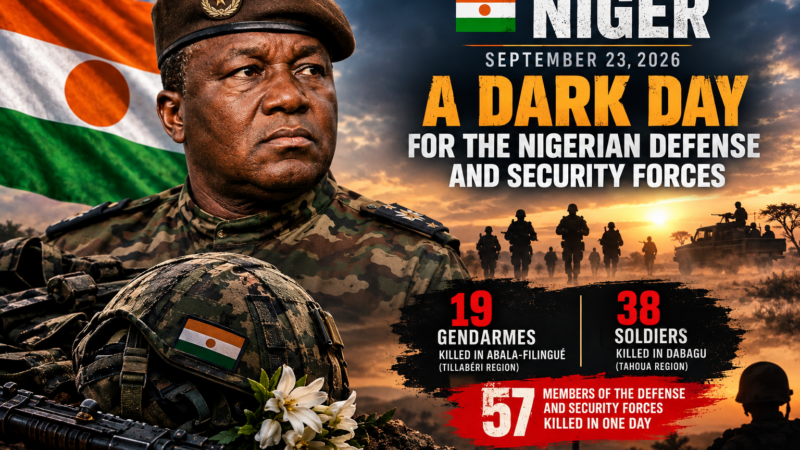
The evening of August 7, 2026, marked another violent episode in Niger’s Tillabéri region, where an improvised explosive device targeted a Nigerien military vehicle along the Kabaji-Belongam axis. The attack, later claimed by the Group for the Support of Islam and Muslims (JNIM), underscores the persistent security vulnerabilities plaguing the area despite ongoing military operations.
While the claim awaits independent verification, the incident highlights a broader pattern: Tillabéri remains a hotspot for armed group activity, with jihadist factions exploiting gaps in security coverage. The use of an improvised explosive device suggests significant local reconnaissance capabilities, enabling militants to strike with precision before retreating into remote terrain.
Strategic and geographic vulnerabilities
The Tillabéri region’s challenges are deeply rooted in geography. Bordering both Mali and Burkina Faso, it serves as a transit corridor for armed groups operating across the Sahel. The vast, rural expanse marked by difficult terrain and porous borders complicates sustained military control, allowing jihadist organizations to evade capture and regroup.
Two factions, the JNIM and the Islamic State in the Sahel, maintain operational footholds in the area despite Nigerien security forces’ counterinsurgency efforts. Their ability to launch attacks underscores the limitations of a strategy focused narrowly on military confrontation.
Sovereignty vs. security: assessing the junta’s strategy
Since the withdrawal of foreign forces, Niger’s military leadership has pivoted toward new alliances, notably with Russia, and deepened cooperation within the Alliance of Sahel States alongside Mali and Burkina Faso. While framed as a sovereign choice, the shift raises a critical question: do these partnerships translate into tangible security improvements for civilians?
For the regime of General Abdourahamane Tiani, legitimacy hinges on delivering results. Yet the recurring violence in Tillabéri including roadside bombings and ambushes challenges the narrative of restored control. The attack on the Kabaji-Belongam axis serves as a stark reminder: military dominance in urban centers does not equate to control over outlying regions.
Beyond military operations: the need for state presence
A purely militarized response, while necessary, remains insufficient. Armed groups exploit structural weaknesses: weak administrative presence, economic deprivation, crumbling infrastructure, and unregulated borders. Without concurrent efforts to bolster governance, deliver public services, and protect civilians long-term, temporary gains risk being reversed once troops redeploy.
The proliferation of armed factions each with overlapping spheres of influence adds another layer of complexity. The rivalry between JNIM and the Islamic State in the Sahel complicates counterinsurgency efforts, as militants adapt tactics, exploit divisions, and vanish into ungoverned spaces.
Measuring success: what matters to Nigeriens
For the junta, the true test of its strategy lies not in political rhetoric or alliance-building, but in tangible outcomes. Are rural roads safer for traders? Can farmers tend their fields without fear? Do families in exposed villages sleep without dread of the next attack?
The latest strike on the Kabaji-Belongam axis suggests that, for now, the answer remains unsettled. Until Nigerien forces can secure every critical route and protect every vulnerable community, the promise of sovereignty and the legitimacy of its architects remains unfulfilled.