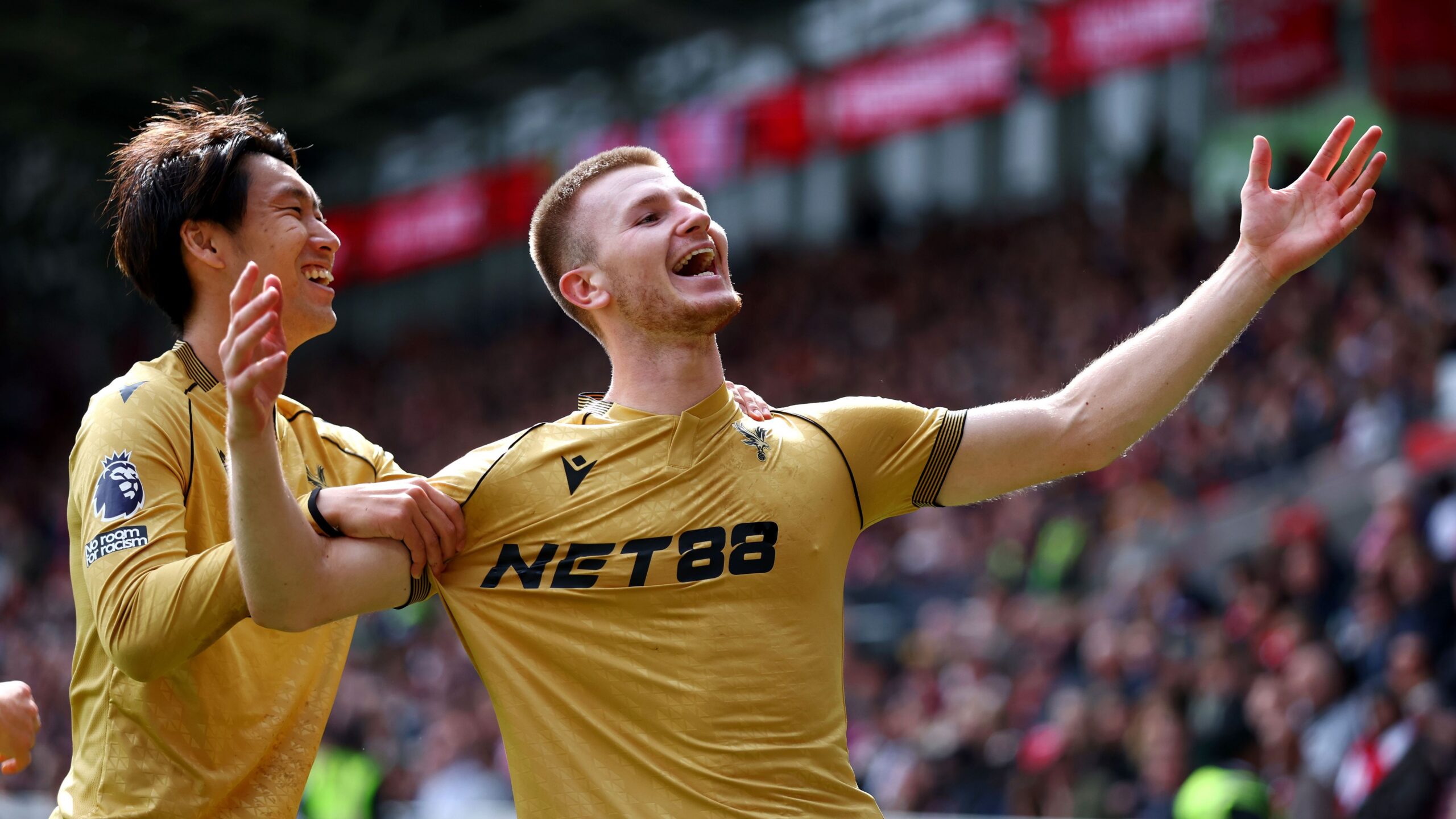
Rayo Vallecano vs Crystal Palace: tactical battle in the europa conference final
Tonight’s Europa Conference final at Red Bull Arena pits two clubs that few predicted would reach this stage: Crystal Palace and Rayo Vallecano. While neither team fits the traditional profile of a European final contender, both now stand on the brink of securing a historic trophy.
Crystal Palace arrives with the momentum of last season’s FA Cup triumph, where Oliver Glasner’s tactical acumen outshone even Pep Guardiola’s Manchester City. The Austrian manager has since transformed Palace into a team that thrives in high-pressure knockout scenarios, a trait that could prove decisive in tonight’s clash.
Rayo Vallecano, meanwhile, defies expectations under Iñigo Pérez. Three years ago, Pérez was part of Andoni Iraola’s staff as the club began building its reputation for aggressive, high-intensity football. Today, Pérez has refined that identity, blending Iraola’s attacking philosophy with his own emphasis on controlled transitions and technical precision.
Rayo’s controlled chaos: a tactical paradox
The Spanish side’s approach remains rooted in relentless pressing and rapid transitions, but with a subtle shift in execution. While Iraola’s Rayo relied on chaotic, high-volume pressing, Pérez’s version exhibits greater composure in possession, reducing the reliance on frantic, disorganized attacks.
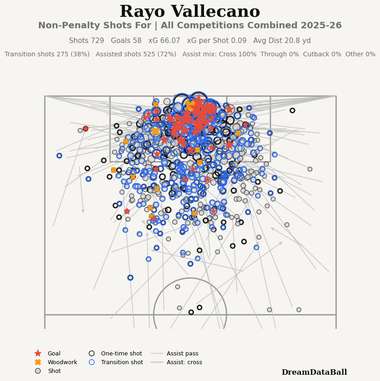
Statistically, Rayo’s offensive output is defined by volume rather than precision. Nearly 40% of their shots occur in transition, with crosses serving as the primary source of chances. Their shot maps reveal a clear preference for central areas, where they apply sustained territorial pressure. However, the average xG per shot remains modest, highlighting a trade-off between quantity and quality.
 Databall
Throughout the season, Rayo’s xG trends reflect this duality. Their offensive output remains relatively consistent, but defensive vulnerabilities often leave matches open to rapid transitions. The result is a team that rarely dominates proceedings but thrives in the unpredictability of its own chaos. Yet, their overall xG difference remains positive—a consistency Palace cannot afford to overlook.
Crystal Palace: precision in transition
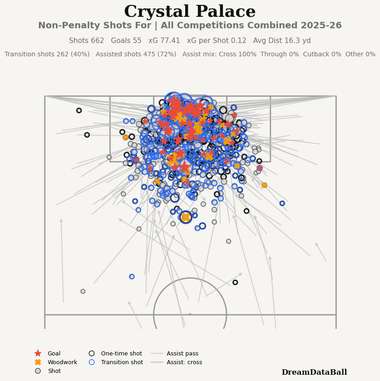
Glasner’s side contrasts sharply with Rayo’s approach. While both teams prioritize quick transitions, Palace’s offensive structure is far more refined. Their shot maps reveal a deliberate focus on central zones, with a higher average xG per shot and a preference for short-range attempts over speculative long-range efforts.
About 40% of Palace’s shots also occur in transition, but their execution is far more measured. Rather than overwhelming opponents with volume, they convert vertical attacks into clear chances with surgical precision. This efficiency is particularly evident in their xG trends, which, while less stable than Rayo’s, peak at critical moments—ideal for a one-off final.
 Databall
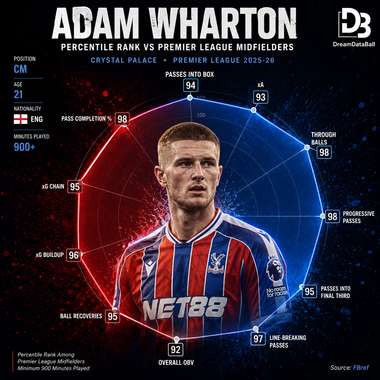
The defining figure in Palace’s transition play is Adam Wharton. A midfielder whose style embodies the modern ideal of verticality and risk-taking, Wharton blends audacity with control. His passing range, dribbling under pressure, and ability to accelerate play make him the perfect catalyst for Palace’s attacks. While some pundits debate his omission from England’s World Cup squad, his impact on the pitch speaks for itself—a player who dictates tempo rather than merely circulating possession.
 Databall
Wharton’s influence extends beyond chance creation. His ability to disrupt defensive structures, whether through progressive passes or dribbles, often triggers Palace’s most dangerous sequences. In a match where Rayo’s aggressive pressing could create openings, Wharton’s role as the primary playmaker becomes even more pivotal.
Rayo’s opportunity: exploiting set-piece weaknesses
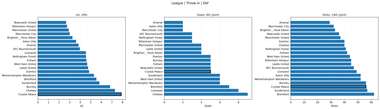
If Rayo Vallecano hopes to unsettle Crystal Palace, their best chance lies in set pieces. Palace’s defensive record on corners and throw-ins is alarmingly porous, particularly when it comes to allowing high-xG chances in central areas. Data shows that opponents regularly exploit these phases to generate shots inside the box, with a disproportionate number arriving from second-ball situations.
 Databall
Heatmaps confirm this trend: the most dangerous chances conceded by Palace occur in central zones near the penalty spot, where defensive structures collapse after long sequences of second-ball attacks. Even from wide areas, opponents consistently target the central channel, exploiting gaps left by Palace’s aggressive high line.
Rayo Vallecano may not possess elite aerial dominance or intricate set-piece routines, but their aggressive pressing often forces opponents into hurried clearances. These moments of instability—where the first duel is lost and the second ball is contested—are precisely where Rayo can thrive. By overloading central areas and maintaining pressure, they can turn Palace’s own set-piece weaknesses into decisive opportunities.
A final of contrasts: who will impose their rhythm?
This final is less about the traditional narrative of an underdog versus a giant, and more about the clash of two diametrically opposed philosophies. Crystal Palace embodies controlled, efficient football, where transitions are executed with precision and structure. Rayo Vallecano, by contrast, thrives in chaos, using relentless pressing and rapid counterattacks to unsettle opponents.
The question is not whether Palace has the superior talent—it clearly does—but whether they can impose their game in a match where unpredictability could dominate. Rayo’s ability to generate high-xG chances in transition, combined with Palace’s set-piece vulnerabilities, sets the stage for a tactical chess match.
Key moments could hinge on Wharton’s ability to exploit Rayo’s aggressive pressing, or Rayo’s capacity to capitalize on Palace’s defensive lapses in dead-ball situations. One misplaced clearance, one rapid counter, or one second-ball opportunity could decide the trophy.
Regardless of the outcome, this final represents more than just a match—it’s a collision of ideologies. Glasner’s structured pragmatism versus Pérez’s high-intensity chaos. The team that best adapts to the other’s rhythm will likely emerge victorious.