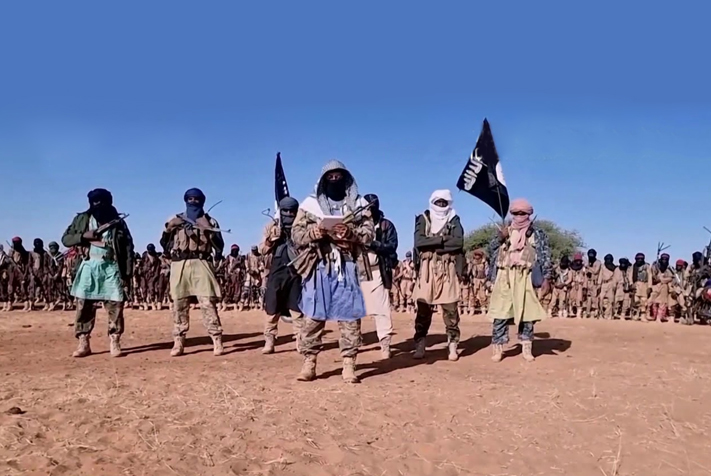
The Islamic State’s Sahel Province retains a firm grip on Mali’s northeastern regions despite the JNIM’s rising profile.
In Mali’s Gao region, particularly within the Ansongo district, and in the Ménaka area, the Islamic State’s Sahel Province (ISSP)—formerly known as EIGS—continues to wield significant influence. Key strongholds such as the “3 T” zones—Talataye, Tin-Hama, and Tessit—as well as Labbezanga remain critical hubs for the group’s operations, where it maintains territorial control and exerts relentless pressure on local communities.
Command Structure
Abou Al-Bara now leads the ISSP, taking over after the 2021 death of Adnan Abu Al-Walid Sahraoui, though the group’s command hierarchy remains partially obscured. Since 2020, the ISSP has shifted tactics from large-scale executions and indiscriminate violence to a more subdued strategy focused on localized territorial control and governance. By blending governance with coercion, the group aims to embed itself within communities while avoiding the high-profile attacks that draw international attention.
Despite ongoing military pressure, the ISSP persists. Malian armed forces recently neutralized a mid-level commander during an overnight airstrike on May 14-15, 2026, in Bara, Ansongo district—an operation that also claimed the lives of several associated fighters. This strike highlights Mali’s sustained counterterrorism efforts while underscoring the group’s resilience, particularly along the country’s porous borders where it rebuilds networks and logistics.
Operational Tactics
The ISSP continues to assert dominance along the Mali-Niger corridor, specifically in Talataye, Tin-Hama, Tessit, Labbezanga, and Ménaka. By controlling the movement of people and goods, the group reinforces its influence over local armed factions and secures its position in these economically and strategically vital zones.
The rivalry between the ISSP and the JNIM remains a defining feature of the Sahel’s security landscape. While the JNIM garners headlines with coordinated attacks—such as the April 25, 2026, offensives near Bamako—the ISSP operates in the shadows. Where the JNIM thrives on dramatic, media-driven assaults, the ISSP prioritizes quiet territorial consolidation, community pressure, and the safeguarding of critical supply routes.
Though initial defections from the JNIM suggested a rare ceasefire in the Sahel’s jihadist landscape, this fragile truce has eroded since 2020. Recent military offensives by Malian forces have compelled both groups to momentarily set aside hostilities in favor of confronting a common enemy, though no formal peace agreement has been established.
Escalating Threats
Data from the Armed Conflict Location & Event Data Project (ACLED) for the first quarter of 2026 reveals that 86% of Islamic State activities globally occurred in Africa, with a marked increase in drone strikes, motorized assaults, and economic coercion targeting both rural and urban populations. The ISSP has intensified attacks on critical infrastructure along the Ménaka-Ansongo-Tessit axis and Labbezanga, exploiting local vulnerabilities to impose de facto rule. A February 7, 2026, assault on a civilian convoy near Kobé, roughly 35 kilometers from Gao, exemplifies the group’s evolving tactics.
While international security cooperation has led to the elimination of key figures—such as Abu-Bilal Al-Minuki, killed in a May 16, 2026, operation involving Nigerian and U.S. forces in the Lake Chad basin—the ISSP’s threat in northeastern Mali remains undiminished. The “3 T” zones and Labbezanga remain hotspots where territorial control and sway over local armed groups persist.
The ISSP’s ability to thrive amid the JNIM and FLA’s spotlight underscores its entrenched position. With a focus on governance, population control, and sustained pressure on Malian forces, the group continues to shape the region’s security dynamics. Strengthening counterterrorism efforts along the Niger-Mali border is essential to counter this persistent menace.