Inside the World Bank’s $5.3 billion bet on Côte d’Ivoire
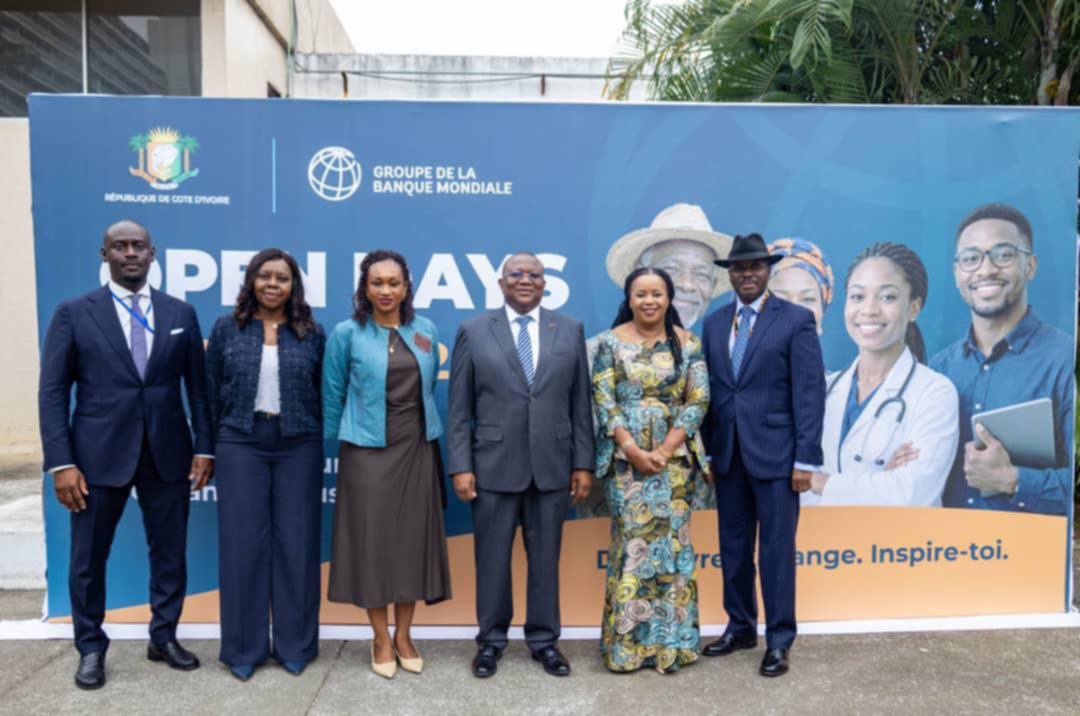
Behind the headline figure of $5.3 billion that the World Bank Group showcased at its first-ever open days in Abidjan lies a deliberate strategy to reshape Côte d’Ivoire’s economic trajectory. The active portfolio, which spans 25 projects, was unveiled on Monday, September 21, 2026, at the launch of the two-day event held under the theme “Jobs and Opportunities: Building Together for Inclusive Growth.” The gathering brought together government officials, students, young graduates, and project leaders, offering a rare window into how the institution’s financing is being deployed across the country.
The opening ceremony featured Amadou Coulibaly, Minister of Communication and Government Spokesperson, who represented Dr. Souleymane Diarrassouba, Minister of Planning and Development and World Bank Group Governor for Côte d’Ivoire. Marie-Chantal Uwanyiligira, World Bank Division Director for Côte d’Ivoire, Benin, Guinea, and Togo, also attended, underscoring the regional weight of the partnership.
What makes this portfolio tick? According to the details shared at the event, the funds are channeled into infrastructure, agriculture, energy, education, health, and human capital development. But the real engine behind the numbers is a dual focus: job creation and private-sector confidence. The National Development Plan 2026-2030 sets an ambitious target of three million jobs, with youth and women at the forefront. Over two days, attendees engaged directly with project teams, exploring opportunities in education, employment, entrepreneurship, and infrastructure.
Yet the active portfolio is only part of the story. A separate, larger commitment was announced earlier during the Consultative Group meeting for the financing of the 2026-2030 National Development Plan, held in Abidjan on July 8-9, 2026. There, the World Bank Group pledged over $17 billion: $10 billion from the World Bank, $5 billion from the International Finance Corporation (IFC), and $2 billion from the Multilateral Investment Guarantee Agency (MIGA). The IFC alone has invested nearly $2.7 billion in Côte d’Ivoire over the past five years, while MIGA works to bolster investor trust.
The partnership has also broken new ground with financial instruments that are rare in the region. In December 2024, Côte d’Ivoire completed a debt-for-development swap with the World Bank’s support—the first of its kind backed by the institution. The operation covered nearly €400 million in commercial debt, improving the country’s debt profile while freeing up resources for education. Then, in 2025, the country secured West Africa’s first sustainability-linked sovereign loan, worth €433.3 million, with dual guarantees from the International Bank for Reconstruction and Development (IBRD) and MIGA.
These moves are not isolated. On September 10, Dr. Souleymane Diarrassouba met in Abidjan with Harold Tavares, Executive Director for the Africa Group II at the World Bank Group’s Board. Their discussions focused on the Ivorian portfolio and preparations for the next Country Partnership Framework, which will align with the priorities of the 2026-2030 National Development Plan.
As the open days concluded, the underlying message was clear: the $5.3 billion is more than a number—it is a bet on jobs, infrastructure, and the kind of inclusive growth that could define Côte d’Ivoire’s next decade.