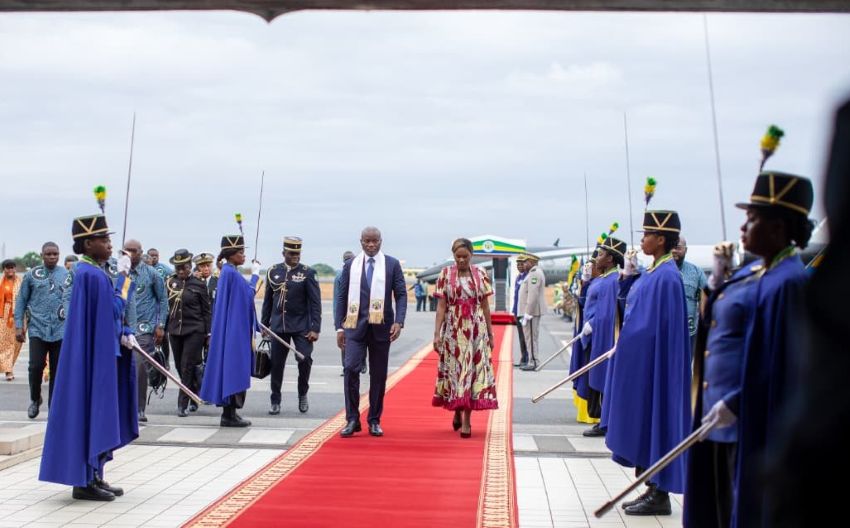
Libreville, Saturday, August 8, 2026. From July 27 to August 7, 2026, Brice Clotaire Oligui Nguema embarked on an African tour with a mission that transcended traditional diplomacy. Upon his return to Libreville on Friday, the Gabonese head of state initiated a more demanding phase.
Beyond handshakes and signed agreements, the true test now lies in execution. The success of this diplomatic engagement will no longer be measured by the number of meetings held, but by tangible outcomes: investments infused into the economy, new infrastructure projects, job creation, and expanded market access for Gabonese businesses.
Diplomacy with tangible results
The itinerary was packed with high-level political discussions alongside targeted talks on infrastructure, energy, agriculture, vocational training, trade, and investment. This shift signals a fundamental change in Gabon’s foreign policy approach—one that no longer views diplomacy as mere representation but as a strategic tool to accelerate economic transformation.
The visit to Côte d’Ivoire best exemplifies this strategy. In Abidjan, President Oligui Nguema toured industrial zones, examined key infrastructure projects, and engaged with economic leaders, including representatives from NSIA and Aurion Capital, to explore investment and energy opportunities.
This approach aligns with economic ambitions. For a nation striving to diversify its economy and maximize resource value, diplomacy must now serve as a bridge to capital, technology, expertise, and new markets. The presidential trip was as much about reinforcing state relations as it was about positioning Gabon as a prime investment destination.
From African solidarity to economic interdependence
The tour’s overarching narrative also reflects a broader vision for Gabon’s role on the continent. Libreville aims to deepen ties with African partners and contribute to a regional integration model built on mutual economic interests.
Côte d’Ivoire serves as a compelling case study. Its aggressive push into infrastructure, industrialization, and private-sector mobilization demonstrates how deliberate policies can elevate a country’s economic standing in West Africa. By studying Ivorian factories, urban development models, and mobility systems, Oligui Nguema was not merely fulfilling a diplomatic duty—he was gathering actionable insights to guide Gabon’s own economic decisions.
The strengthened Gabon-Côte d’Ivoire partnership is no longer confined to state-level goodwill. It has evolved into a platform for shared learning, financing, industrial collaboration, and skills transfer.
The same principle applies to other agreements forged during the tour. Whether in agriculture, energy, infrastructure, or education, progress will only materialize if political commitments transition into concrete action. That is where the real challenge begins.
The moment of truth for Gabon’s diplomacy
The president’s return to Libreville marks not the end of a journey, but the start of its evaluation. A results-driven foreign policy cannot be judged by the number of agreements signed; it must be measured by hard indicators: the volume of committed investments, the number of jobs created, the launch of new projects, the acquisition of technology, and the opening of new markets for Gabonese enterprises.
This is the stage where expectations are highest. The tour has strengthened Gabon’s diplomatic footprint and opened doors to cooperation, but ambitious foreign policy only becomes transformative when it reshapes the real economy and daily life.
The white presidential sash emblazoned with Gabon’s coat of arms, worn throughout the trip, symbolizes a dual commitment: preserving national identity while embracing continental engagement. Symbols alone, however, will not suffice.
The next presidential trip may well be judged less by the distance traveled than by the projects delivered. Gabon now has a diplomatic window to attract partners, negotiate investments, and adapt successful African models. The task ahead is clear: prove that diplomacy can evolve from a showcase into a powerful engine of economic growth.
The challenge is set. The goal? To transform diplomacy from a display of Gabon’s potential into one of its most potent drivers of progress.