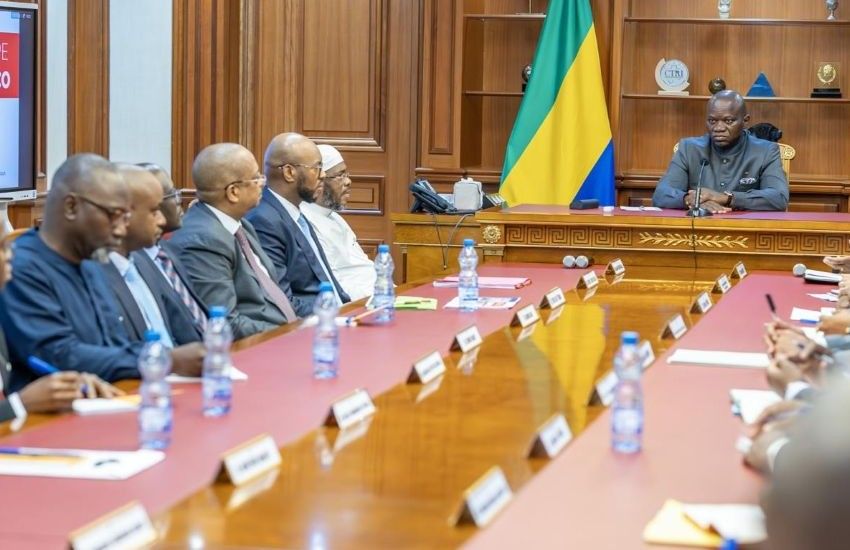
Gabon may have just opened one of the most decisive chapters of its economic transformation. By welcoming a delegation from the Guinean group SONOCO, led by its director general Abdoul Karim Diallo, President Brice Clotaire Oligui Nguema brought to life an ambition expressed weeks earlier at the Kigali Forum: to build a new development model based on productive sovereignty, African economic cooperation, and wealth creation on the continent.
More than a routine diplomatic meeting, this encounter marks the realization of a call to African investors to support Gabon’s economic repositioning. The response from SONOCO, one of West Africa’s largest private conglomerates, sends a strong signal. It reflects the growing confidence Gabon inspires among African economic actors as the country accelerates its diversification strategy.
The food sovereignty push
The choice of the agri-food sector is no coincidence. For years, food security has become one of the major challenges for African economies. Despite considerable agricultural potential, many nations still rely heavily on imports to feed their populations. Gabon is no exception: a significant share of its poultry consumption remains imported, weighing heavily on the national trade balance.
It is precisely on this front that the project led by SONOCO aims to act. The stated ambition goes well beyond simply setting up production units. The Guinean group plans to replicate in Gabon an integrated model already proven in several African countries. This strategy relies on full mastery of the value chain.
The project includes local cultivation of plant raw materials for animal feed, construction of a modern feed mill, establishment of hatcheries, brooding houses, laying farms, broiler production sites, and an industrial slaughterhouse meeting international standards.
An industrial-scale production chain
This integrated approach is one of the most strategic elements of the program. In many African countries, agricultural sectors suffer from fragmentation that limits competitiveness. By controlling every stage of production, SONOCO aims to ensure greater economic efficiency while strengthening the overall resilience of the sector.
The announced targets reveal the scale of the ambition. With an annual production set to exceed 15 million broilers, Gabon could achieve self-sufficiency in this segment and drastically reduce its reliance on imports. For a country that still imports a large portion of its food needs, the stakes are immense.
Yet the expected impact goes beyond food alone. Just as in Guinea, where SONOCO’s poultry sector already generates nearly 4,000 jobs, the Gabonese project is expected to create thousands of direct and indirect positions in agriculture, livestock, industrial processing, transport, logistics, and services. This dynamic perfectly aligns with the economic vision of Gabonese authorities: no longer merely exploit national resources, but process them locally, generate more added value, and build an industrial fabric capable of sustainably supporting growth.
The symbol of an Africa investing in Africa
Another major dimension of this partnership lies in its geopolitical significance. At a time when African states are seeking to strengthen intra-African trade, cooperation between Libreville and Conakry illustrates the emergence of a new economic paradigm: an Africa that invests in Africa, shares expertise, and builds its own value chains.
Administrative and land procedures are now underway with the relevant ministries, and the first infrastructures should be operational in the coming months. If the timeline holds, the SONOCO project could quickly become one of the most visible symbols of Gabon’s new economic policy.
In a global context marked by food uncertainties, supply chain pressures, and the need to strengthen local production, this initiative takes on a dimension that transcends Gabon’s borders. It reflects a conviction increasingly shared across the continent: Africa’s economic sovereignty will depend as much on its mines and infrastructure as on its ability to sustainably feed its populations. The partnership between Gabon and SONOCO fits precisely into this trajectory and could become one of the most accomplished examples of South-South cooperation driving Africa’s economic transformation.