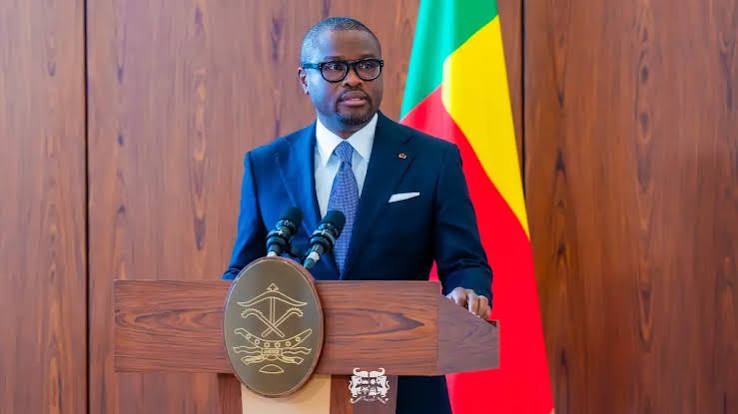
Gabon leader outlines bold economic and political vision
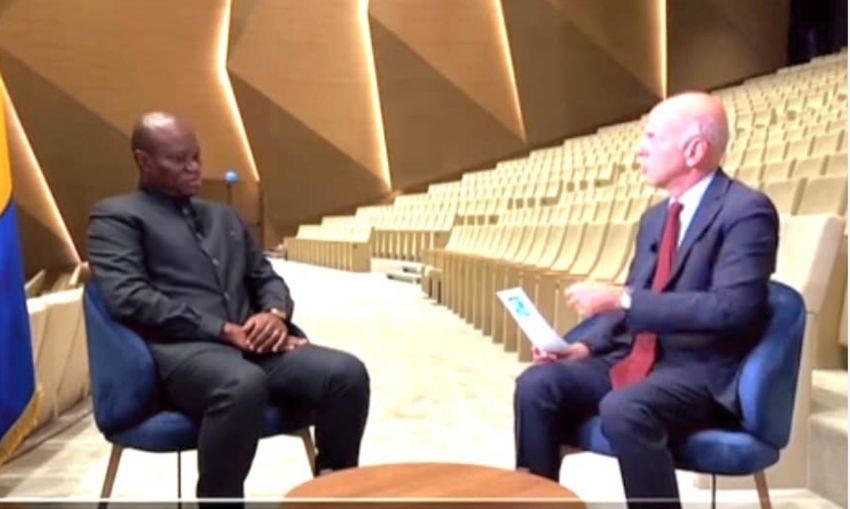
Libreville, June 3, 2026 — In a landmark interview with a major international broadcaster, Gabon’s Head of State outlined a sweeping vision for the nation’s future, emphasizing economic sovereignty, progressive reforms, and the rejection of dynastic rule.
Three years after taking office and one year after securing over 94% of the vote in a landmark election, President Brice Clotaire Oligui Nguema used the platform to present what many are calling his first major international policy address. Speaking from the Congress Hall of the Cité de la Démocratie in Libreville, the President defended his administration’s record, defended its economic policies, and addressed pressing national and global issues with unfiltered candor.
Behind the carefully orchestrated media event lies a clear political doctrine: a government committed to long-term reform, asserting economic independence from foreign conglomerates, and redefining Gabon’s relationships with its traditional partners—without resorting to confrontation.
Progress through reform
Addressing concerns over the pace of development—particularly in access to clean water and reliable electricity—the President acknowledged the challenges faced by citizens while underscoring the scale of investments already underway. More than 800 billion CFA francs have been committed to energy infrastructure upgrades, a figure he insists reflects a commitment to sustainable progress.
President Oligui Nguema cautioned against judging national transformation by short-term benchmarks. His message underscores a governance philosophy built on incremental progress rather than instant results—a principle now central to his administration’s communication strategy.
Economic sovereignty as national doctrine
It was on the economic front that the President delivered some of his most consequential remarks. He confirmed Gabon’s intention to negotiate with the International Monetary Fund—but only after a comprehensive audit of the country’s public finances. This measured approach signals a broader ambition: to regain control of the nation’s financial commitments before entering new international agreements.
The mining sector also came under sharp focus. The announcement that Gabon will ban the export of unprocessed manganese starting in 2029 marks a pivotal shift in national policy. As one of the world’s leading producers, Gabon is determined to process more of its mineral wealth domestically. The directive to French mining giant Eramet is unambiguous: processing facilities must be operational before the deadline—or raw ore exports will halt.
This stance reflects a broader strategy to rebalance power between the state and multinational corporations, ensuring greater value creation remains within Gabon’s borders.
A balanced diplomacy
On the international stage, President Oligui Nguema emphasized that asserting Gabonese sovereignty does not equate to isolation. He reaffirmed an upcoming state visit to France on July 20 and highlighted the strength of relations between Libreville and Paris. The return of Camp de Gaulle to Gabonese authorities, he explained, stems from a collaborative process—not a confrontational one, as seen in certain Sahelian nations. This partnership-first approach stands as a cornerstone of current Gabonese diplomacy.
The same principle guided his response to a U.S. proposal to host deportees. While not rejecting ties with Washington, the President made clear that such an arrangement did not align with Gabon’s national interests.
Rejecting dynastic rule
The interview also touched on the legacy of former President Ali Bongo Ondimba. In measured tones, the current leader referenced the health of his predecessor and hinted that accountability for past governance failures should be sought elsewhere.
Yet it was his stance on political succession that drew particular attention. In a region where extended mandates and familial political dynasties persist, President Oligui Nguema declared unequivocally that no political dynasty bearing his name would emerge. He affirmed the seven-year presidential term—renewable once—as an inviolable constitutional principle, framing it as part of a broader effort to institutionalize democratic alternation.
A presidency under scrutiny
Beyond policy declarations, the interview revealed the ideological foundation of Gabon’s current leadership. Economic sovereignty, local resource processing, balanced international partnerships, phased infrastructure reform, and a stated commitment to democratic alternation form the pillars of this vision.
The ultimate test, however, lies in implementation. While the President retains significant political capital, public expectations remain high. Gabonese citizens, the President acknowledged, will judge not by rhetoric, but by tangible outcomes. One year into his mandate, Brice Clotaire Oligui Nguema has pledged to restore Gabon’s control over its economic and political destiny. Whether this ambition translates into lasting change now falls to the nation—and to history.

François Mvondo
Journalist