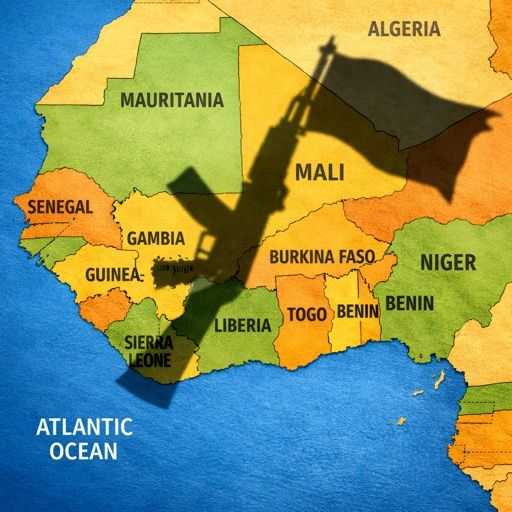
Since its emergence in 2017, the Al-Qaeda affiliate known as Jama’at Nusrat al-Islam wal-Muslimin (JNIM) has established itself as a dominant militant force in the central Sahel. Operating through various katibas, the group has successfully challenged state authority in large swathes of Mali, Niger, and Burkina Faso, effectively competing for territorial governance.
However, recent trends in West Africa Sahel news indicate a strategic shift. Since 2019, JNIM has been pushing southward toward the Gulf of Guinea. This expansion has led to significant operations in northern Bénin, Togo, and Côte d’Ivoire. While this movement appears to be a calculated strategy by JNIM leadership, it remains inconsistent: Ghana has remained untouched, and while Côte d’Ivoire faced attacks between 2020 and 2022, militant activity there has since stalled. Conversely, the security Sahel situation in Bénin saw a sharp decline throughout 2025.
The strategic dilemma of territorial growth
A recent report by the International Crisis Group delves into the complex geography of this expansion. It suggests that spreading further south is not a simple choice but a profound dilemma for the organization. Internal divisions often arise as different leadership levels prioritize different goals. While failing to expand might allow rival factions to seize territory, moving too quickly risks overextending resources and triggering internal fragmentation.
In the current political Sahel landscape—defined by the emergence of the Alliance of Sahel States (AES), their departure from ECOWAS, and ongoing regional friction—analyzing JNIM’s internal logic is vital. Such understanding is necessary for developing effective security Sahel policies in neighboring coastal nations.
Event details and participants
This discussion is organized by the Africa Programme and the research group focused on citizenship, violence, and politics at CERI.
- Date: February 24, 2026, from 18:00 to 19:30
- Location: Room K011, 1 pl. Saint-Thomas-d’Aquin, 75007, Paris
Featured speakers
Jean-Hervé Jézéquel (International Crisis Group): As the Sahel Project Director, he specializes in the political and security dynamics of the region. He earned his doctorate from the EHESS in 2002.
Marte Beldé (Sciences Po Bordeaux): A postdoctoral researcher involved in the GOVJIHAD project, her work examines the economic and spatial growth of jihadist movements. She completed her PhD at Ghent University in 2025, focusing on militant expansion in Sikasso, Mali.
Beatriz de León Cobo (GEMASS – Sorbonne Université): A doctoral candidate researching radicalization, she is an Associate Fellow at RUSI in London and leads the Europe-Sahel Dialogue Forum in Madrid.
Moderator: Dan Sanaren (CERI–Sciences Po / CNRS)