Two african capitals, two visions of constitutional rule
When courts draw the line between power and legality
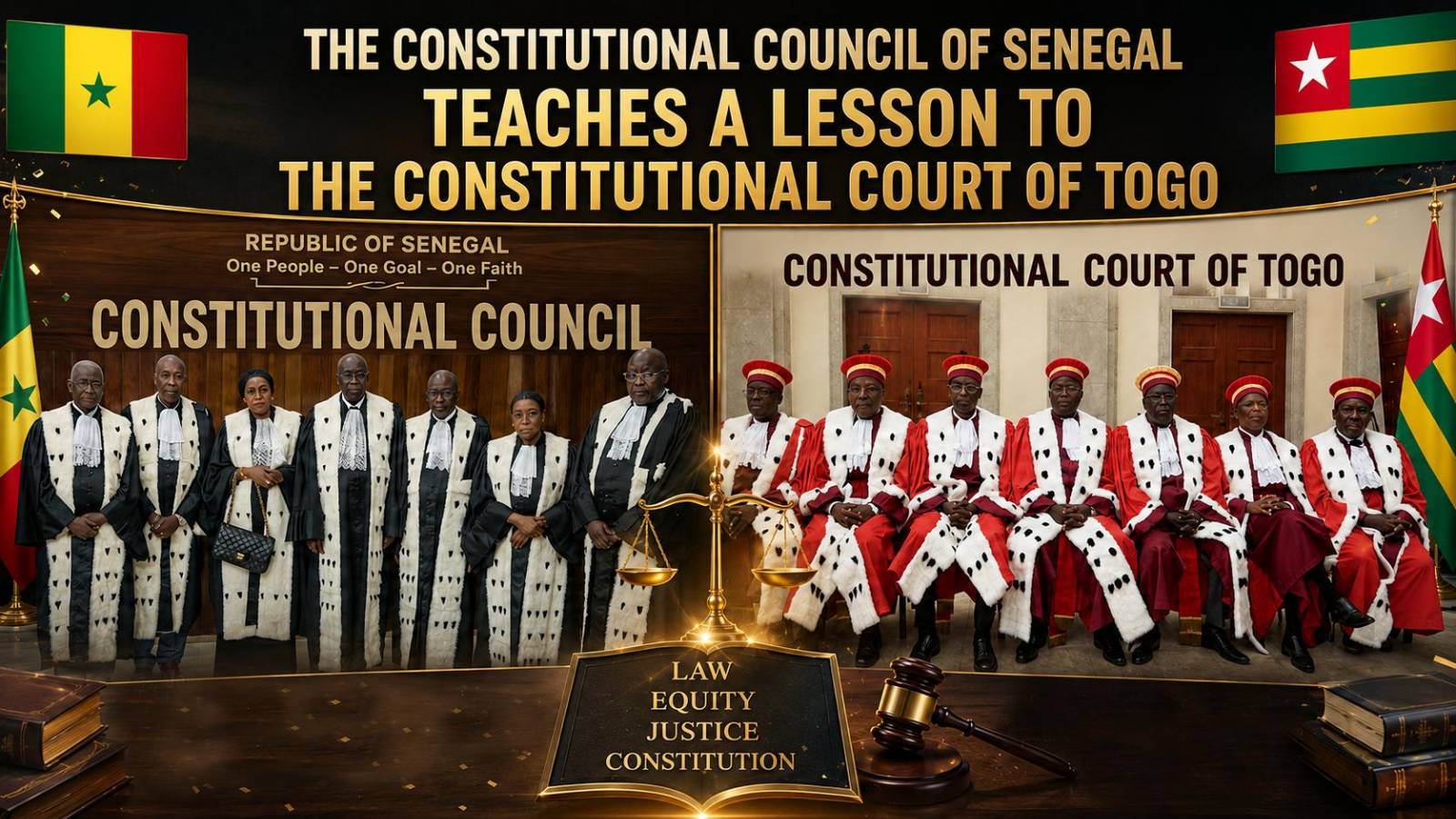
The constitutional courts of Dakar and Lomé have recently laid bare two radically different interpretations of the rule of law in West Africa. One jurisdiction has drawn a clear boundary around executive ambition; the other has been accused of rubber-stamping political change without sufficient safeguards.
Senegal: judges put the constitution first
At the heart of the Senegalese capital, the Constitutional Council delivered a landmark ruling that reaffirmed an unassailable principle: no political mandate, however sweeping, can override the Constitution. The decision blocked a sweeping constitutional amendment championed by the government of Prime Minister Ousmane Sonko and endorsed by the parliamentary majority. In a single stroke, the judges reminded the nation that elections confer authority, but not the right to rewrite the rules at will.
The verdict underscored a vital truth: in a functioning democracy, legitimacy begins and ends with constitutional fidelity. By refusing to yield to pressure from the executive branch, the Council demonstrated how an independent judiciary can anchor stability and protect citizens from the volatility of shifting political majorities.
Togo: critics question the legitimacy of deep constitutional change
Across the border, Togo’s Constitutional Court has taken a markedly different path. It validated a sweeping overhaul of the country’s foundational law despite vocal objections from opposition parties, civil society organisations and a number of legal scholars. Critics argue that the reform was rushed through without inclusive national debate and fundamentally alters the institutional architecture of the state. When a constitution is perceived as a tool of political convenience rather than a durable social contract, its moral authority inevitably erodes.
Such a perception carries real consequences. Citizens may conclude that domestic legal avenues offer little protection, pushing disputes toward regional courts. Indeed, the ECOWAS Court of Justice has already intervened in multiple cases concerning rights and freedoms, highlighting the limits of Togo’s internal oversight mechanisms. A judiciary that appears aligned with the executive risks undermining confidence in the entire system and invites external scrutiny.
Why judicial independence is the bedrock of stability
The Senegalese experience provides a clear lesson: a truly independent constitutional court acts as the ultimate firewall against political crises. By striking down measures that violate the Constitution, the Council prevents institutional clashes and preserves the credibility of the state. Crucially, it also reassures investors, development partners and ordinary citizens that the rules of the game will not be rewritten overnight.
Predictability in law is a currency that buys both domestic calm and international trust. When a constitutional court can censure government action without fear of reprisal, it signals that no actor—regardless of electoral strength—is above the law. This consistency strengthens governance, deters future abuses and enhances a country’s standing on the global stage.
By contrast, a court that routinely approves executive initiatives risks becoming a mere extension of the presidency. Over time, such deference erodes public confidence in domestic institutions and pushes aggrieved parties to seek remedies abroad. The resulting erosion of legitimacy can discourage investment, strain diplomatic relations and deepen political polarisation.
Constitutions are not playthings of the moment
The manner in which a constitution is amended shapes the health of a democracy for decades. In mature democracies, constitutional reforms are preceded by exhaustive consultations, robust debate and a search for broad consensus. The goal is not to satisfy the immediate priorities of a single administration, but to safeguard the rules that will govern future transitions of power.
When amendments are seen as partisan tools rather than collective agreements, they set dangerous precedents. Each incoming majority may feel emboldened to reshape institutions to its liking, fostering chronic instability and concentrating authority in the hands of the executive. Over time, the constitution ceases to be a neutral framework and becomes itself a source of conflict.
Togo’s authorities have cited international study tours—including visits to India—as part of their preparation for a parliamentary transition. While comparative learning can be valuable, it cannot replace the hard lessons drawn from African contexts that share similar political, social and historical realities. The continent offers numerous examples of countries where durable democracy has flourished not through imported blueprints, but through rigorous respect for constitutional principles.
A question of credibility
The divergent paths of Dakar and Lomé reveal that constitutions are only as strong as the institutions charged with upholding them. A constitutional court that acts with courage and integrity bolsters public trust, attracts investment and enhances a nation’s reputation. Conversely, a court perceived as compliant risks undermining the very foundations it is meant to protect.
Ultimately, the contrast between the two capitals is less about the texts themselves than about the philosophy that guides their interpretation. In Senegal, the Constitution stands as a limit on power; in Togo, critics warn it is increasingly treated as an instrument of political expediency. A resilient democracy is measured not by the frequency of constitutional amendments, but by the capacity of its institutions to shield citizens from the excesses of every branch of government—today and for generations to come.