The Sahel security crisis: Mali’s escalating instability and Algeria’s strategic dilemma
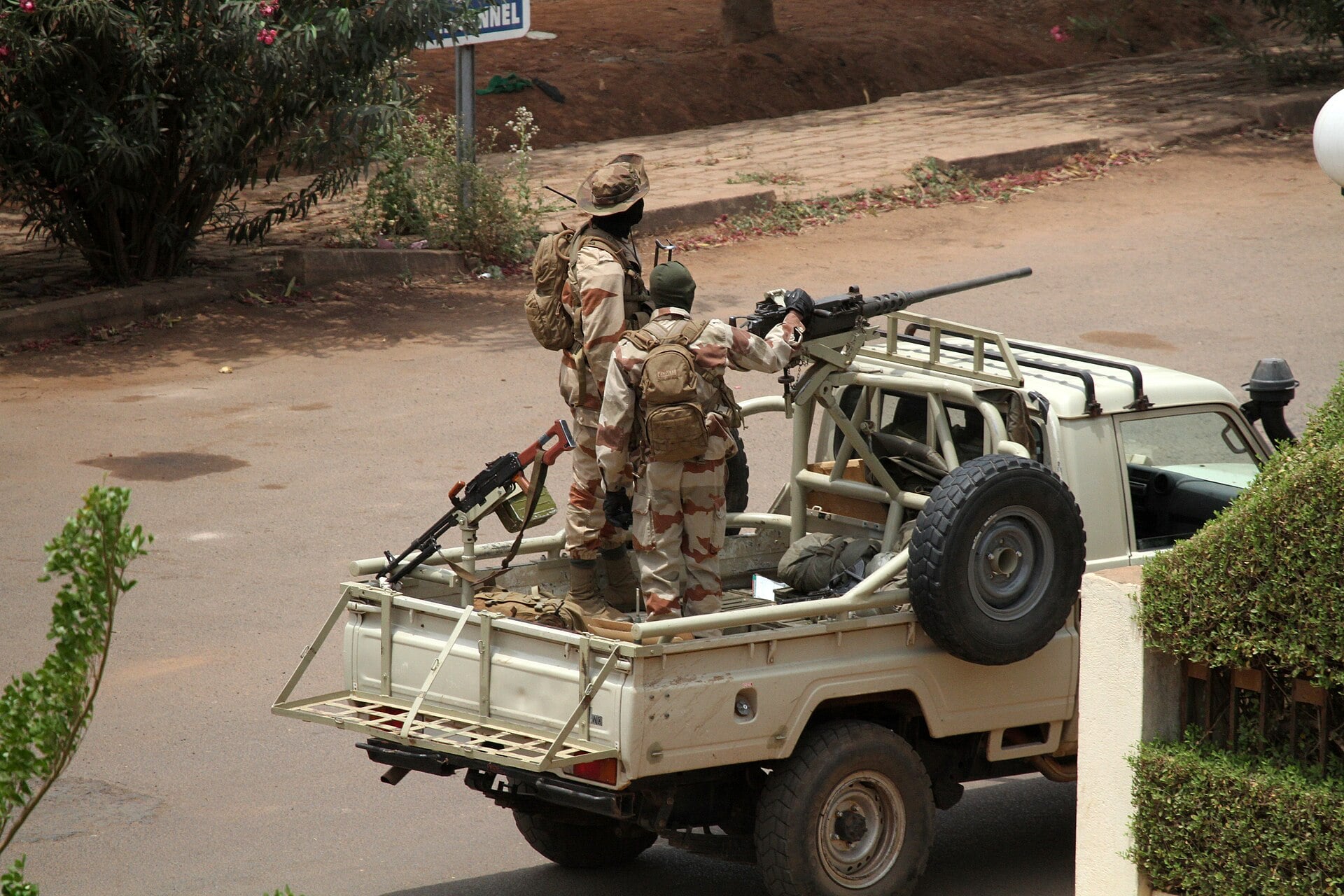
The extensive offensive that swept across Mali on April 25th represented more than just another chapter in the nation’s decade-long descent into turmoil; it signaled a critical turning point. Islamist insurgents and Tuareg factions launched synchronized assaults on military facilities and significant population centers, successfully dislodging Russian-backed government forces from the strategically vital northern town of Kidal. This demonstrated an operational reach that now directly imperils Bamako itself. For the wider Sahel region, and particularly for Algeria, the fundamental question is no longer about whether the area is becoming unstable, but rather if any entity possesses the capability to halt its accelerating deterioration.
Junta’s Miscalculation Backfires
To grasp the circumstances that led Mali to this precarious juncture, one must revisit the pivotal political decisions made in the aftermath of the 2021 coup. The military junta, under the leadership of Colonel Assimi Goita, expelled French military contingents, terminated the United Nations peacekeeping mission MINUSMA, and enlisted the Wagner Group (now operating under Russian state oversight) as its primary security provider. Western observers cautioned that this strategic pivot would inevitably create a security void. The junta, however, dismissed these warnings as mere neocolonial interference. The April offensive has, tragically, corroborated every one of those forewarnings.
Far from being the decisive counter-insurgency force they were purported to be, Wagner’s Russian successors have now been driven from Kidal, a location of immense symbolic and strategic importance, recognized as the historical epicenter of Tuareg resistance. The militant groups not only withstood Russian firepower but also adapted, coordinated their efforts, and advanced. The security apparatus for which the junta exchanged French logistical support and invaluable Sahelian institutional knowledge is proving woefully inadequate against a threat that has only grown more sophisticated.
The Islamist-Tuareg alliance spearheading this offensive is, in itself, a revealing development. Historically, these two forces have often been at odds, competing for control over the same ungoverned territories in northern Mali. Their current tactical alignment suggests a shared conviction that the junta’s weakness is sufficient to warrant simultaneous pressure. This assessment is likely accurate.
Algeria’s Uncomfortable Reality
No external actor observes Mali’s deepening crisis with greater apprehension than Algeria. Algiers shares an expansive, permeable southern border with Mali, a frontier that for many decades has functioned as a conduit for illicit arms, narcotics, migrants, and militant recruitment networks. Algerian officials, drawing from painful past experiences, understand intimately that unaddressed security crises do not remain localized; they invariably spill across borders and metastasize.
The irony inherent in Algeria’s current predicament is profound. Algiers dedicated years to cultivating its image as the indispensable regional mediator, notably brokering the 2015 Algiers Peace Agreement between Bamako and various Tuareg factions. That accord effectively collapsed when Goita formally renounced it in early 2024, a move interpreted by Algiers as a deliberate affront. Relations deteriorated further in March 2025 when Algerian forces shot down a Malian drone operating near their shared boundary, precipitating a diplomatic rupture with Bamako and its allies in Burkina Faso and Niger, all three of whom are members of the Russia-aligned Alliance of Sahel States.
Algeria now finds itself diplomatically isolated from the very crisis to which it is most exposed. It lacks the leverage to impose a resolution on Mali. Reliable coordination with a junta that views it with hostility is impossible. And it cannot afford to disregard the unfolding events, as the alternatives—including the establishment of permanent armed group sanctuaries along Algeria’s southern flank—pose existential threats to Algerian internal security.
Algerian Foreign Minister Ahmed Attaf adopted a resolute public stance this week, reaffirming support for Mali’s territorial integrity and unequivocally condemning terrorism. However, declarations of principle cannot compensate for the absence of a functional diplomatic channel that no longer exists.
Washington’s Diminished Role in Sahel Stability
The unraveling of the Sahel is also a narrative shaped by American disengagement. The United States scaled back its counter-terrorism presence across West Africa, largely due to pressure from regional governments increasingly aligned with Moscow, and has failed to replace that presence with any cohesive alternative. The consequence is a power vacuum, partially filled by Russia through military contracting, but more comprehensively occupied by Islamist networks offering governance, taxation, and recruitment in territories abandoned by the state.
The crucial lesson currently being etched in Mali demands careful consideration by Washington. Military collaborations, intelligence sharing, and sustained counter-terrorism pressure are not optional components of regional stability; they are its fundamental prerequisites. When these elements recede, the vacuum does not remain neutral; it is actively filled.
Prospective Trajectories for Mali
Three potential paths now seem plausible. The Malian junta could pursue a political settlement with Tuareg groups, halting the military decline at the cost of significant territorial concessions. Alternatively, it could intensify its military efforts, relying on Russian aerial and ground support to contest the north, with uncertain outcomes. Or, it might persist in its current pattern of tactical withdrawals while publicly asserting its legitimacy, until Bamako itself becomes a contested battleground.
Algeria observes all three scenarios with profound apprehension. The implosion of the Sahel is no longer a distant humanitarian concern; it is rapidly approaching its border.