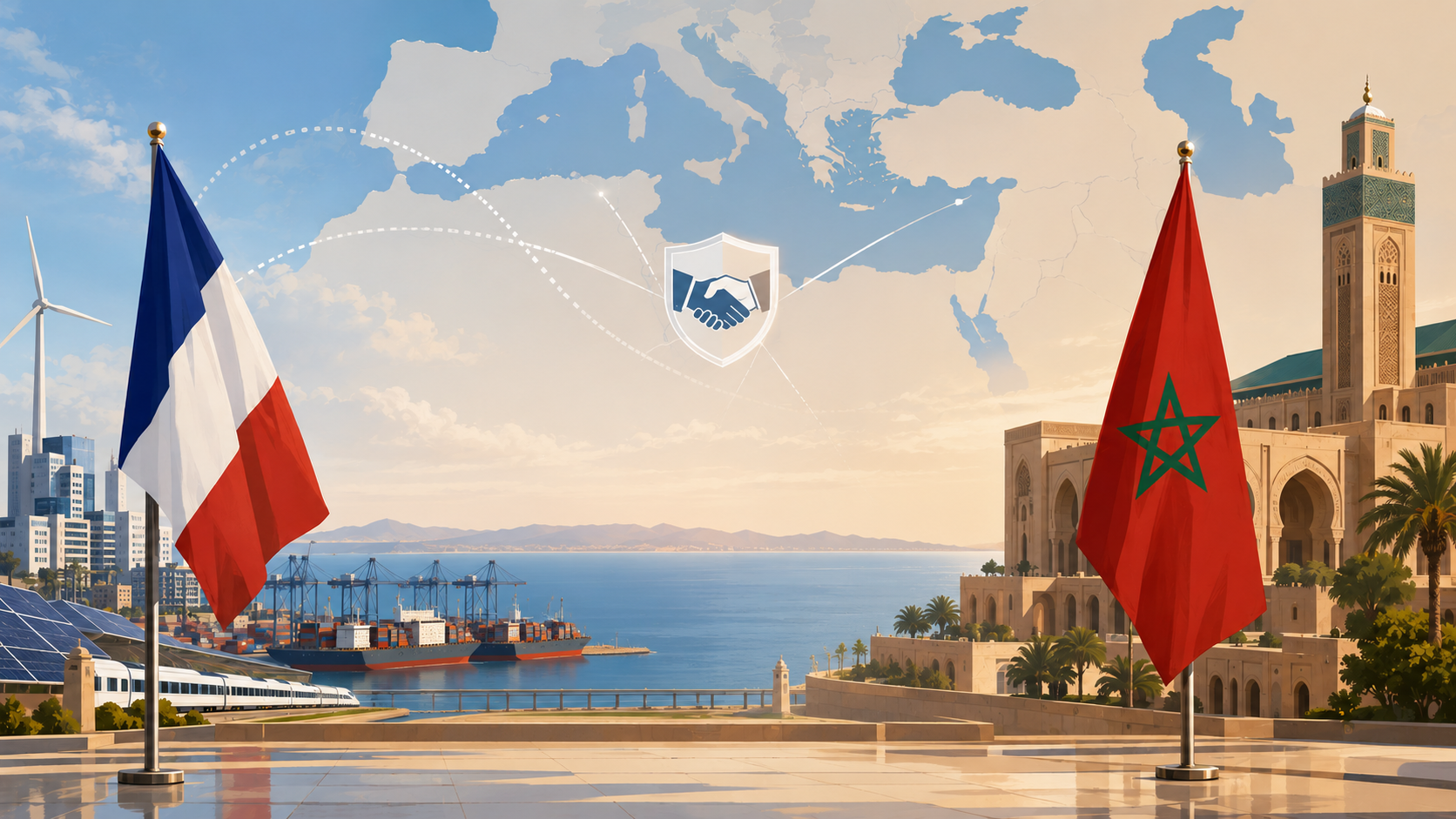
The two-day official visit of French Prime Minister Sébastien Lecornu to Rabat, accompanied by a dozen ministers, marks more than just a diplomatic formality. This mission signals a bold political commitment, solidifying an extraordinary new chapter in bilateral relations that had experienced a brief slowdown before 2024. As the first high-level intergovernmental meeting of its kind since 2019, it underscores that ties between Paris and Rabat have entered a decisive phase: one defined by an exceptional partnership slated to be formalized through a binding bilateral treaty.
This visit validates the observations in my recently published book, Morocco, the Power of Stability. Amid a Mediterranean and Middle Eastern landscape plagued by crises, the Kingdom has emerged as one of the few reliable bastions of stability that France must increasingly rely upon.
A stable anchor in a shifting region
From the Sahel to Libya, persistent tensions in the Middle East, and the lingering uncertainties surrounding Iran’s nuclear negotiations, the post-Arab Spring era has seen an explosion of crises. The Mediterranean has reemerged as a strategic frontier where terrorism, migration flows, energy rivalries, and great-power competition collide.
In this volatile environment, Morocco stands out. The Kingdom has maintained remarkable political stability while modernizing its economy, infrastructure, industrial sector, and defense capabilities. It has earned the trust of the United States, the European Union, and Gulf monarchies, while expanding its influence across Africa. Its diplomacy, rooted in dialogue and pragmatism, enables it to engage with actors who have long ceased direct communication. This knack for bridging divides rather than deepening them is now one of its defining geopolitical strengths.
The linchpin of France’s strategic interests
Since France reaffirmed its support for Morocco’s sovereignty over the Sahara and following President Macron’s state visit to Rabat in October 2024, bilateral relations have taken on a new dimension. Both nations have officially launched an enhanced exceptional partnership, designed to structure cooperation across security, defense, energy, industry, innovation, infrastructure, and culture.
The arrival of Prime Minister Lecornu with such a high-profile ministerial delegation demonstrates that this ambition is no longer merely diplomatic—it is now operational. Defense, intelligence, internal security, investments, energy, transportation, artificial intelligence, and training: rarely have so many sectors converged under a single political vision.
This level of governmental mobilization reflects a deliberate choice to build a long-term relationship between two states whose strategic interests are increasingly aligned.
A partnership built on deep trust
Morocco is no longer just a neighbor south of the Mediterranean; it has become a cornerstone of France’s security architecture. It plays a leading role in counterterrorism efforts, serves as a key stabilizing force in the Sahel, acts as an industrial hub for Europe, functions as a logistical gateway linking both sides of the Mediterranean, and serves as a primary entry point into Sub-Saharan Africa.
In a world where supply chains are increasingly fragile, migration pressures intensify, and energy geopolitics reshuffle alliances, having such a reliable partner offers France a significant strategic advantage. The cooperation between French and Moroccan intelligence and security services is widely recognized as among the most effective in combating terrorism and organized crime. This trust was not built overnight—it is the result of years of shared effort and mutual benefit.
A mutually beneficial alliance
The Franco-Moroccan relationship transcends historical ties or human connections—it now reflects a geopolitical necessity. As Europe seeks to secure its energy supplies, strengthen its presence in Africa, and stabilize its Mediterranean neighborhood, Morocco stands out as a natural ally. Its industrial growth, port strategy centered on Tanger Med, commitment to renewable energy, and outreach into Africa position it as an indispensable player in the new Euro-African value chains.
From automobile and aerospace industries to green hydrogen, rail infrastructure, artificial intelligence, security cooperation, and military partnerships, few bilateral relationships have witnessed such a broad and positive convergence of interests. While many international partnerships fracture under pressure, the one uniting Paris and Rabat proves that a relationship grounded in political trust, mutual respect, and shared goals can yield tangible results.
The recent events—including this historic visit by the French Prime Minister with a sizable ministerial delegation—only reinforce a clear truth: in a Mediterranean fraught with tension and a Middle East in flux, Morocco has become one of France’s most solid, reliable, and strategic partners.
Ultimately, this exceptional relationship is no longer just a legacy of history—it is a forward-looking choice. For France, making Morocco its principal strategic partner south of the Mediterranean may well be the wisest investment in navigating today’s rapidly changing world.

François Mvondo
Journalist
Related Story