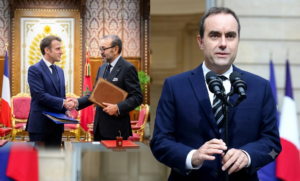
France’s Prime Minister, Sébastien Lecornu, is leading a high-profile government delegation of twelve ministers to Morocco today for the 15th Franco-Moroccan High-Level Meeting (HLM). This gathering is set to inject fresh momentum into the long-standing strategic partnership between the two nations.
The delegation includes key ministers such as Laurent Nunez (Interior), Catherine Vautrin (Armed Forces and Veterans Affairs), Roland Lescure (Economy, Finance, and Industrial Sovereignty), Annie Genevard (Agriculture), Jean-Noël Barrot (Europe and Foreign Affairs), Naïma Moutchou (Overseas Territories), Catherine Pégard (Culture), Philippe Tabarot (Transport), Sabrina Roubache (Vocational Education), Anne Le Hénanff (Artificial Intelligence and Digital), Nicolas Forissier (Foreign Trade and Attractiveness), and Éléonore Caroit (Francophonie and International Partnerships).
Senator Christian Cambon, head of the France-Morocco Friendship Group in the Senate, and Deputy Karim Ben Cheikh will also join the delegation and engage with leaders of Morocco’s two parliamentary chambers.
Strengthening bilateral ties through dialogue
The 15th HLN, hosted at the Moroccan Ministry of Foreign Affairs, will be co-chaired by both prime ministers. This mechanism, first established in 1997, last convened in December 2019 in Paris.
The meeting follows the signing of the Enhanced Exceptional Partnership in October 2024 between King Mohammed VI and President Emmanuel Macron, aiming to assess ongoing projects and outline new priorities for collaboration.
Discussions will span internal security, irregular migration control, organized crime, narcotics trafficking, cultural exchanges, agriculture, infrastructure, water management, administrative modernization, artificial intelligence, defense industries, and preparations for the 2030 FIFA World Cup.
Economic initiatives are already underway, including the expansion of Safran Electronics & Defense’s industrial site and Alstom’s new manufacturing facility in Fès.
The agenda features bilateral talks between prime ministers, sector-specific ministerial meetings, a plenary session on shared priorities, and a concluding summary by the foreign affairs ministers.
A major highlight will be the signing of around fifteen agreements spanning decentralized cooperation, the Rabat Regional Express Railway (RER), water resources, development of the Casablanca-Settat region, civil aviation, cinema, artist residencies, and the integration of Arabic language and history-geography into French school curricula.
This meeting also serves as a pivotal step toward finalizing a future bilateral treaty between France and Morocco, designed to solidify the partnership ahead of King Mohammed VI’s upcoming state visit to France.