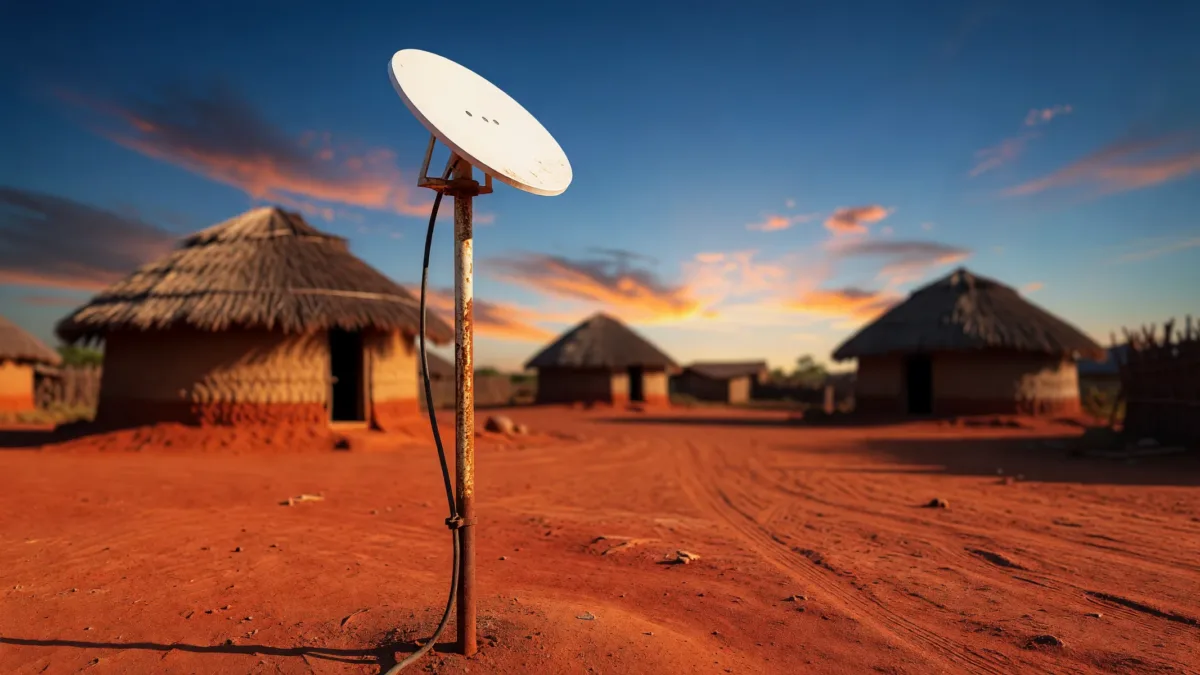
The green light has been given. Starlink, Elon Musk’s satellite internet service, is now authorized to operate in Côte d’Ivoire. The announcement was made on July 16 at the U.S. Embassy in Abidjan by Frank R. Garcia, U.S. Deputy Secretary of State for African Affairs, during an official visit that included multiple economic agreements.
Bridging the digital divide in rural areas
Starlink will leverage low-orbit satellite technology to extend high-speed internet access to rural and remote regions of Côte d’Ivoire, as confirmed by the Ivorian Press Agency. The local subsidiary had already secured a provisional 12-month license from ARTCI, the Ivorian telecommunications regulator.
This initiative arrives at a critical moment for a country where fixed broadband coverage remains sparse outside major urban centers. Unlike traditional infrastructure, Starlink’s satellite constellation delivers robust connectivity without the need for extensive ground-based installations.
170 million USD sovereign data center initiative
The approval of Starlink coincides with a significant U.S. investment in Côte d’Ivoire’s digital infrastructure. Cybastion, an American firm, has secured a $170 million financing guarantee from the U.S. Export-Import Bank to build the nation’s first sovereign data center.
Named Cybastion, this project also includes plans to modernize public services through digitalization. The data center will serve as a secure national hub for sensitive information, reinforcing Côte d’Ivoire’s digital sovereignty—a key priority for Abidjan.
Three major agreements signed in one visit
The discussions at the U.S. Embassy formalized three distinct partnerships. In addition to Starlink and Cybastion, a $293 million agreement was finalized with ABD Group to finance and develop critical infrastructure in health and education.
A separate contract was signed with NTELX to optimize truck coordination at the Port of Abidjan, aiming to enhance logistical efficiency—a vital component of the country’s economic backbone.
Côte d’Ivoire’s digital ambitions
As West Africa’s largest Francophone economy with over 29 million inhabitants, Côte d’Ivoire has set ambitious digital transformation goals. Recent years have seen efforts to digitize administrative services and expand e-government initiatives.
However, internet penetration remains uneven. While cities like Abidjan and Bouaké enjoy robust connectivity via fiber and 4G, rural areas—particularly in the north and west—lag behind. Starlink’s entry could significantly narrow this digital gap.
The U.S. is a key economic partner for Côte d’Ivoire, particularly in energy, infrastructure, and agriculture. These new agreements further solidify technological cooperation between Washington and Abidjan.
Meeting with the Vice President
Frank R. Garcia also met with Ivorian Vice President Tiémoko Meyliet Koné the same day to assess the economic partnership’s impact, according to official statements.
These developments unfold amid intensifying competition among global powers for influence in West Africa. With China, France, and the U.S. ramping up infrastructure deals, Côte d’Ivoire is strategically leveraging diverse partnerships for negotiation leverage and development. The next milestones to watch are Starlink’s full deployment and the progress of the Cybastion data center project.