Some silences are louder than confessions, and some condemnations merely dress up a surrender. As Caracas faced its defining moment in early 2026—when a sweeping American military intervention unfolded and Nicolás Maduro was swiftly removed from power—the response from the Russian Federation was nothing short of stunning in its restraint. For a nation that had long positioned itself as Venezuela’s guardian against foreign interference and a bulwark against what it termed ‘Yankee imperialism,’ this retreat into cautious diplomacy amounted to a dramatic admission of strategic failure.
Where did Moscow’s once-formidable stance go? Where were the grand alliances and high-profile treaties that once filled headlines?
diplomacy without teeth
Yes, the Russian Foreign Ministry issued its obligatory denunciation of the ‘armed aggression,’ and Foreign Minister Sergei Lavrov did invoke the sanctity of bilateral agreements. But beyond these perfunctory declarations, what concrete action followed? A handful of symbolic naval maneuvers, the belated dispatch of a submarine to escort a sanctioned oil tanker, and a faint plea for Washington to ‘uphold international law.’
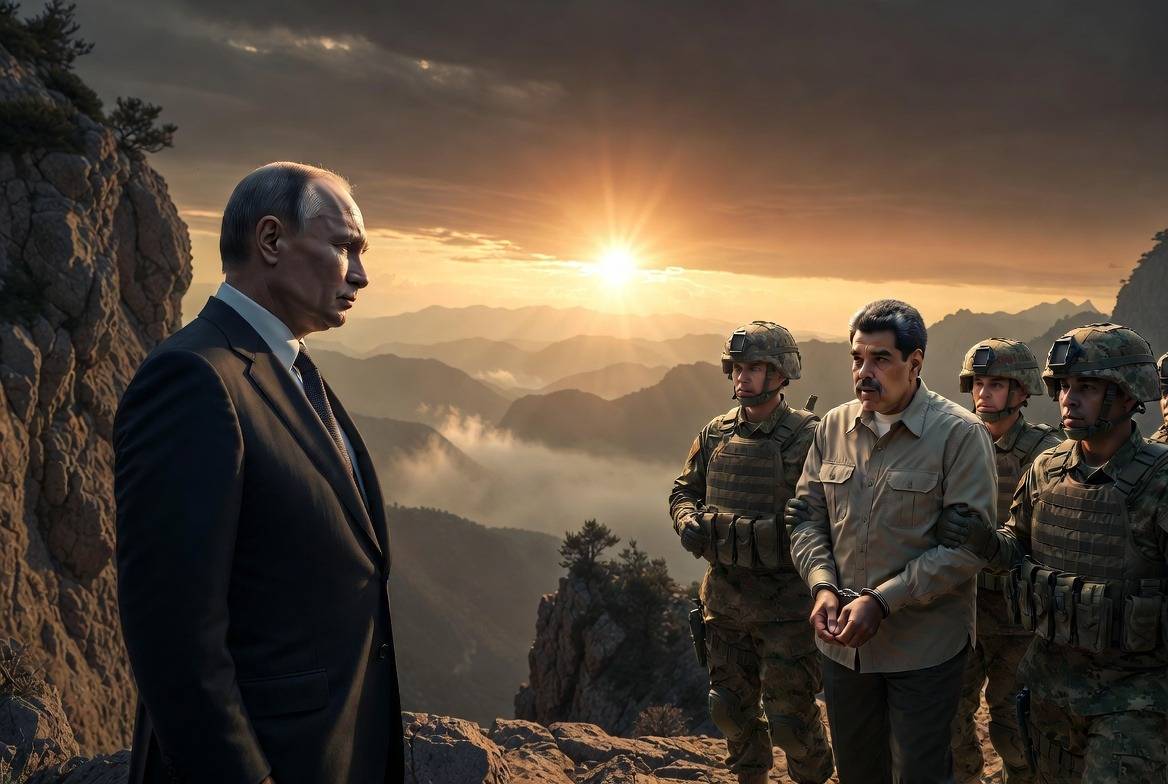
This was not deterrence—it was surrender. By refusing to mount a meaningful diplomatic counteroffensive or challenge the developments at the United Nations Security Council, Russia allowed its closest Latin American ally to be extracted to a New York detention facility without so much as a protest. Its vaunted intelligence services, usually quick to detect Western maneuvers, remained conspicuously silent, leaving Caracas exposed to the full force of a revitalized Monroe Doctrine.
The bitterness of this failure lingers: the 2025 strategic partnership treaty now reads like a hollow promise. When tested by its first real challenge, the Russian shield shattered, exposing the fragility of Moscow’s global power projection.
the weight of strategic exhaustion
This failure is not a tactical misstep—it is the inevitable consequence of exhaustion. Years of war, compounded by an ‘economy of death’ that drains financial and human resources at an unsustainable pace, have left the Kremlin with little room for maneuver. Venezuela, in this context, became an involuntary bargaining chip—or worse, collateral damage in Russia’s own isolation.
By limiting its response to perfunctory statements, Moscow has sent a chilling message to allies worldwide: Russian protection ends where Russian power wanes. The signal is clear: promises are only as strong as the resources behind them.
a geopolitical betrayal
In standing idle as a transitional government took shape under American pressure, Russia did more than abandon an ally—it endorsed the fait accompli. For the Venezuelan people, this meant trading one form of external control for another, with no credible alternative in sight.
This silence is not restraint; it is surrender. In retreating into diplomatic passivity, Russia did not merely lose a key ally or privileged access to the world’s largest oil reserves—it surrendered its role as a global counterbalance. The curtain has fallen in Caracas, and the once-proud protector was nowhere to be seen.