Peru’s elected president Fujimori backs Morocco’s Sahara autonomy plan
Keiko Fujimori, Peru’s newly elected president, reaffirms her country’s support for Morocco’s territorial integrity and UN Resolution 2797 to the Moroccan ambassador
This stance marks a significant shift from decades of ambiguous Peruvian foreign policy toward the Sahara issue
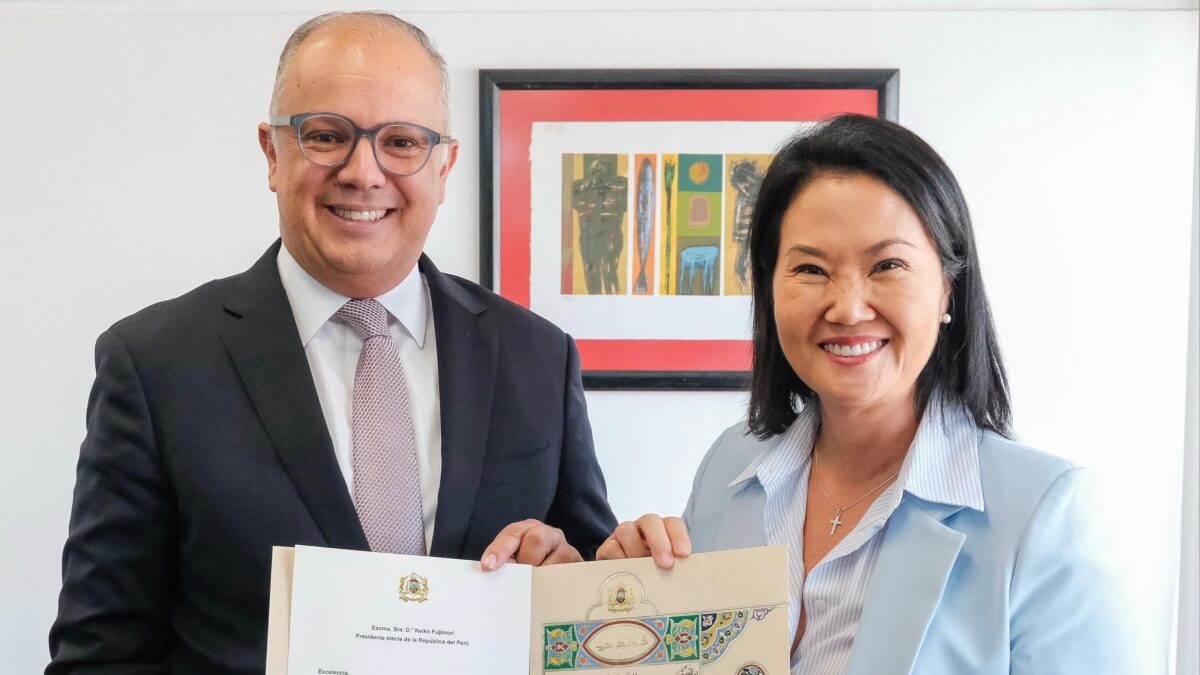
Peru’s newly elected president, Keiko Fujimori, has begun outlining key foreign policy priorities in the early weeks following her closely contested election victory. One of the most significant decisions involves Peru’s stance on Morocco’s territorial sovereignty, a topic that gained prominence during the recent visit of Morocco’s ambassador to Peru, Amine Chaoudri, who delivered a congratulatory letter from King Mohammed VI.
Read aloudDuration: 4 min
Support for Morocco’s Sahara autonomy plan
According to a statement from the president-elect’s office, Fujimori confirmed to the Moroccan ambassador that Peru’s government will support Morocco’s territorial integrity and its autonomy initiative for Western Sahara. She also expressed full backing for UN Security Council Resolution 2797, which recognizes Morocco’s autonomy plan as a viable framework for resolving the long-standing regional dispute.
During the meeting, the Moroccan ambassador presented Fujimori with a letter from King Mohammed VI congratulating her on her election. The monarch emphasized the strong historical ties between Morocco and Peru, built on mutual respect and shared values, and expressed his commitment to strengthening bilateral relations into a comprehensive strategic partnership benefiting both nations.
End to previous ambiguity
Fujimori’s position carries particular weight, signaling a clear departure from Peru’s previous governments’ ambiguous stances on the Sahara issue, which often leaned toward recognition of the Polisario Front. This shift in policy represents a return to the position established by her father, former President Alberto Fujimori, who suspended Peru’s recognition of the self-proclaimed Sahrawi Arab Democratic Republic (SADR) in 1996.
Peru’s recognition of SADR dates back to 1984 under President Fernando Belaúnde Terry, with diplomatic relations established in 1987 under President Alan García. These ties persisted until 1996, when Alberto Fujimori terminated them. Subsequent administrations maintained this status quo until recent years saw renewed ambiguity under President Pedro Castillo, who briefly restored relations with the Polisario in 2021 before his removal from office.
Morocco-Peru diplomatic shift
Peru’s new stance aligns with Morocco’s intensified diplomatic efforts across Latin America, where the Polisario Front had previously enjoyed considerable support. Through enhanced economic, cultural, and educational cooperation, Morocco has successfully strengthened ties with multiple nations in the region, positioning itself as a strategic gateway to Africa, Europe, and the Arab world.
This diplomatic push has led several countries that previously recognized SADR—including Colombia, Guatemala, Paraguay, the Dominican Republic, Haiti, Jamaica, El Salvador, Guyana, Ecuador, and Panama—to either suspend recognition or sever diplomatic relations with the separatist entity.
Morocco’s diplomatic offensive in Latin America
The shift in Peru’s position reflects the broader success of Morocco’s regional strategy. By emphasizing shared economic opportunities and mutual development, Morocco has repositioned itself as a key partner, countering the Polisario’s influence through concrete cooperation initiatives rather than political confrontation.