Peace process DRC-Rwanda stalled by lack of US strategy
Peace process between DRC and Rwanda hits deadlock amid Washington’s strategic vacuum
- Security
The peace process between the Democratic Republic of Congo (DRC) and Rwanda remains completely stalled, according to Jason K. Stearns, Associate Professor at Simon Fraser University, who spoke during a Space session hosted by journalist Stanis Bujakera Tshiamala. He emphasized that both the Doha-Montreux and Washington-led negotiation tracks have yielded no tangible results over the past year.
No progress in Montreux talks
Stearns noted that the Montreux negotiations have seen minimal changes, with major disagreements persisting between the Congolese government and the AFC/M23 rebel group. Despite the signing of multiple agreements under US mediation, implementation remains the core challenge.
Washington’s approach: agreements without substance?
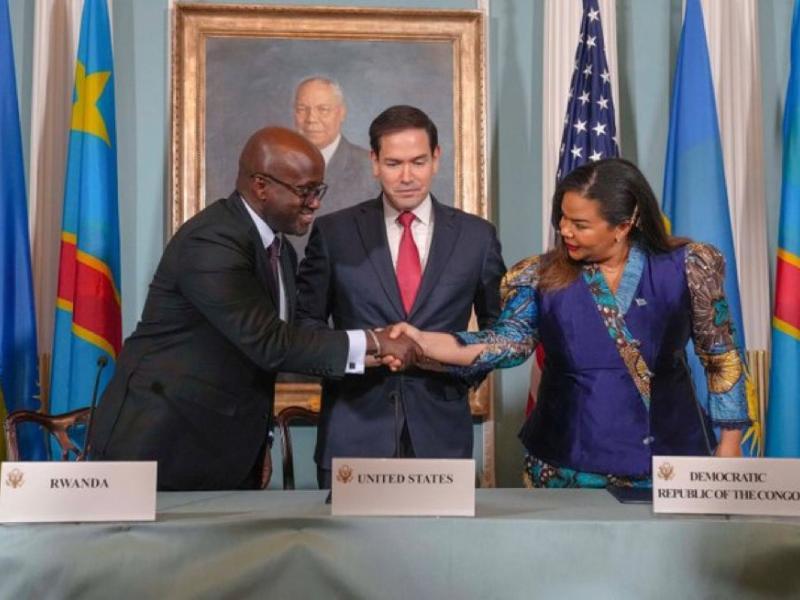
Comparing US diplomacy to other cases, such as Iran, Stearns argued that while the Trump administration has shown strong diplomatic engagement, it risks settling for memorandums of understanding (MOUs) and declarations without ensuring real progress. He stressed that the true test lies in moving beyond these frameworks to achieve a concrete compromise, which currently remains elusive.
The recurring DRC-Rwanda compromise
The proposed compromise between Kinshasa and Kigali, Stearns explained, mirrors past agreements—including the 2003 Global and Inclusive Agreement—calling for Rwandan troop withdrawal in exchange for Congolese commitment to dismantle the FDLR. Yet, implementation has stalled, with no visible progress.
On the M23 front, Stearns highlighted an absolute lack of compromise: while the Congolese government continues to rely on military solutions, the rebel movement has vowed to remain active for another decade. The researcher concluded that the prospects for success are extremely slim.
Why is the process failing?
Stearns acknowledged that the Trump administration has introduced a new level of pressure compared to previous mediations by the East African Community and the African Union (via Angola). Sanctions on Rwanda, he noted, are more aggressive than ever since the Congo wars began in 1996.
However, two critical weaknesses undermine this approach:
- Inconsistent international backing: While Washington imposes sanctions on Rwanda, European partners—key financial backers of Kigali—have not followed suit. Stearns pointed out that Rwandan President Paul Kagame continues to sign high-profile agreements, such as sports partnerships with US teams, which contradicts the image of a leader under severe pressure.
- Absence of a clear global strategy: Despite US diplomats’ claims of exerting pressure, Stearns contends that Washington lacks a defined strategy for achieving a compromise. He shares the view that a military solution is not viable but argues that the diplomatic approach remains vague and ineffective.
Stearns also revealed that US diplomats presented a vague compromise proposal during the Montreux talks, offering the M23 partial integration—though he had not seen the actual text. Both parties rejected the offer.
Finally, Stearns emphasized that the Congolese government has not faced equivalent diplomatic pressure from the US, unlike Rwanda. This imbalance further complicates the path to resolution.