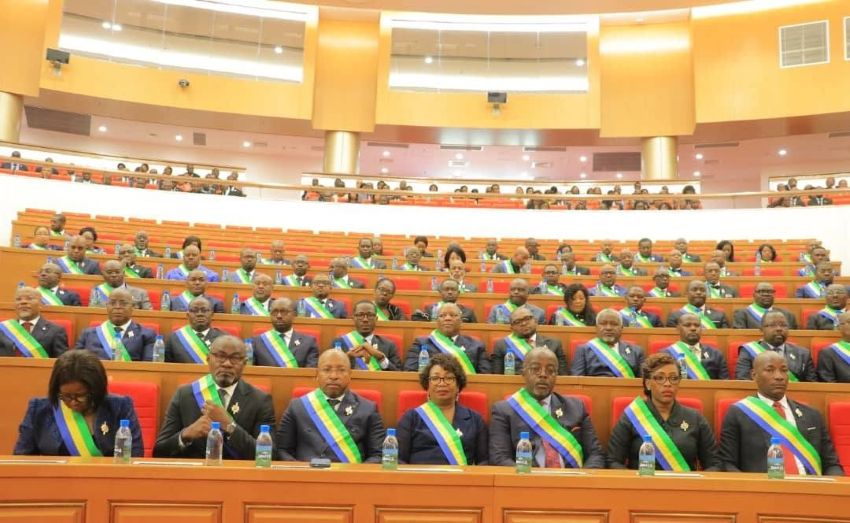
Libreville, Monday 15 June 2026 — A historic moment unfolded in Gabon’s political landscape today as President Brice Clotaire Oligui Nguema addressed a joint session of Parliament for the first time under the Fifth Republic’s Constitution. This unprecedented gathering marked not just a procedural milestone but the beginning of a fundamental shift in the nation’s governance framework.
The event signals more than a routine constitutional obligation; it represents the deliberate repositioning of Parliament as the cornerstone of the republic. No longer confined to legislative functions, the National Assembly is emerging as the central arena where executive accountability meets democratic representation. The Léon Mba Palace, long the symbolic seat of executive power, now hosts a new ritual of governance where the president himself comes to deliver his annual report.
Institutional innovation reshaping Gabon’s political landscape
The Fifth Republic’s constitutional reforms have transformed what was once an exceptional occurrence into an annual requirement. Under the new dispensation, the head of state must now appear before Parliament in joint session to present achievements, outline future plans, and respond to questions about governance. This evolution transcends mere procedural change—it embeds a culture of regular executive accountability within the heart of the state.
Unlike traditional presidential systems where power often remains concentrated in the executive branch, Gabon’s model introduces a layer of democratic scrutiny that extends beyond electoral legitimacy. The president’s presence before legislators every year creates a structured mechanism for evaluating government performance, reinforcing public trust in institutions.
The symbolic significance of the venue cannot be overstated. By convening in the National Assembly rather than at the presidential palace, the head of state acknowledges that democratic legitimacy flows from continuous engagement with elected representatives. This shift from executive dominance to institutional balance marks a profound transformation in how power is perceived and exercised.
A stronger parliament emerges as democratic watchdog
The constitutional reforms born from the 2023 national dialogue have elevated Parliament’s role to unprecedented heights. Far from its previous image as a secondary institution, the legislature now stands as a primary guarantor of the new balance of powers. The annual joint session exemplifies this redefined mandate, serving as a unifying moment where the executive and legislative branches converge despite political differences.
This gathering does more than fulfill a constitutional requirement—it cultivates republican ritual. The 215 deputies and senators assembled represent not just political factions but the nation’s diversity. Their presence transforms the event into a mirror reflecting Gabon’s social and geographical fabric, with the president’s address directed as much to the people as to their representatives.
Forging a new political culture built on transparency
Institutional traditions anchor democratic systems, providing rhythm and meaning to political life. Gabon’s annual parliamentary congress could well become one such defining ritual. Beyond its formal protocols, the event institutionalizes a governance philosophy centered on openness and institutional dialogue. Authority in this new framework derives not solely from decision-making but from explanation, justification, and accountability.
For a continent often scrutinized for institutional fragility, this innovation sends a powerful signal of stability. It demonstrates a commitment to predictable, transparent governance—qualities increasingly valued by international investors, development partners, and multilateral organizations. The Fifth Republic’s willingness to institutionalize public accountability suggests a leadership dedicated to long-term nation-building rather than short-term power consolidation.
The true significance of today’s joint session lies beyond the content of the presidential address. What enters the annals of history is not merely the words spoken but the establishment of a republican tradition. By making Parliament the common house where the executive and legislature meet annually, Gabon has laid the foundation for a more balanced and accountable form of governance. In doing so, the nation has taken its most consequential step toward redefining power—not through concentration, but through transparency and shared responsibility.