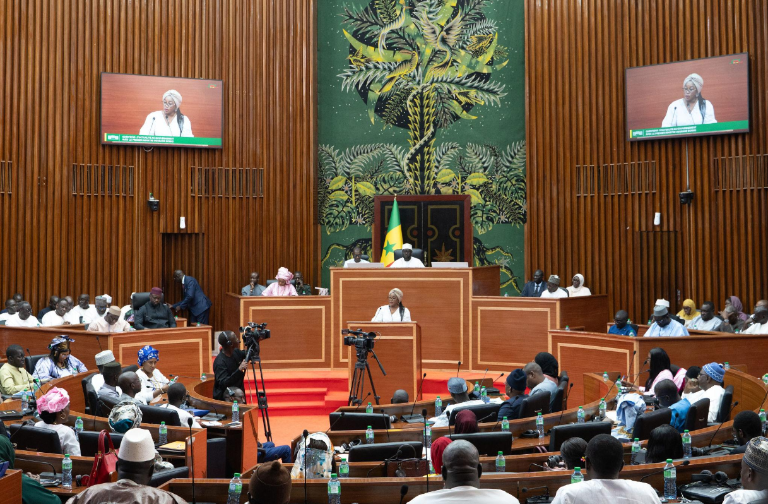
A significant step forward is underway in the relationship between Gabon and the International Monetary Fund (IMF). On July 23, in Libreville, government Vice-President Hermann Immongault hosted a delegation led by Régis Olivier N’Sondé, an administrator from the Bretton Woods institution. The primary agenda item was to define the framework for a new financial cooperation program, with the goal of signing an agreement by December 2026. Both parties concurred that this new accord would be structured around Gabon’s National Development Plan for Transition (PNCD), which serves as the Gabonese executive’s economic guiding principle.
The PNCD: cornerstone of the upcoming program
The National Development Plan for Transition (PNCD) represents the strategic blueprint adopted by Gabonese authorities for the post-transition era. Its core objectives include diversifying an economy still heavily reliant on oil revenues, modernizing national infrastructure, and strengthening public finance governance. Positioned at the heart of discussions with the IMF, the PNCD will act as the foundational matrix for the reforms Libreville commits to implementing in exchange for budgetary and technical support.
For the transitional government, aligning the PNCD with the IMF program aims to bolster the nation’s credibility among its financial partners. Following several years of fiscal pressures exacerbated by volatile hydrocarbon prices, Gabon is actively seeking to secure budgetary flexibility while maintaining its investment trajectory. An agreement with the Fund would also send a positive signal to credit rating agencies and international investors, particularly as several economies within the Central African Economic and Monetary Community (CEMAC) are simultaneously negotiating their own arrangements with the institution.
An eighteen-month negotiation timeline
The agreed-upon timeline anticipates the conclusion of technical discussions by December 2026. This relatively extended period is designed to allow Gabonese teams and IMF services to synchronize macroeconomic assessments, fine-tune fiscal consolidation targets, and establish monitoring indicators. Previous programs between Libreville and the institution encountered execution challenges, notably concerning public sector wage control and tax collection. Negotiators intend to draw lessons from these past experiences to construct a more sustainable framework.
Régis Olivier N’Sondé, who represents a group of African nations including Gabon on the IMF’s Executive Board, plays a pivotal role in this process. His involvement alongside technical teams underscores the Fund’s commitment to supporting Gabon’s political and economic transition. Discussions with Hermann Immongault specifically addressed the public debt trajectory, the mobilization of non-oil revenues, and the quality of public expenditure—three critical pillars of the PNCD.
Economic diversification and financial sovereignty in focus
Beyond the purely financial dimension, the sought-after agreement directly impacts Gabon’s economic sovereignty. Authorities are keen for the future program to include a component dedicated to the local transformation of raw materials, particularly within the timber, manganese, and hydrocarbon sectors. Industrial upgrading is a stated priority for transitional leaders, who aim to reduce dependence on raw material exports and foster skilled employment opportunities.
The business climate is also a key topic. The IMF traditionally advocates for rationalizing tax exemptions, enhancing transparency in public procurement, and strengthening oversight institutions. These demands largely align with the orientations articulated by Gabonese authorities since the transition. The challenge remains to define concrete implementation details, including quantitative benchmarks and prerequisite measures that the country must adopt before any disbursements.
In practical terms, the coming months will involve technical missions from the institution to Libreville, the exchange of updated macroeconomic data, and the formalization of an economic policy memorandum. The outcome of these efforts will determine the scope and nature of financial support, whether it takes the form of an Extended Credit Facility arrangement or a non-financial monitoring instrument. For the Gabonese executive, the stakes are twofold: to solidify the country’s fiscal credibility and to equip the PNCD with the means to achieve its ambitious goals.